
What's inside
- Quick picks by shop situation
- What separates an industrial wood planer from a contractor machine?
- Industrial planer comparison
- Width capacity: buy for your normal stock, not your rarest board
- Horsepower and feed speed: throughput is a system
- Cutterhead design and finish quality
- Dust collection is a production requirement
- Footprint, power, and installation
- Maintenance demands and ownership costs
- Decision matrix for industrial wood planers
- Bottom line
- Related Guides
As an Amazon Associate I earn from qualifying purchases. This post may contain affiliate links at no extra cost to you.
The best industrial wood planer for a high-volume shop is usually a 20–24-inch, 5–15-hp machine with a helical or segmented cutterhead, power feed of at least 20 feet per minute, and enough dust-collection capacity to maintain airflow during continuous production.
As an Amazon Associate we earn from qualifying purchases at no extra cost to you.


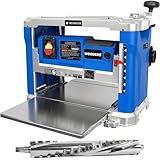
Quick picks by shop situation
- Best value for a small production shop: a 20-inch, 5-hp thickness planer with a spiral or helical cutterhead and two-speed feed.
- Best for wide solid timber: a 24–26-inch industrial planer with 7.5–15 hp, a rigid cast-iron bed, and at least 6 inches of cutting height.
- Best for quiet finishing work: a helical or segmented carbide cutterhead, particularly when the shop regularly machines figured maple, walnut, or reclaimed lumber.
- Best for continuous furniture production: a four-column industrial planer with powered bed adjustment, automatic lubrication, and feed speeds above 30 feet per minute.
- Best where floor space is limited: a 15–20-inch planer with a compact footprint, rather than a wider machine that will spend most of its time processing narrow boards.
What separates an industrial wood planer from a contractor machine?
A wood planer industrial buyers can rely on is built around sustained feed pressure, repeatable thickness, and serviceability. Industrial models generally use a heavier frame, larger feed rollers, enclosed gearboxes, adjustable pressure bars, and a longer bed. These features reduce snipe and thickness variation when a stack of boards passes through the machine.
Portable and light-duty planers may be useful for installation work or occasional repairs, but they often have smaller cutterheads, shorter beds, limited dust ports, and motors designed for intermittent use. Running one continuously can accelerate belt, bearing, and cutter wear even when the maximum board width looks adequate on paper.
Industrial planer comparison
| Machine class or example | Typical width | Motor range | Feed-speed range | Cutterhead choice | Approximate footprint | Best use |
|---|---|---|---|---|---|---|
| Heavy 15-inch shop planer | 15 in / 380 mm | 3–5 hp | 16–30 fpm | Knife or helical | 32–42 sq ft | Small furniture and cabinet shops |
| 20-inch production planer, such as the Powermatic 201HH class | 20 in / 508 mm | 5–7.5 hp | 16–30 fpm | Helical or segmented carbide | 45–60 sq ft | General production and wide panels |
| 20-inch industrial planer, such as the JET JWP-208HH class | 20 in / 508 mm | 5 hp | 16–30 fpm | Helical carbide | 45–55 sq ft | High-quality finish in a compact shop |
| 24–26-inch industrial planer | 24–26 in / 610–660 mm | 7.5–15 hp | 20–60 fpm | Knife, helical, or segmented | 60–90 sq ft | Millwork, beams, and repeated wide stock |
| European production planer, such as a MARTIN T45 class | 20–25 in / 500–630 mm | 7.5–15 hp | 20–60 fpm | Segmented or helical options | 65–100 sq ft | Continuous professional production |
Dimensions and motor options vary by configuration and market, so confirm the exact electrical requirements, maximum stock height, and installed dimensions before ordering. The footprint figures should include operating clearance, not just the steel cabinet.
Width capacity: buy for your normal stock, not your rarest board
Width is the most visible specification, but it is not automatically the deciding one. A 20-inch planer can handle most furniture components, table parts, and cabinet material. Moving to 24 or 26 inches makes sense when wide slabs, architectural panels, or multiple narrow boards are routine rather than occasional.
Use this sizing check before paying for extra capacity:
- Measure the widest board you process in a typical month.
- Add 2–3 inches for practical flexibility and future work.
- Allow additional space if you intend to gang-feed multiple narrow parts.
- Confirm that the machine’s usable width is not reduced by a cutterhead guard, pressure bar, or edge limitation.
For example, if 85 percent of your work is 12–16 inches wide and only a few projects require 22 inches, a 20-inch planer may produce a better return than a 26-inch machine. The larger model brings higher purchase cost, greater electrical demand, heavier tooling, and more floor space.
Horsepower and feed speed: throughput is a system
Horsepower determines how well the planer maintains cutter speed under load; it does not, by itself, determine production rate. A 5-hp machine may perform very well on 6-inch-wide boards but slow noticeably when removing 1/8 inch from a 20-inch board. A 10 or 15-hp planer can sustain deeper cuts and faster feed rates, provided the dust collector and electrical supply are equally capable.
For a rough capacity estimate, multiply board width by material removed per pass and feed speed. If a planer removes 1/16 inch from a 16-inch board at 20 feet per minute, it processes approximately 1.67 square feet of board surface per minute before allowing for loading, inspection, and joint gaps. Increasing feed speed to 40 feet per minute can nearly double theoretical output, but only if the finish remains acceptable and the motor does not overload.
Machines with two or more feed speeds are more useful than a single fast setting. Use the slower setting for difficult grain, deep cuts, or a finer finish; reserve the faster setting for already-flattened stock and rough sizing.
Cutterhead design and finish quality
Straight-knife cutterheads
Traditional knife heads are often the least expensive to maintain and can produce an excellent finish when knives are sharp and aligned. They are efficient for long runs of straight-grained material. Their disadvantages are louder operation, more noticeable tear-out in reversing grain, and longer changeover when a knife is damaged.
Helical and segmented carbide heads
These heads use many small carbide inserts. Instead of replacing a long knife after a localized defect, the operator can rotate or replace individual inserts. They generally reduce noise and improve performance on figured, interlocked, or reclaimed wood. The trade-off is a higher initial cost and a larger number of fasteners to inspect.
Helical does not mean tear-out-proof. Feed direction, cutting depth, moisture, and grain orientation still matter. A machine with a rigid bed and properly adjusted pressure bars can outperform a more expensive cutterhead installed in a poorly aligned planer.
Dust collection is a production requirement
Industrial wood planers create large volumes of chips quickly. A planer with a 5-inch dust port may need roughly 800–1,200 cubic feet per minute of effective airflow; a 6-inch port commonly benefits from approximately 1,200–2,000 CFM, depending on hose length, ducting, chip size, and hood design.
Use smooth, adequately sized ducting and keep flexible hose short. A collector that appears powerful at the impeller may lose much of its airflow through undersized ductwork, clogged filters, sharp bends, or a full chip bin. Poor extraction causes chip packing beneath the pressure bar, dust leakage around the hood, and inconsistent feeding.
Footprint, power, and installation
Plan for more than the machine’s listed length and width. Add an infeed zone longer than your longest board, an equally clear outfeed path, room to open the hood, and access to the motor and gearbox. A 10-foot board may require more than 30 feet of unobstructed handling space when loading and unloading safely.
Many industrial planers require 230-volt single-phase power, while larger European production machines commonly require three-phase service. Check motor amperage, phase, disconnect requirements, dust-collection power, and ceiling height before delivery. A rigging quotation may be necessary for machines weighing 1,000–3,000 pounds or more.
Maintenance demands and ownership costs
The components that usually wear first are feed rollers, belts, bearings, cutter inserts or knives, anti-kickback fingers, and table adjustment mechanisms. Reclaimed lumber accelerates wear because grit and embedded fasteners can damage carbide and roller surfaces.
- Every shift: remove chips from the hood, bed, rollers, and anti-kickback assembly.
- Weekly: inspect belts, chain tension, insert screws, and feed-roller condition.
- Monthly: check table parallelism, column lubrication, electrical connections, and dust ducting.
- After damaged stock: stop the machine, inspect the cutterhead, and replace damaged inserts rather than continuing with vibration.
A common mistake is using excessive wax or lubricant on the bed. A thin, compatible coating can reduce friction, but too much attracts abrasive dust and may contaminate workpieces. Another mistake is taking a deep final pass to save time. A lighter finishing pass usually improves surface quality and reduces strain on the feed system.
Decision matrix for industrial wood planers
| Your situation | Recommended specification | Why |
|---|---|---|
| Limited budget, occasional production | 15–20 in, 5 hp, two feed speeds | Provides useful capacity without overpaying for industrial throughput |
| Daily furniture production | 20 in, 5–7.5 hp, helical head, 20–30 fpm | Balances finish, maintenance, and electrical demand |
| Wide slabs or architectural panels | 24–26 in, 7.5–15 hp, heavy rollers | Maintains feed pressure and motor speed across broad cuts |
| Small floor area | 15–20 in compact cabinet design | Leaves room for safe board handling and dust collection |
| Reclaimed or abrasive lumber | Segmented carbide head and accessible roller assemblies | Limits downtime when individual cutters are damaged |
Bottom line
For most high-volume furniture shops, a 20-inch industrial wood planer with 5–7.5 hp, variable feed speed, a helical or segmented cutterhead, and a properly sized dust collector is the strongest all-around choice. Move to a 24–26-inch, 7.5–15-hp machine when wide stock is a regular revenue source, not merely an occasional requirement. Prioritize service access, feed-system rigidity, electrical readiness, and extraction capacity alongside width; those details determine whether the planer produces consistently or becomes an expensive bottleneck.