What's inside
As an Amazon Associate I earn from qualifying purchases. This post may contain affiliate links at no extra cost to you.
Choosing between wall hooks and ceiling hooks comes down to what the cord is, how often you use it, and what structure you can fasten into. Wall hooks are easier to reach and inspect. Ceiling hooks keep long cords out of the way, but they are harder to load and can put a concentrated pull on an overhead joist. Neither type is automatically safer: a cord that slips off, snags a tool, or gets crushed behind a stored item is still a problem.
As an Amazon Associate we earn from qualifying purchases at no extra cost to you.
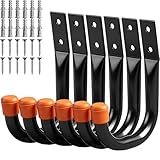


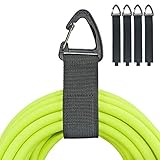
Match the hook to the cord
For light extension cords, air hoses, and charger leads, a hook with a smooth, rounded contact surface is usually sufficient. Avoid sharp screw hooks and rough edges that can nick insulation or abrade a hose. A cord wrapped tightly around a small hook can also develop kinks, especially if it is stored that way for months. Choose a hook wide enough to support a loose loop rather than folding the cord sharply over a narrow point.
Heavy outdoor extension cords, welding leads, and long air hoses need more support. Use a larger, purpose-made cord hanger or a broad hook with a closed or retaining shape. Check its rated load where a rating is provided, but remember the rating assumes proper installation into suitable material. A strong hook in drywall is still a weak storage system.
Wall versus ceiling hooks
| Consideration | Wall hook | Ceiling hook |
|---|---|---|
| Access | Easy to reach and put away | May require reaching overhead or using a step stool |
| Floor clearance | Works well above benches or beside a door | Best for keeping long cords clear of the floor |
| Installation | Simple to lay out and fasten into studs | Requires locating and fastening into a joist or other structural framing |
| Typical drawback | Can compete with tools and shelving for wall space | Harder to inspect; stored cords can fall or snag when lifted down |
| Good fit | Frequently used cords and hoses | Occasional-use cords and long, bulky loops |
When wall hooks make sense
Wall storage is the practical choice for cords you grab several times a week. Mount the hook near the outlet or the work area, but not where a hanging loop crosses a walkway, door swing, machine control, or fire extinguisher. Leave enough clearance to lift the cord off without dragging it across a sharp bench edge.
For drywall-covered walls, locate a stud and fasten into it with an appropriate screw. Do not rely on a plastic drywall anchor for a heavy cord that will be pulled off repeatedly; the repeated side load can loosen the anchor even when the cord’s static weight seems modest. If studs do not line up with the desired location, attach a short board securely across two studs, then mount the hanger to that board.
A basic wall-mounted extension-cord hanger is often enough for ordinary shop cords. Paying more for a deep, wide hanger can make sense for bulky leads, but a simple hook is fine for a light cord that is easy to coil.
When ceiling hooks make sense
Ceiling hooks help when wall space is already occupied by cabinets, lumber racks, or toolboards, or when a long cord otherwise trails across the floor. They are best for cords used occasionally. For a cord used all day, repeatedly reaching overhead gets old and can encourage unsafe stretching from a ladder or stool.
Fasten ceiling hardware into a joist, not just ceiling drywall. Use a stud finder, confirm the joist location, and choose a fastener suited to the wood and the hanger. If you are unsure what is above a finished ceiling, check for wiring, plumbing, and other obstructions before drilling. Keep the loop high enough to clear people and moving equipment, but low enough to retrieve without a risky reach. A purpose-made ceiling-mounted cord hanger may hold bulky loops more securely than an open hook.
Do not hang a loaded cord from an eye screw that is only partly driven into a joist, or from a hook whose opening lets the loop bounce out when disturbed. For overhead storage, a closed hanger or a hook with a retaining lip reduces the chance of a cord dropping. Keep stored cords away from hot lights, heaters, and rotating machinery.
Install and load safely
Estimate the load with the cord fully coiled, then leave a margin rather than choosing hardware that barely meets the listed weight. The pull from removing a snagged cord can be several times its resting weight. Use corrosion-resistant hardware in a damp garage, and check hooks periodically for loosening, bent metal, cracked plastic, or sharp wear points.
Coil cords loosely using broad loops—roughly 12 to 18 inches across for many shop extension cords—unless the cord maker specifies otherwise. Avoid tight wraps around your hand, which can cause a whipping injury if a cord is still connected or catches. Unplug cords before storage, inspect for cuts and crushed sections, and do not hang damaged cords back up for later use.
Keep cord storage separate from dust-collection hoses when practical. Hoses are bulkier and can press a cord against a hook or wall, while fine dust can hide damage. If you need to store both, use separate hangers with enough room to remove either item without pulling the other down.
Choose by use, not by appearance
For one lightweight extension cord and a clear stud location, an inexpensive wall hook is a sensible buy. Choose a ceiling hanger when floor clearance matters and you can fasten it securely into framing. For several heavy leads or hoses, install a dedicated rack or multiple wide hangers instead of stacking everything on one hook. A heavy-duty cord storage rack costs more and takes more room, but it separates bulky loops and makes individual cords easier to retrieve.
Before drilling, hang a temporary loop at the proposed location and check the reach, clearance, and path from the outlet to the tool. That quick test often reveals whether the wall or ceiling is the better spot—and whether the hook is actually going to make the shop safer rather than just tidier.