What's inside
As an Amazon Associate I earn from qualifying purchases. This post may contain affiliate links at no extra cost to you.
Start with the opening, not the door
In a tight workshop, a cabinet door can block the very aisle it was meant to tidy. A hinged door needs room to swing; a sliding door needs room inside its track and usually leaves part of the cabinet opening covered. The right choice depends on what you store, how often you reach for it, and how much clear floor space you can spare.
Measure the aisle with the cabinet open, not just with the doors shut. A typical 24-inch-deep base cabinet with a door opened 90 degrees can project roughly 24 inches into the room. If that leaves too little clearance to pass safely or move sheet goods, sliding doors may help. But they are not automatically the better workshop door: tracks collect dust, and you cannot expose the full cabinet opening at once.
As an Amazon Associate we earn from qualifying purchases at no extra cost to you.

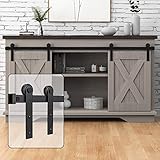

Compare the two options
| Consideration | Sliding doors | Hinged doors |
|---|---|---|
| Clearance in front | No swing into the aisle | Needs room for the door’s swing |
| Access to cabinet | Usually one section is covered | Can open the full cabinet |
| Dust and debris | Tracks can trap fine dust and chips | Fewer horizontal tracks; hinges can still clog |
| Hardware and adjustment | Track must stay straight and clear | Hinges are simple to adjust or replace |
| Best suited to | Long cabinets along narrow aisles | Frequently used cabinets with room to open |
These are practical tendencies, not guarantees. A badly aligned hinged door can sag, while a well-built sliding door can run smoothly for years. Cabinet width, door weight, and how carefully the opening is built all matter.
When sliding doors make sense
Sliding doors suit long, shallow storage runs beside a narrow walkway, especially when you store items that can be reached through a partial opening. They are also useful beneath a bench where an open door would collide with a stool or a rolling tool chest. Measure the clear opening you need: with a basic two-panel bypass setup, you can typically access only about half the cabinet at a time.
For a shop cabinet, use a track and rollers rated for the combined weight of the doors, with enough margin that the hardware is not working at its limit. A simple sliding cabinet door hardware kit is a reasonable starting point, but check the stated door thickness and installation dimensions before ordering. Some kits are intended for lightweight furniture doors, not heavy plywood panels.
Dust is the common failure point. Sawdust and chips in the bottom track can make a panel bind, jump, or refuse to close fully. Fit the track where it can be vacuumed, avoid routing it beside a sander’s exhaust, and clean it regularly. If the cabinet holds small parts, also account for the gap between panels: bypass doors are not a dust-tight seal.
When hinged doors are better
Hinged doors are usually the simpler choice when you need full access to shelves, bins, or a tool charger. They are also a better fit for cabinets holding bulky tools that are awkward to remove through a half-width opening. If you have enough aisle clearance, standard hinges are inexpensive, easy to adjust, and less likely than tracks to collect a ridge of packed sawdust.
Check the swing before fixing the cabinet in place. Tape the door’s outline on the floor, or temporarily clamp a panel where the door will sit and open it through its full arc. Allow extra room for handles and for the user standing in front of the cabinet. In a tight aisle, a 16-inch-wide door can still be a problem if it opens across the route used to carry lumber.
For ordinary plywood or solid-wood doors, concealed cabinet hinges give a clean exterior and allow some alignment adjustment. Soft-close hardware is optional in a workshop; it costs more and can be knocked out of adjustment, but it prevents doors from slamming when your hands are full. Basic butt hinges are fine for a low-cost utility cabinet if they are sized for the door and securely screwed into solid material.
Build for shop conditions
Use cabinet material that stays flat in your shop’s humidity changes. A door that cups can rub a track or leave uneven gaps at the frame. Three-quarter-inch plywood is a common, sturdy choice for larger doors; thinner panels can work on small cabinets if they are supported by a frame. Seal exposed plywood edges so they do not soak up finish or swell as readily.
Keep doors light enough for their hardware. A heavy door on undersized hinges can sag, while a heavy sliding panel can strain cheap rollers and pull fasteners from a thin cabinet side. Mount hinges or track into solid wood, a plywood cleat, or suitable threaded inserts rather than relying on a few short screws in a weak edge. Leave a small, even clearance around doors; a gap of roughly 1/8 inch is a useful starting point, but verify it against the hardware and your build.
Think about what is behind the door, too. A cabinet full of sanding discs or router bits benefits from quick, full access. A cabinet storing long clamps or rarely used supplies may be more forgiving of a partially blocked opening. If the contents need protection from dust, neither a loose-fitting sliding door nor a typical workshop hinge guarantees a seal. Add overlapping edges or a compressible seal only if the door and frame can close consistently without binding.
Make the decision
Choose sliding doors when an open door would obstruct a narrow aisle and you can live with partial access and track cleaning. Choose hinged doors when full access matters more than swing clearance; they are often the cheaper, easier-to-repair option. For a mixed setup, use sliders on the cabinet run beside the main walkway and hinged doors on cabinets with open floor in front.
Before buying hardware, measure the cabinet opening, door thickness, available swing or bypass overlap, and the load each panel will carry. Then test the layout with a temporary panel. A few minutes of checking clearance can prevent a cabinet that technically fits but makes the workshop harder to use.