
Our Top Picks


What's inside
As an Amazon Associate I earn from qualifying purchases. This post may contain affiliate links at no extra cost to you.
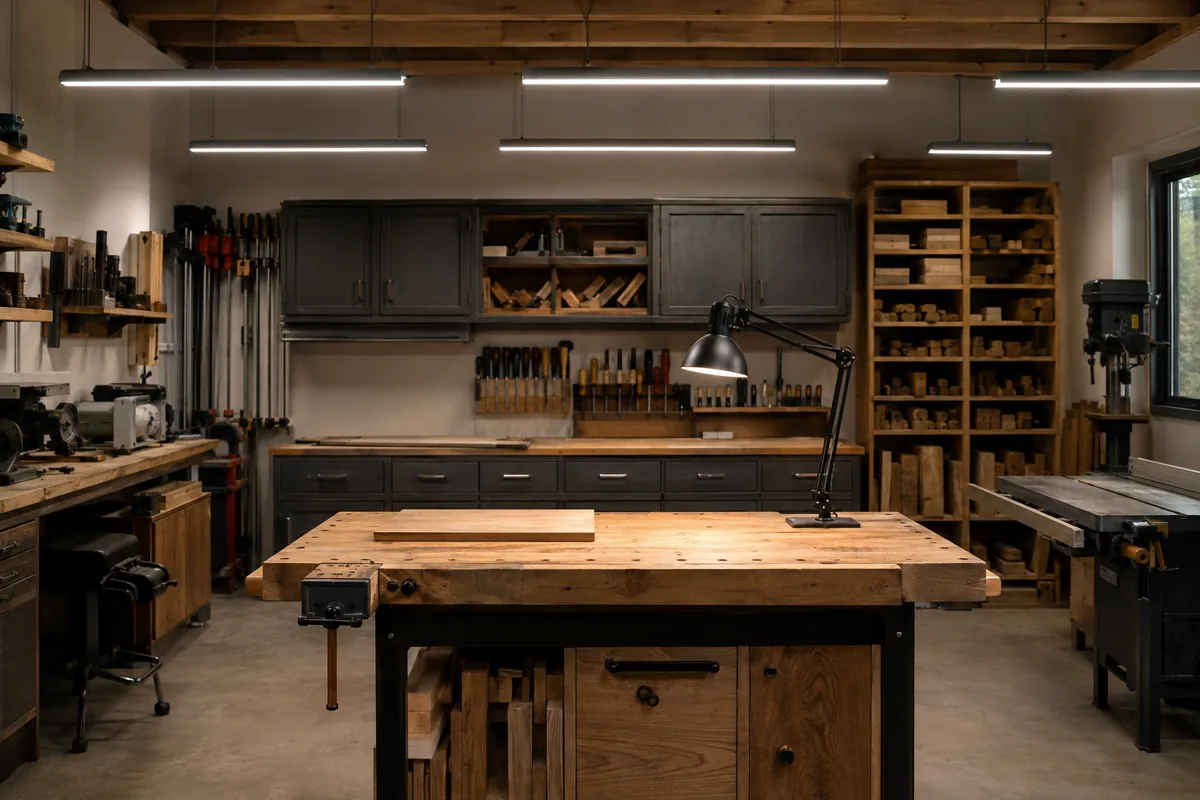
My garage shop looked fine until I started applying finish. Every time I carried a panel outside into daylight I found sanding scratches and blotchy stain that were invisible under the two builder-grade fixtures on my ceiling. That is the trap with shop lighting: bad light does not look bad, it just hides your mistakes until they are sealed under three coats of poly. The best shop lights for woodworking are not the brightest ones on the shelf, they are the ones that put even, honest light where your eyes actually need it.
I have redone the lighting in my one-and-a-half-car garage three times. Round one was a pair of cheap fluorescent strips that hummed and would not start below about 40 degrees. Round two was swapping LED fixtures into those same two spots, which was brighter and still wrong, because two lights down the center of a room means every cut happens in your own shadow. Round three finally worked, and it had less to do with buying premium fixtures than with buying more of them and hanging them in smarter places.
As an Amazon Associate we earn from qualifying purchases at no extra cost to you.


![hykolity 4FT LED Shop Light, 42W [250W Equivalent],4400LM,5000K Daylight | Utility Linkable Shop Light Fixture,Hanging or Surface Mount, with Power Cord,Shop Lights for Workshop,ETL,White,4 Pack](https://m.media-amazon.com/images/I/51NpOzfl4JL._AC_UL320_.jpg)


| Fixture type | Best for | Main trade-off |
|---|---|---|
| Linkable 4 ft LED strip | General light, 8-9 ft ceiling | Needs 6-8 units to kill shadows |
| LED wraparound panel | Finished drywall shops, low ceilings | Less spread per dollar |
| LED high bay, UFO or linear | Ceilings over 12 ft | Glare if hung too low |
| Shelf-mounted strip light | Shadows on the bench top | Easy to knock loose |
| Articulating task lamp | Layout lines, carving, lathe | Lights one small area |
What Actually Matters in the Best Shop Lights for Woodworking
Most of the spec sheet here is noise. Four things genuinely change how a shop feels to work in.
Total lumens, not lumens per fixture
A big lumen number on one fixture does not help if it is all coming from one spot. I aim for roughly 50 to 75 lumens per square foot of floor for general work, and closer to 100 over the bench and any machine with a spinning blade. A 20 by 20 garage is 400 square feet, so that is a 20,000 to 30,000 lumen target overall. Most 4-foot linkable shop lights land in the low thousands each, which is how you end up buying six or eight.
CRI, the spec that catches scratches
Color rendering index describes how faithfully a light shows color. Budget fixtures often sit in the low 80s, which is fine for parking a car and poor for judging stain, matching grain, or deciding whether a streak is figure or a defect. I will not buy a shop light under CRI 90 again. For the money, it did more for my finishing than any sander I own.
Color temperature: 4000K to 5000K
Warm 3000K light flatters walnut and hides surface defects. Very cold 6500K light is clinical and gives me a headache by hour three. I run 4000K to 5000K overhead and keep one warmer lamp near the finishing bench so I can see roughly how a piece will read in someone’s living room.
Flicker, cold starts and dust
An unheated garage is rough on electronics. Check the rated temperature range against your actual winter, look for a gasketed housing if you make fine dust, and take flicker seriously: a strobing light near a spinning blade can make the cutter look slower than it is. That is a safety issue, not just eye strain.
Linkable 4 ft LED Shop Lights
This is the default answer for most garage shops. Buy a multi-pack of linkable plug-in fixtures at 4000K to 5000K with CRI 90 or better, then order one or two more than you think you need. Check the daisy-chain limit and cord length before you buy, because that is what decides whether your layout works.
How Many Fixtures, and Where to Hang Them
Layout beats raw brightness. Run your rows perpendicular to the bench and main machines so light arrives from more than one direction, and push fixtures out toward the walls instead of clustering them down the center. Shadows come from a single source behind you. In an 8 to 9 foot garage, spacing rows about as far apart as the ceiling is high is a reasonable starting point.
Decide how you are mounting before you order. Chain and hook is fast and adjustable, but chained fixtures swing and collect dust on top. Flush-mounting to the joists looks better and is harder to change later. If you rent, plug-in linkable fixtures on a switched outlet get you most of the way there without touching wiring. Anything hardwired is worth handing to an electrician; I am a woodworker, not a sparky.
- ✔ Cheap per lumen and easy to add to over time
- ✔ Instant-on and silent, unlike old fluorescent tubes
- ✔ Plug-in versions need no wiring work
- ✔ Many small sources spread light and kill shadows
- ✘ Low-CRI budget models make finish work harder
- ✘ Chain-hung fixtures swing and collect sawdust
- ✘ Cheap drivers can flicker or fail early in a cold shop
LED High Bay Fixtures for Tall Shops
If your shop has a real ceiling, 12 feet or more, strip lights waste output on the walls. A few high bay fixtures cover the same floor area with fewer units and less clutter. Watch mounting height: hung too low they become glare bombs, and reflectors or frosted lenses help a lot.
Task Lighting Is the Half I Ignored
Overhead light tells you where things are. Raking light tells you what the surface is doing. A movable lamp set low and nearly parallel to a board throws long shadows across every scratch, glue line and dent, and it is the single fastest way to check sanding before finish goes on. I keep one clamp light on a flexible arm for exactly this and move it around the shop constantly.
The other easy win is a strip light screwed under the shelf above the bench, aimed at the vise. It costs almost nothing and it removes the shadow your own hands cast over layout lines, chisel work and dovetails. Do the same over the drill press and the lathe if you can run power there.
Magnetic LED Task Light
A magnetic or clamp-mount LED task light is the cheapest upgrade in this whole article. Look for a stiff arm that holds position, a magnet strong enough for a cast iron table, and a head you can aim almost flat across a board for raking light.
Shop Lighting FAQ
How many lumens do I need for a two-car garage shop? A 400 square foot space wants somewhere around 20,000 to 30,000 lumens total for comfortable woodworking. Err high and split the fixtures across two switches if you want the option to run half.
Is high CRI actually worth paying more for? For woodworking, yes. It is the difference between seeing a blotch while you can still fix it and seeing it in daylight after the finish cures. For a garage you only park in, no.
Will LED shop lights work in an unheated garage in winter? Most do, and they beat fluorescent tubes badly in the cold, but check the rated low temperature on the listing. Cheap drivers are usually the first thing to quit after a few freezing seasons.
If I were starting over in an empty garage, I would spend the budget on quantity and CRI first, layout second, and fancy features never. Get honest light on the wood and everything downstream gets easier.
Check prices on Amazon →