
Our Top Picks


What's inside
As an Amazon Associate I earn from qualifying purchases. This post may contain affiliate links at no extra cost to you.
My garage ran on one bare bulb in the middle of the ceiling for two years. Every time I leaned over the bench, my own head threw a shadow across the cut line. I chased tearout that turned out to be a shadow, and I sanded through a finish I could not see. Adding hanging LED shop lights fixed more accuracy problems than any tool I bought that year, and the install took one afternoon.
The category is the hard part. Listings shout lumen figures the fixture never delivers, 6500K daylight reads cold and blue over walnut, and budget linkable strips often ship with hanging hardware too short to reach a truss. Here is how I think about it after redoing my ceiling twice.
As an Amazon Associate we earn from qualifying purchases at no extra cost to you.

![hykolity 4FT LED Shop Light, 42W [250W Equivalent],4400LM,5000K Daylight | Utility Linkable Shop Light Fixture,Hanging or Surface Mount, with Power Cord,Shop Lights for Workshop,ETL,White,4 Pack](https://m.media-amazon.com/images/I/51NpOzfl4JL._AC_UL320_.jpg)


| Fixture Type | Best For | Main Trade-Off |
|---|---|---|
| 4 ft linkable LED strip | 8 to 10 ft ceilings, plug-in wiring, tight budget | Basic diffusers, glare if aimed wrong |
| 4 ft lensed or wraparound fixture | Bench and walkway light, less glare | A little less output per watt |
| 8 ft strip or twin-tube | Long walls and machine rows | Awkward to hang alone |
| UFO high bay | Ceilings 12 ft and up | Hard shadows unless you spread several |
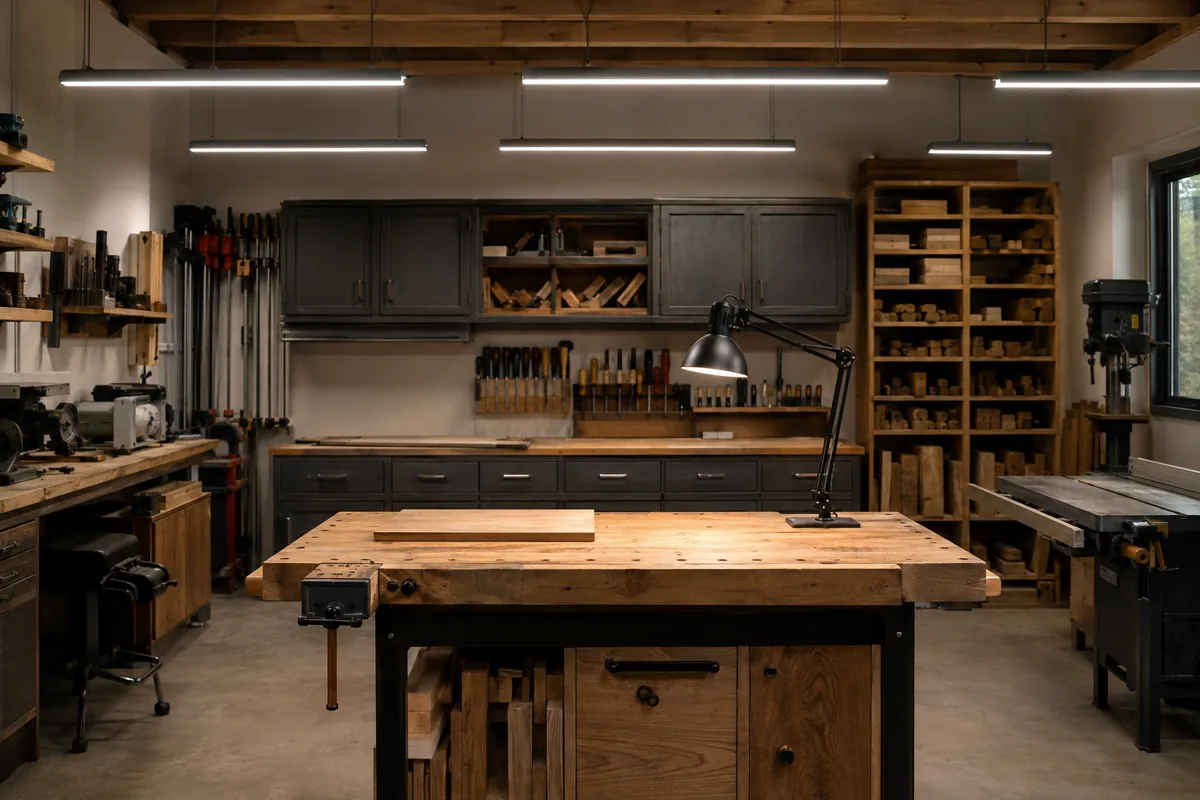
How Many Hanging LED Shop Lights Do You Actually Need?
Start with floor area, not fixture count. For general shop work I aim for roughly 70 to 100 lumens per square foot, and more over the bench. A two-car garage is around 400 square feet, so the math lands near 30,000 to 40,000 lumens. A common 4 ft strip is rated somewhere around 4,000 to 5,500 lumens, which means six to ten fixtures, not the two most of us start with.
I bought four the first time, decided it was a huge upgrade over the bare bulb, and then spent a year annoyed at gloomy corners. I ended up at eight ceiling fixtures plus task lights at the bench and drill press. Buy a bit more than the math says: advertised lumens run optimistic, dust films the diffusers within a season, and output drifts down over time.
Two cheap moves gave me more usable light than another fixture would have. I painted the ceiling and upper walls flat white, and I quit hanging fixtures directly behind where I stand. Light coming from both sides of the bench is what kills the head shadow.
Linkable 4 ft LED Shop Lights, Multi-Pack
The cheapest path to real light in a garage. Buy one pack more than you think you need, and confirm the kit includes both hanging chains and link cords.
Specs That Matter, and Specs That Are Noise
Color temperature and CRI
I run 5000K over the machines because layout lines read crisply, and 4000K in the finishing corner because it is closer to the indoor light where the piece will live. 6500K looks impressive in the aisle and makes stain choices harder at home. CRI matters more than another few thousand lumens: 80 and up is workable, 90 and up if you match finishes or photograph your builds. Low-CRI light makes cherry and walnut look flat and muddy.
Efficiency, flicker, and cold starts
Realistic efficiency for a decent fixture is roughly 100 to 130 lumens per watt, and claims far beyond that usually mean the lumen rating is wishful. The driver matters more. Cheap ones flicker in a way that looks bad on camera and, near a spinning blade, can make the work look slower than it is. Aim a phone camera in slow motion at one fixture before you buy a dozen. If the shop is unheated, check the low-temperature start rating and look for a damp-location listing.
Hanging Them Without Fighting Your Ceiling
Find the framing first. Joists and truss bottom chords hold a fixture forever. Drywall anchors holding a chain that gets bumped by a sheet of plywood do not. Chains with S-hooks are ugly and adjustable, which is what you want on a first install. Cable toggles look cleaner once the layout is settled. Mounting tight to the ceiling gives the best bounce and the least swinging, so I hang most of mine flush and drop only the pair over the bench.
Measure with the garage door open. I had to move a fixture after the open door panel clipped a chain, and I am not the only one who has done that. Plan around dust collection ducts and any future ceiling rack while you are up there.
- ✔ No electrician needed for plug-in linkable runs
- ✔ Easy to relocate when the shop layout changes
- ✔ Multi-packs are the cheapest lumens per dollar
- ✘ Visible cords and link wires on the ceiling
- ✘ You need high outlets or you are running extension cords
- ✘ Total amp draw limits how many you can chain
LED UFO High Bay Light
Worth a look if your ceiling is 12 ft or higher, where strips spread light thin. Plan on several spaced across the shop instead of one bright fixture in the middle.
Switching, Circuits, and the Extension Cord I Am Not Proud Of
My first setup fed every fixture from a power strip on the end of one extension cord draped over a rafter. It worked, technically. It was also ugly, the strip ran warm, and switching on the lights meant reaching behind the bench. Now the ceiling is split into two runs on separate circuits, each on a wall switch by the door, with the finishing corner on its own plug.
Respect the daisy chain limit in the manual and do the arithmetic. Total watts divided by 120 gives amps, and I stay under about 80 percent of the breaker rating with everything else on that circuit counted. Ceiling outlets, hardwired fixtures, and dedicated lighting circuits are electrician work in most places and worth paying for. I also skipped motion sensors on the main lights, because they are great when your hands are full and infuriating when you stand still at the bench.
Selectable CCT High-CRI Shop Light
The upgrade I would make over the bench. Switching between warmer and cooler light with a higher CRI rating makes color decisions much easier than fighting a fixed 6500K strip.
Hanging Shop Light FAQ
How many 4 ft LED shop lights do I need for a two-car garage? Six to ten typical fixtures for about 400 square feet, arranged in rows so the beams overlap, plus task light at the bench. Fewer works with a low white ceiling, and plan on more if the ceiling is dark, high, or crowded with storage.
Is 5000K too harsh for a woodshop? Not over machines and assembly, where I prefer it. If the space doubles as a hangout or you finish there, 4000K is easier on the eyes and truer to how the piece will look indoors. Mixing zones is fine.
Can I plug all my shop lights into one outlet? Sometimes. Check two limits: the maximum linked fixtures per run in the manual, and the amp draw on that circuit. Splitting them across two circuits also means one tripped breaker does not leave you working in the dark.
If you are coming from a single bulb, do not agonize over brands. Get enough fixtures, pick the color temperature and CRI that suit the work you actually do, screw them into real framing, and leave room to add two more later. That has held up better in my shop than any spec sheet I studied beforehand.
Check prices on Amazon →