
Our Top Picks


What's inside
As an Amazon Associate I earn from qualifying purchases. This post may contain affiliate links at no extra cost to you.
For two years my shop light was one bulb in the middle of the ceiling plus whatever came through the open garage door. The tell never changed. I would carry a board out to the driveway and suddenly see sanding scratches, glue squeeze out and a gap in a dovetail that were invisible at the bench. A garage lighting upgrade is the cheapest accuracy improvement in a one person shop, and I put it ahead of another jig or a nicer blade.
Most lighting advice is written for warehouses or finished basements, and a garage is its own animal. The ceiling is low or oddly tall, an overhead door eats the best mounting space, the room is unheated, and plenty of us run off one 15 amp circuit. Here is how I approach it after redoing my own ceiling twice.
As an Amazon Associate we earn from qualifying purchases at no extra cost to you.




| Fixture type | Where it wins | Trade-off |
|---|---|---|
| Linkable 4 ft LED strip | Standard 8 to 10 ft ceilings, easy to expand | Bare lens glares, cheap drivers fail first |
| LED wraparound | Low finished ceilings, softer light | Fewer lumens per dollar |
| UFO high bay | Ceilings past about 11 ft | Narrow beam leaves dark corners |
| LED tube retrofit | Reusing fluorescent housings | Bypass wiring, old lens and sockets stay old |
| Magnetic or clamp task light | Bench, drill press, finish checks | No help as general room light |
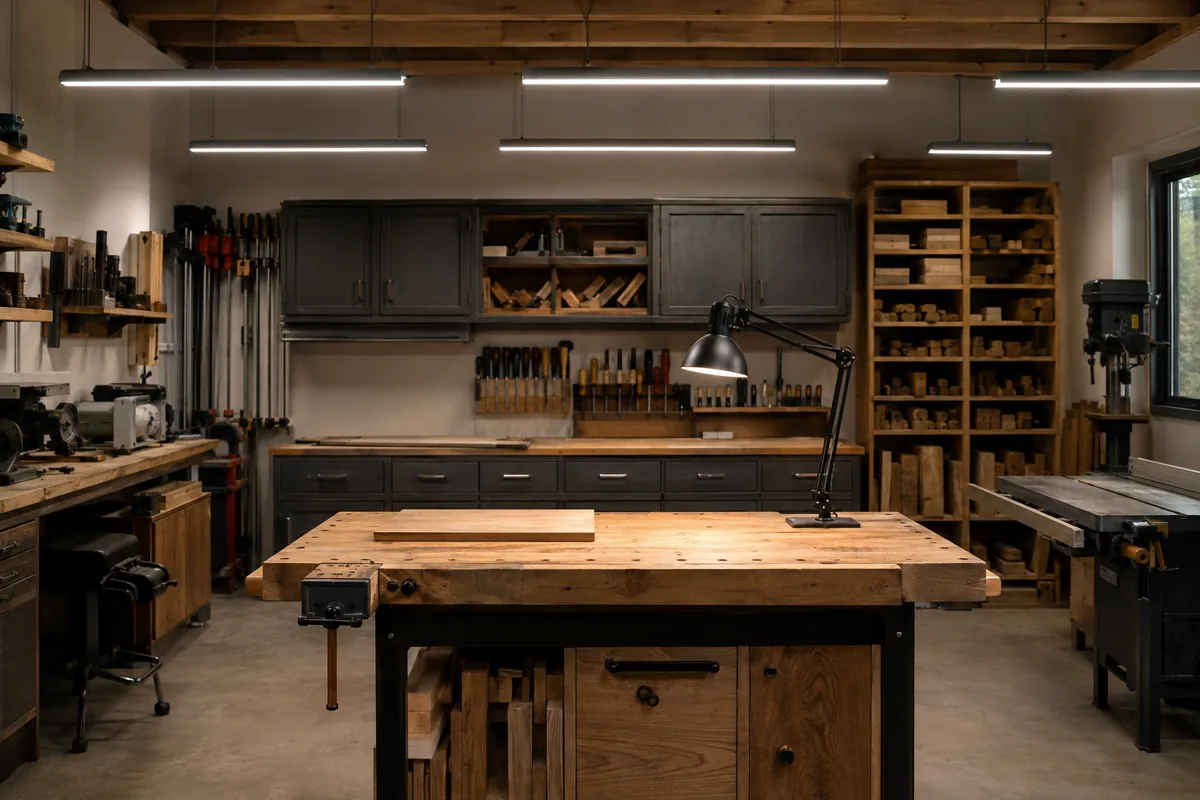
How I Size a Garage Lighting Upgrade in Lumens
Fixtures come second. Figure out how much light the room needs first. I aim for 50 to 75 lumens per square foot of general light, and 75 to 100 over the bench and any machine where I read a pencil line. A 400 square foot two car garage lands near 20,000 to 30,000 lumens. Most 4 foot linkable strips fall in the 4,000 to 5,000 lumen range, so that is five to eight fixtures, not the two I first talked myself into.
Color temperature and CRI matter more than the listings suggest. I stay between 4000K and 5000K. The cooler end shows dust and tearout, the warmer end is easier over a long session. CRI is the spec people skip. Treat 80 as the floor and pay for 90 plus if you stain or match boards, because low CRI light makes cherry and walnut read wrong and you find out in daylight.
Fixture Types That Earn Their Spot on the Ceiling
For a normal 8 to 10 foot ceiling I would buy linkable 4 foot LED strips again. They are the cheapest lumens on the shelf, several chain off one receptacle, and adding another over a new machine takes ten minutes. If your ceiling is finished and low, a wraparound spreads light more gently and looks less industrial, though you pay for that in lumens per dollar.
High bays only start to make sense once the ceiling clears roughly 11 feet, and beam angle decides whether you get an even room or hot spots. Retrofit LED tubes in old fluorescent housings do work, but you keep a yellowed lens and aging sockets, and bypass style tubes mean rewiring the fixture. I would rather hang something new.
Linkable 4 ft LED Shop Lights, Multi Pack
Buy a multi pack from one seller so the color matches, and check how many fixtures the maker allows on a single linked run before you plan the layout. A frosted lens is worth it under a nine foot ceiling.
- ✔ Cheapest lumens per dollar right now
- ✔ One plug can feed a linked run
- ✔ Easy to add a fixture over a new machine
- ✔ Instant start in a cold garage
- ✘ Bare lenses glare on a low ceiling
- ✘ Budget drivers are the first failure
- ✘ Color shifts between batches so buy a spare
- ✘ Most cheap models will not dim
Layout, Shadows and the Overhead Door
One fixture in the center of the room is the mistake nearly everyone makes, me included, because your own body blocks it. Two rows running the length of the bay, about a third of the way in from each wall, light the work from both sides and kill most of the shadow. At the table saw I want light from the operator side as well as past the blade, since a shadow on the cut line is how you drift off a rip.
Open the overhead door and look up before you drill. The door panels and spring assembly claim more ceiling than you expect, and I have already relocated two fixtures I hung in that zone. While you are up there, paint the ceiling and walls white or light gray. Bare studs and OSB swallow light, and paint gave me a bigger visible jump than the last pair of fixtures did.
LED UFO High Bay Light for Tall Shops
Worth considering once your ceiling runs past about 11 feet, where strips start to feel weak. Check the beam angle, since a narrow lens concentrates light and leaves the walls of a small garage dark.
Task Light Is Where the Accuracy Lives
Overhead light makes a room usable. Low angle light makes work accurate. A cheap articulating lamp clamped to the bench and aimed almost parallel to the surface turns invisible sanding scratches and plane tracks into obvious shadows, which is the only way I reliably catch them before finish. A rechargeable magnetic panel covers the drill press, the bandsaw and the underside of a wall cabinet.
Rechargeable Magnetic LED Work Light
The one item here that changes how your work looks. A magnetic base grabs cast iron tables and steel cabinets, and a swivel head lets you rake light across a surface to find scratches before the stain does.
Flicker, Cold Starts and What I Got Wrong
Two specs never show up in the listing photos. Flicker is the first. Cheap drivers pulse, and a pulsing light over a spinning blade can make it look slower than it is, so I look for a flicker free claim and run several fixtures instead of one. Cold is the second. LEDs handle an unheated garage far better than old fluorescent tubes, but check the rated temperature range if your winters drop well below freezing.
My honest list: I centered one fixture and lit my own shadow, bought the cheapest four pack and had a driver buzz out in a season with no color match left for the replacement, mounted inside the door swing, and ignored CRI long enough to finish a cherry panel that looked orange outdoors. Put lights on their own circuit if you can, and treat anything past plugging in a cord as electrician work.
Frequently Asked Questions About a Garage Lighting Upgrade
How many lumens do I need for a two car garage shop? Plan on 50 to 75 lumens per square foot for general light and 75 to 100 over benches and machines. For 400 square feet that is roughly 20,000 to 30,000 lumens, or five to eight typical 4 foot LED strips, with task light added on top.
Are LED shop lights actually better than fluorescent T8s? In a garage, yes. Fluorescent tubes start slow and dim in the cold, fade as they age, and the ballasts eventually fail. LEDs start instantly at low temperatures and draw less power. The only advantage the old tubes have is that you already own the fixtures.
Can I put LED tubes in my existing fluorescent fixtures? You can. Plug and play tubes run on a working ballast, and bypass tubes require rewiring the fixture, which is not a job to guess at. You also keep aging sockets and a yellowed lens, so with an old housing I would put the same money into a new fixture.
If you do one thing this weekend, add fixtures until the room looks flat and boring, then add one lamp you can aim sideways across a board. I have never wished for less light in the shop.
Check prices on Amazon →