
Our Top Picks
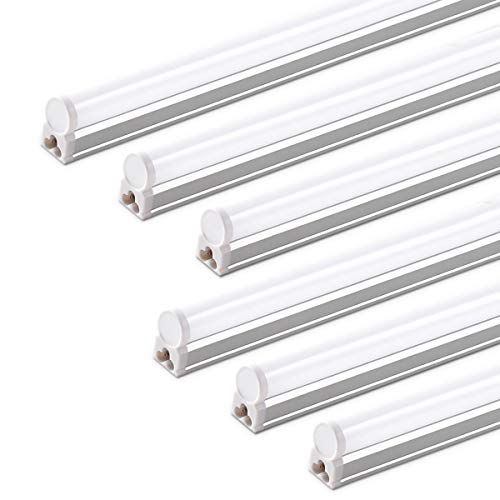 Barrina LED T5 Integrated Single Fixture4 Feet-6 Power Cords46.1 x 0.9 x 1.45 Inches0 PoundsCheck on Amazon


What's inside
As an Amazon Associate I earn from qualifying purchases. This post may contain affiliate links at no extra cost to you.
My garage shop opened with one bulb in a porcelain socket dead center in the ceiling. Every time I leaned over the bench I worked inside my own shadow, and I did not spot the tearout on a walnut panel until I carried it out to the driveway. Good energy efficient shop lighting is not really a save-the-planet project for a one-car garage. It is how you get enough usable light on the work without maxing out the single circuit that already feeds your opener, your fridge, and your dust collector.
That constraint is the part most lighting guides skip. Old T12 strips burn a lot of watts for mediocre light and they sulk in a cold garage in February. LED fixtures give you the same output for roughly half the draw, and that is the real win: you can hang eight where you could only afford four. Lower bills are a bonus. Seeing a pencil line at 9 p.m. in December is the point.
As an Amazon Associate we earn from qualifying purchases at no extra cost to you.


![hykolity 4FT LED Shop Light, 42W [250W Equivalent],4400LM,5000K Daylight | Utility Linkable Shop Light Fixture,Hanging or Surface Mount, with Power Cord,Shop Lights for Workshop,ETL,White,4 Pack](https://m.media-amazon.com/images/I/51NpOzfl4JL._AC_UL320_.jpg)

Here is how the usual options compare in a home shop.
| Fixture type | Rough efficiency | Where it fits |
|---|---|---|
| Old T12 fluorescent | Worst of the group and slow in the cold | Replace it rather than repair it |
| T8 or T5HO fluorescent | Middle of the pack with ballasts that fail | Keep it if it is installed and working |
| Linkable 4 ft LED strip | High and instant-on when cold | Main ambient light in most garages |
| LED high bay or UFO | Highest output per fixture | Ceilings above roughly 12 feet |
| LED retrofit tube | High and depends on the tube | Cheap upgrade when the housings are good |
Why energy efficient shop lighting is a wiring question first
Do the math before you shop. A 15 amp 120 volt circuit gives you about 1,800 watts, and you should plan on using maybe 80 percent of that for a continuous load. A 4 foot LED shop light generally lands in the 35 to 50 watt range with something like 4,000 to 5,000 lumens. Ten of them stays under 500 watts. The same amount of light out of old fluorescent strips is close to double.
If you have any say in it, put lighting on its own circuit. I did not, and for two years my lights dipped every time the table saw spun up. Not dangerous, but it teaches you to distrust your eyes at the wrong moment.
Three numbers I check before buying
Lumens, not watts
For general woodworking I aim at 50 to 75 lumens per square foot of floor, and closer to 100 over the bench. A 12 by 20 one-car shop is 240 square feet, so figure 15,000 to 18,000 lumens of ambient light, which is three or four solid fixtures plus task lamps. Watts tell you almost nothing now.
CRI, if you finish your own work
Color rendering index describes how honestly a light shows color. Budget fixtures sit near 80 CRI, which is fine for cutting and assembly. If you mix stain, match a repair, or spray finish in the same space, 90 or better earns its premium. I fought a blotchy dye job for an evening before I realized the light was lying to me, not the dye.
One color temperature everywhere
4,000K to 5,000K is the shop range. 3,000K makes maple look yellow, and 6,500K gets harsh after a couple of hours. Pick a number and buy every fixture at it, because a mismatched ceiling looks bad and wrecks your color judgment.
Linkable 4 ft LED shop lights
This is the category I would buy again for a garage. Plug-in linkable strips daisy chain off one outlet and move easily when the layout changes. Check the label for how many you can chain, and skip anything without a real multi-year warranty.
Fixture types and the mistake I made
Plug-in linkable strips are the default for good reason: cheap, easy to hang on chain or screws, simple to rearrange when you move the bench again. The limit is the chain itself, usually four to eight fixtures per run depending on the model.
Wraparound or flush fixtures suit a low ceiling where you keep clipping hanging strips. High bay fixtures belong above roughly 12 feet. In an 8 foot garage they glare right into your eyes.
My mistake was buying the cheapest three-pack on the page. Two flickered inside a year, the seller had vanished, and there was no warranty to chase. Three good fixtures now and a fourth next month beats six you have to hang twice.
- ✔ Instant-on in a freezing garage with no warm-up
- ✔ Roughly half the draw of old fluorescent strips
- ✔ Linkable and easy to move when the shop changes
- ✔ No ballasts to replace down the road
- ✘ Bargain fixtures flicker and carry weak warranties
- ✘ Most are not dimmable unless the driver says so
- ✘ Bare strips glare badly in your line of sight
- ✘ The fixture is the bulb, so a failure means replacing all of it
High-CRI articulating bench lamp
Ceiling light will never reach into a mortise or rake across a coat of sanding sealer. One aimable clamp-on or magnetic-base lamp is the cheapest upgrade here. Look for 90-plus CRI and an arm stiff enough to stay where you put it.
Layout beats lumens
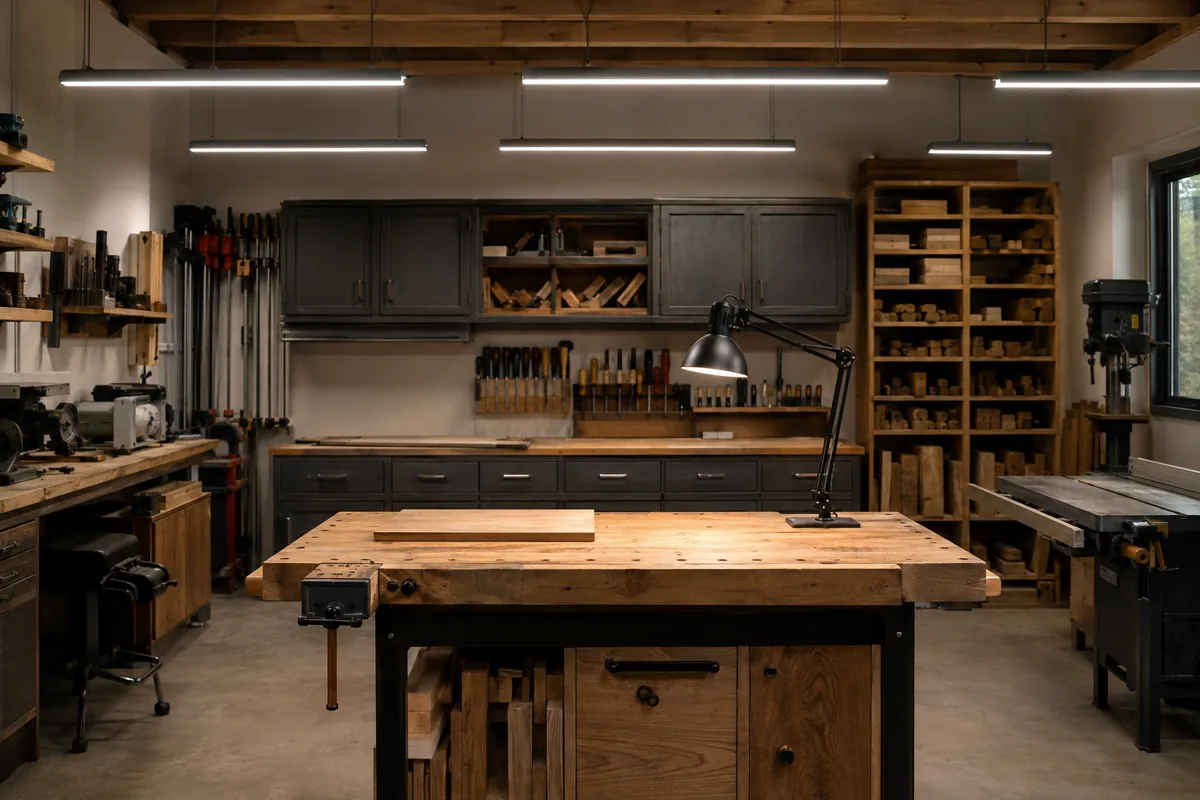
My first row of strips ran directly over the bench, parallel to the front edge, and I still worked in a shadow. Light from one line above you gets blocked by your own head and hands. Two rows flanking the bench, or fixtures running perpendicular to it, fixes that without adding a watt.
Then paint. Flat white on the ceiling and light walls buy real brightness for a gallon and an afternoon, and I would paint before adding a fifth fixture. Map where the garage door travels and where a full sheet of plywood tips up on edge. I clipped a fixture once and that was plenty.
Switches, sensors, and the part that saves real energy
The biggest saving is a light that is off. Mine burned for hours because the only switch sat by the side door while I worked in the back corner. Zone it: one switch or smart plug for the bench, one for the machine side, one for the storage bay you rarely touch. Motion sensors are great at the entry and terrible over a bench, since standing still to lay out joinery is exactly what turns them off. If you want dimming, confirm the fixture is dimmable and use a compatible dimmer.
LED retrofit tubes for old fixtures
If your fluorescent housings are solid, retrofit tubes get you most of the efficiency win for a fraction of the cost. Read carefully whether the tube needs the ballast bypassed, because that is wiring work rather than a simple swap.
Shop lighting FAQ
How many LED shop lights do I need for a two-car garage? A two-car garage runs around 400 square feet. At 50 to 75 lumens per square foot that is roughly 20,000 to 30,000 lumens, so six to eight 4 foot fixtures in the 4,000 to 5,000 lumen class plus task lighting. Go slightly over rather than under, since you can always switch a zone off.
Is it worth replacing fluorescent fixtures that still work? With old T12s, yes. The efficiency and cold-start difference is big enough that you notice it the first winter evening. With working T8s I would run them until a ballast dies, then choose between retrofit tubes in the existing housings or new fixtures.
Do LED lights cause a strobe effect on spinning tools? Some inexpensive drivers ripple enough to make a lathe or a blade look slower than it is. Fixtures advertised as low flicker are the safer buy. Either way, never decide something has stopped spinning by looking at it under a single light source. Wait it out.
If I wired a garage shop from scratch tomorrow I would run a dedicated lighting circuit, paint everything white, hang four or five mid-grade 4 foot LED fixtures at one color temperature, split them across two switches, and spend the leftover money on task lamps. It is the upgrade I notice every time I walk in.
Check prices on Amazon →