What's inside
As an Amazon Associate I earn from qualifying purchases. This post may contain affiliate links at no extra cost to you.
LED Shop Lights vs Fluorescent Fixtures for a Woodworking Workshop
Lighting affects more than how well you can see a cut line. In a woodworking shop, poor light hides tear-out, makes sanding defects easy to miss, and increases the chance of putting your hands too close to a blade. LED shop lights are now the usual choice for new installations, but fluorescent fixtures are not automatically a bad buy. If you already have working fluorescent lights, replacing them may not be the best use of your workshop budget.
For a general-purpose shop, aim for roughly 50 to 100 foot-candles at the work surface. In practical terms, that often means 4,000 to 6,000 lumens over a typical 4-by-8-foot bench, with additional fixtures over machines and assembly areas. Light-colored walls and ceilings help, while dark plywood, exposed rafters, and accumulated dust absorb light quickly.
As an Amazon Associate we earn from qualifying purchases at no extra cost to you.
![hykolity 4FT LED Shop Light, 42W [250W Equivalent],4400LM,5000K Daylight](https://m.media-amazon.com/images/I/31OHKTx7DoL._SL160_.jpg)

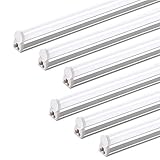

How LED and fluorescent fixtures differ
| Factor | LED shop lights | Fluorescent fixtures |
|---|---|---|
| Energy use | Usually 30 to 50 watts for a 4-foot fixture | Often 64 to 96 watts for a comparable two-lamp fixture |
| Startup | Instant, including cold conditions | Can start slowly or flicker, especially in an unheated shop |
| Maintenance | No tubes to replace; driver failure usually means replacing the fixture | Tube and ballast replacements are routine |
| Color quality | Commonly available at 80 to 90+ CRI | Good tubes are available, but cheap lamps may look green or gray |
| Cold-weather performance | Generally reliable, if rated for the temperature | Output and startup can suffer below about 50°F |
| Purchase cost | Usually higher initially | Often cheaper when usable fixtures are already installed |
LEDs also produce light more efficiently. A 40-watt LED fixture producing 5,000 lumens can replace a much hotter fluorescent setup while using less electricity. That matters in a shop that runs lights for several hours every day, though the payback depends on your electricity rate and how much replacement work is required.
Why LEDs usually win in a new shop
LED shop lights are a strong choice when you are wiring a new workshop or replacing unreliable fixtures. They start immediately, do not contain fragile glass tubes, and maintain better performance in a cold garage. Many are available as linkable units, making it easier to create even rows over benches and machines.
Look for fixtures with a stated output, a color temperature between 4,000K and 5,000K, and a color rendering index of at least 80. For finishing, paint matching, and judging subtle differences in wood color, 90+ CRI is preferable. A 5,000K fixture looks crisp and daylight-like; 4,000K is slightly warmer and often less harsh for an all-day workspace. Avoid choosing solely by wattage. Lumens tell you how much light you are buying.
These linkable LED shop lights are convenient for a typical ceiling-mounted layout, but check the mounting hardware and cord length before ordering. Lightweight fixtures often use small clips that can pull out of drywall or thin ceiling panels. In a garage, screw the clips into framing when possible.
When fluorescent fixtures are still the sensible choice
Fluorescent lighting is fine when the fixtures are already installed, the ballasts work properly, and replacement tubes are easy to find. A clean, well-maintained T8 system can provide useful, even light at a low upfront cost. This is especially reasonable for a hobby shop used a few hours per week.
Do not replace fluorescent tubes with LED tubes casually. Some LED retrofit tubes require the ballast to remain in place, while others require ballast bypass wiring. A wrong tube or incorrect wiring can create a nonworking fixture, overheating, or a shock hazard. If you retrofit, follow the tube manufacturer’s wiring diagram and turn off the circuit at the breaker, not just the wall switch. When the ballast is old, noisy, or frequently burns out, replacing the entire fixture is usually simpler.
Fluorescent lamps also contain a small amount of mercury. Do not throw broken tubes or spent lamps in ordinary trash where local rules prohibit it. Keep spare tubes protected from impact, particularly in a crowded shop where long boards and sheet goods move overhead.
Plan for shadows, glare, and dust
One bright fixture in the center of a shop creates strong shadows from your head and arms. Install multiple fixtures in parallel rows, with a row near each side of a workbench or machine. For a 4-by-8-foot bench, two 4-foot fixtures running along the bench length are a useful starting point. Add task lighting at the drill press, lathe, assembly bench, or finishing table.
Diffuse lenses reduce harsh glare, but heavily frosted covers can reduce output. Bare LED strips can be uncomfortable when you look toward the ceiling, especially over a table saw. Position fixtures slightly to the side of your normal sightline and use a shaded task lamp where close work demands it. Adjustable high-CRI task lights are useful for inspecting joinery and finish defects.
Sawdust is another practical concern. Dust settles on lenses and reduces light output long before a fixture appears visibly dirty. Vacuum or wipe fixtures periodically, but do not blow compressed air into an enclosed fixture or its electrical connections. Keep lights away from locations where a dust collector hose, long board, or sheet of plywood can strike them.
Electrical and workshop safety details
Use fixtures rated for the temperature and location of your shop. In a damp or unheated garage, confirm the fixture’s operating range. Do not assume a plug-in shop light is suitable for a dusty area just because it is sold for garages; inspect its construction and keep connections away from dust piles and moisture.
Put general lighting on a circuit that is not shared with a large dust collector or table saw if your electrical layout allows it. A motor startup can trip a breaker and leave you in darkness while a blade is still coasting. Keep a separate, switched emergency light or battery-backed light available. A rechargeable emergency workshop light is inexpensive insurance during a power failure.
Finally, check for flicker before committing to a large purchase. Poor LED drivers can produce visible or camera-visible flicker that causes eye strain and makes rotating tools look stationary. Fluorescent lamps can also flicker when tubes or ballasts age. If a light buzzes, pulses, or causes headaches, replace the lamp, ballast, or fixture rather than tolerating it.
A practical buying decision
Choose LED fixtures for a new shop, a cold garage, frequent daily use, or any workspace where good color and low maintenance matter. Choose fluorescent fixtures when you already have sound T8 units, use the shop occasionally, and want to spend the money on dust collection, storage, or safer machine setup instead. In either case, buy enough fixtures for even coverage, clean them regularly, and treat lighting as part of the shop’s safety system rather than ceiling decoration.