What's inside
As an Amazon Associate I earn from qualifying purchases. This post may contain affiliate links at no extra cost to you.
A small workshop usually has room for one serious workbench, not two. The choice between a fixed bench and a mobile bench affects more than where you do assembly. It determines how easily you can work on long stock, connect a dust extractor, store hand tools, and keep safe clearance around machines.
As an Amazon Associate we earn from qualifying purchases at no extra cost to you.
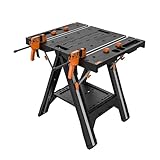


Fixed Workbench: Strength and Stability
A fixed workbench is bolted to the floor or built heavily enough that it stays put. It is the better choice for hand-planing, chopping, sanding, and any work where the bench must resist sideways movement. A solid bench should weigh roughly 150 to 300 pounds, or be anchored to wall studs or the floor. A lighter bench can work if it has a wide base, but it may creep across the floor when you use a hand plane.
For general woodworking, a top around 30 to 36 inches deep and 60 to 72 inches wide is a useful target. A top between 1-1/2 and 3 inches thick gives you room for dog holes, holdfasts, and repeated clamping without excessive flex. If you mostly repair tools or assemble cabinets, a 24-inch-deep top may save valuable floor space.
The main weakness is access. A fixed bench consumes its footprint all the time, including when you are not using it. It can also block the only practical route for moving sheet goods or long boards through the shop. Leave at least 30 inches of walking space in front of it; 36 inches is more comfortable when drawers or cabinet doors open there.
A fixed bench is also easier to organize permanently. You can mount a woodworking bench vise, screw down a sharpening station, and run a dust hose or power strip without disconnecting everything after each job. The trade-off is that a poorly planned fixed bench becomes an obstacle and encourages clutter to accumulate around it.
Mobile Workbench: Flexibility and Storage
A mobile workbench earns its floor space by doing more than one job. You can pull it into the center of the shop for assembly, move it beside a table saw for outfeed support, or push it against a wall when the shop needs to handle a vehicle or large project. Locking casters are essential. Non-locking wheels turn a workbench into a dangerous rolling platform.
Choose casters rated for at least twice the bench’s loaded weight. A bench that weighs 180 pounds and carries 120 pounds of tools should have at least 600 pounds of total caster capacity, not merely 300 pounds. The extra capacity helps with uneven floors and shock loads. Four swivel casters make steering easy, but they can wander during hand work. Two fixed and two swivel casters track more predictably.
Mobility has a cost. Even with the brakes locked, most wheeled benches are less rigid than an anchored bench. You may notice movement while hand-planing or drilling large holes. A low, wide cabinet with a heavy bottom shelf is more stable than a narrow cart with tall drawers. Keep the center of gravity low and avoid storing heavy machines on an upper shelf.
For a mobile build, install a thick top and use leveling feet or retractable casters if possible. The feet carry the load during work; the wheels are used only when relocating the bench. A mobile workbench with locking casters is convenient, but check the actual wheel design before buying. Small 2-inch casters often jam on sawdust and cross floor cracks. Three- or four-inch casters roll better in a working shop.
Fixed Versus Mobile at a Glance
| Factor | Fixed workbench | Mobile workbench |
|---|---|---|
| Stability | Excellent, especially when anchored | Good only with locked or retractable casters |
| Floor-space efficiency | Low; footprint is permanent | High; can be parked or repositioned |
| Hand-planing and chopping | Best choice | Acceptable with leveling feet and a heavy base |
| Tool storage | Easy to make permanent and deep | Convenient, but weight affects mobility |
| Dust collection setup | Simple permanent hose routing | Needs flexible hose and cord management |
| Cost | Often lower if built from lumber | Casters, hardware, and reinforced framing add cost |
Dust Collection and Power
A mobile bench should not rely on a hose stretched across a walking path. Use a short, flexible connection to a nearby dust port, and keep the hose above knee height or routed along the wall. A 2-1/2-inch hose suits a portable shop vacuum and small sanders; larger tools generally need a 4-inch hose and a proper dust collector. A shop vacuum with a cyclone separator keeps fine dust filters from clogging as quickly.
Put outlets on the wall rather than building a permanent extension cord into the bench. If you add a power strip, use one with overload protection and mount it where dust cannot pile up inside it. Keep cords away from casters and leave enough slack for the bench’s full travel. A mobile bench that can roll only six inches before pulling a plug is mobile in name only.
For either style, position the bench so task lighting does not create a shadow from your body. An adjustable LED fixture with a high color-rendering rating is useful for joinery and finish inspection. Aim for roughly 500 to 1,000 lumens over the work surface, with the light mounted 30 to 40 inches above the top if the ceiling allows.
Storage, Clearance, and Safety
Storage should support the work rather than simply fill every cavity. Put frequently used hand tools between waist and shoulder height, heavier tools below the top, and rarely used items in labeled bins. A wall-mounted tool storage system can keep the bench top clear without adding cabinet weight to a mobile base.
Do not park either bench in front of an electrical panel, dust-collector switch, fire extinguisher, or exit. Maintain at least 36 inches of clear access to those points. Round sharp top corners, secure tall storage against the wall, and inspect caster brakes regularly. A brake that looks locked but lets the bench roll under pressure is a failure, not a minor inconvenience.
Which One Makes Sense?
Choose a fixed bench if hand tools are central to your work, you have a dedicated corner, and you can anchor it without sacrificing material flow. It is the cheaper option when you build it from construction lumber, and it usually gives better results for less hardware.
Choose a mobile bench if the shop is shared, your tools must be rearranged, or the bench needs to serve as assembly space, outfeed support, and storage. The extra cost is justified only when you will actually move it. If mobility is occasional, a heavy fixed bench with a separate heavy-duty furniture dolly may be the more economical solution.
When uncertain, build a stable bench first and add mobility later with retractable casters. That approach preserves the option to move it without accepting a permanently wobbly work surface.