What's inside
As an Amazon Associate I earn from qualifying purchases. This post may contain affiliate links at no extra cost to you.
A one-car garage does not have room for a workbench that owns the floor. The useful bench is one you can reach around, load safely, and fold or roll out of the way when the car comes in. For most shops, that means a top between 48 and 72 inches wide, 24 to 30 inches deep, and roughly 34 to 38 inches high.
The best choice depends less on the brand than on how you work. A woodworking bench needs a stiff, flat top and room for clamps. A mechanic’s bench needs drawers, a vise, and resistance to oil and impact. A general-purpose DIY bench should split the difference and leave space underneath for a shop vacuum, compressor, or storage bins.
As an Amazon Associate we earn from qualifying purchases at no extra cost to you.


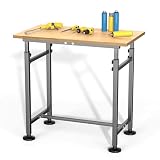

Quick picks for a compact garage
| Bench type | Best for | Typical size | Main weakness |
|---|---|---|---|
| Folding workbench | Occasional repairs and maximum floor clearance | 36–48 in. wide | Less rigid under heavy side loads |
| Rolling cabinet bench | Hand tools, automotive work, and organized storage | 48–72 in. wide | Expensive and difficult to move when loaded |
| Wall-mounted fold-down bench | Very tight garages and permanent work zones | 36–60 in. wide | Needs strong wall framing and limited depth |
| Fixed solid-top bench | Woodworking, assembly, and frequent use | 48–72 in. wide | Consumes floor space all the time |
What to look for before buying
Start with the garage, not the catalog. Measure the available wall, then mark the bench footprint on the floor with tape. Leave at least 36 inches of clear working space in front of it. If a car must pass the bench, measure the actual door and mirror clearance; a bench that leaves a nominal 36-inch aisle may still be a problem with a vehicle door open.
Top thickness matters more than a glossy finish. A 1-1/4-inch or thicker hardwood, laminated plywood, or butcher-block top resists sag and absorbs clamping force. Thin steel tops are acceptable for light assembly, but they tend to ring, flex, and transmit vibration. Particleboard tops are usable when covered with replaceable hardboard, but protect the edges from water because swelling ruins flatness.
Check the stated weight rating, but treat it as a static limit. A 1,000-pound rating does not mean the bench will remain stable while you hammer a seized part. Look for a welded frame, cross-bracing, adjustable feet, and a top that is mechanically fastened rather than simply resting on the legs. For a general garage bench, a real 500-pound capacity is usually more than enough.
Height is a trade-off. Around 36 inches works for general assembly and power-tool use. A lower 32- to 34-inch surface is better for hand-planing or heavy sanding. A 38- to 42-inch bench can be comfortable for detail work, but it makes forceful operations awkward. If more than one person will use it, adjustable legs are worth paying for.
The best compact bench types
A folding workbench is the cheapest way to create a temporary work area. It is a good fit for homeowners who assemble furniture, repair bicycles, or use a circular saw occasionally. Choose one with a wide stance, non-skid feet, and a stated capacity of at least 300 pounds. The failure mode is sideways movement: folding legs can walk across the floor when you are sawing or tightening a fastener. Do not use a light folding table for heavy hammering or mounting a large vise.
A wall-mounted fold-down bench saves the most floor space. It can be only 18 to 24 inches deep when open and disappear against the wall afterward. It must be anchored into studs or a properly installed plywood backer, not drywall alone. Use locking folding brackets rated above the bench’s expected load. The brackets carry vertical weight, but the wall connection must also resist the forward pull created by clamping near the front edge.
A fixed bench with a solid top is usually the best value for a serious hobby shop. You can build one from 2×4 framing and two layers of 3/4-inch plywood, then add a replaceable hardboard skin. This often costs less than a commercial bench and lets you fit the exact wall. The downside is lost parking and less factory-finished storage. Seal the top with polyurethane or paint, but avoid a thick glossy surface if you need reliable clamping.
A rolling tool cabinet workbench makes sense when small parts and hand tools are the main problem. Full-extension drawers keep weight low and make the bench useful as both storage and a work surface. Buy casters rated for the loaded cabinet, not the empty cabinet. Locking wheels stop rolling, but they do not eliminate rocking; leveling feet or a rigid frame are better for filing, chiseling, and vise work.
Vise, storage, and dust collection
Do not mount a vise on a flimsy folding bench. A 4- to 5-inch bench vise is enough for most garage repairs, but the bench needs a reinforced mounting area and through-bolts with large washers. Put the vise near a corner so long workpieces can extend past the edge. Leave room behind it to turn the handle without hitting a wall or cabinet.
Open shelving is inexpensive and convenient for bulky items, but it collects dust and quickly becomes a pile. Drawers cost more but protect measuring tools, fasteners, and abrasives. A practical compromise is one or two shelves for cases and machines, with shallow bins or drawers above for small parts. Keep the heaviest tools below waist height to prevent a top-heavy bench.
If you use a sander, router, or saw at the bench, plan dust collection before filling the storage. A shop vacuum and dust separator can handle portable tools, but a small vacuum hose may clog with shavings. Use the largest practical hose, keep runs short, and add a blast gate only if it seals well. Fine dust still requires a suitable filter; a separator protects the vacuum from chips but does not replace filtration.
Lighting and safety around the bench
Garage door openers and one ceiling fixture rarely provide enough light. Put a dedicated LED fixture over the bench, preferably 4,000 to 5,000K, with the light slightly in front of your head so your body does not cast a shadow on the work. Aim for roughly 500 lux at the top for general work and more for fine layout. A movable task light helps when inspecting edges and wiring.
Keep power strips off the floor and route cords away from the vise and cutting path. Install a clearly reachable switch for the bench outlet, and unplug tools before changing blades or clearing jams. Leave a clear zone around grinders and sparks; do not store cardboard, solvent, or oily rags beneath them. If the bench rocks, the top flexes, or a vise pulls the frame sideways, fix that defect before adding more tools. Stability is cheaper to correct at setup than after a damaged workpiece or hand injury.
For most one-car garages, a 48- to 60-inch fixed bench or rolling cabinet is the practical center point. Choose folding or wall-mounted construction when parking space is non-negotiable, and spend the saved money on a rigid top, proper lighting, and dust control rather than cosmetic features.