What's inside
As an Amazon Associate I earn from qualifying purchases. This post may contain affiliate links at no extra cost to you.
A basement woodworking shop rarely has enough wall space, ceiling height, or electrical capacity. The best storage is not simply the cabinet with the most drawers. It is the system that keeps hand tools visible, puts heavy machines on stable surfaces, and leaves a clear path from the stairs to the workbench. In a basement, storage also has to tolerate dust, occasional humidity, and the risk of blocking the only exit.
As an Amazon Associate we earn from qualifying purchases at no extra cost to you.


Start With the Basement Constraints
Measure the room before buying storage. Record the distance between foundation walls, the location of support posts, the swing of the stair door, and the position of outlets. Leave at least 36 inches for a main walking path; 42 to 48 inches is more comfortable around a workbench or table saw. Do not put a cabinet where it reduces the stair route below a safe exit width.
Check basement humidity as well. Relative humidity consistently above 60 percent can rust plane irons, saw blades, and uncoated hardware. A dehumidifier and a cheap hygrometer may do more for tool storage than an expensive cabinet. Keep wood storage and steel tools off concrete floors, where moisture can migrate into plywood bases and cause swelling.
The Best Compact Storage Types
| Storage type | Best use | Main advantage | Important drawback |
|---|---|---|---|
| Wall cabinets | Small hand tools and finishes | Uses vertical space and keeps tools enclosed | Requires solid mounting and has limited depth |
| Pegboard or French cleat wall | Frequently used hand tools | Fast visual access and flexible layout | Tools collect dust and consume wall area |
| Drawer cabinet | Router bits, measuring tools, hardware | Efficient organization in a small footprint | Quality units can cost more than open shelving |
| Rolling tool cart | Portable tools and accessories | Moves to the work area when needed | Wheels need a level floor and parking space |
| Open shelving | Clamps, lumber, boxes, and shop supplies | Lowest cost and easy loading | Exposes everything to dust and clutter |
Use the Walls for Light, Frequently Used Tools
A wall-mounted French cleat storage system is one of the most space-efficient choices for a basement shop. Build the cleat from 3/4-inch plywood, fasten it to studs with 3-inch structural screws, and use separate holders for chisels, squares, clamps, and sanders. Unlike a fixed pegboard layout, cleats let you move a holder when the shop changes.
Do not hang heavy machinery from a basic pegboard. A benchtop planer or router table can pull fasteners from drywall or bend thin hardboard. Keep wall-mounted loads below the strength of the wall framing and distribute the load across several studs. Put the heaviest items at waist level or lower so they do not fall onto your hands when removed.
For enclosed storage, a shallow wall-mounted storage cabinet works well for finishes, abrasives, and small power tools. A cabinet 12 to 16 inches deep usually holds useful equipment without stealing too much aisle width. Add a latch if children can enter the basement, and never store solvent-based finishes beside a furnace, water heater, or other ignition source.
Choose Drawers for Small Parts and a Cart for Mobility
Drawers beat shelves for router bits, drill bits, marking tools, and hardware because small items do not disappear behind larger boxes. Look for full-extension slides and drawers at least 2 inches deep for general hardware. Very shallow drawers are useful for blades and layout tools, but they are frustrating for mixed fasteners.
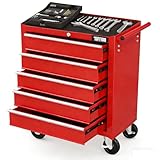
A rolling cart is a good compromise when one tool serves several stations. A compact rolling tool cart with drawers can hold a drill, impact driver, charger, bits, and measuring tools. Choose locking casters rated for more than the loaded weight. A cart that flexes or tips when a drawer is opened is not a bargain.
Use a cart only if you have somewhere to park it. Measure the cart with drawers and doors fully open, not just its closed dimensions. Keep at least 2 inches of clearance from walls so dust and dropped parts do not become trapped behind it.
Recover Space Under the Workbench
Under-bench storage is often the cheapest capacity in a small shop. Build a lower shelf from 3/4-inch plywood, but leave enough knee space for seated work and enough clearance for a shop vacuum hose. A shelf 8 to 12 inches above the floor keeps boxes away from minor water leaks while still using otherwise wasted space.
Put heavy items such as a benchtop planer, compressor, or thickness sander on a low shelf. Store them on a plywood tray with handles rather than lifting directly from the floor. Do not overload a mobile workbench: tools stored below the bench raise the center of gravity, and a bench can become unstable when rolled over an uneven basement slab.
For a narrow bench, consider under-workbench drawer storage instead of a full cabinet. It costs more than open shelves but protects tools from dust and keeps the floor clear. Open plastic totes are fine for seasonal supplies, spare sandpaper, and rarely used accessories; they are a poor choice for precision tools because items become stacked and forgotten.
Storage Must Work With Dust Collection and Safety
Leave room for dust-collection hoses to bend gradually. A 2-1/2-inch hose needs more clearance than its outside diameter suggests, and sharp bends reduce airflow. Do not store boxes in front of the dust collector’s filter, motor vents, or clean-out door. Give the collector at least 12 inches of breathing room where the manufacturer allows it, and more if the basement runs warm.
Keep extension cords off the floor with hooks or a small cable rack. Cords crossing the main aisle create a trip hazard, especially near a table saw. Store blades and router bits in closed holders, not loose in a drawer. Mount a fire extinguisher near the exit, keep a first-aid kit visible, and avoid stacking material higher than shoulder level where it can slide forward.
A Practical Compact Layout
Place the workbench on the longest wall, with the most-used hand tools within one step. Put the dust collector near the machines it serves, but not in the stair path. Use a 12-inch-deep wall cabinet above the bench, a French cleat strip beside it, and drawers underneath. Reserve one narrow rolling cart for portable tools and park it under an overhang or beside the bench when not in use.
The cheaper option is often fine: plywood cleats, open shelves, and labeled plastic bins can outperform a premium cabinet if the layout is disciplined. Spend extra on full-extension drawer slides, locking casters, strong wall anchors, and corrosion control. Those parts affect daily use and safety; cosmetic finishes and matching cabinet doors do not.