What's inside
As an Amazon Associate I earn from qualifying purchases. This post may contain affiliate links at no extra cost to you.
A basement woodshop has one advantage over a garage: stable temperature. It also has a serious dust-collection problem. Fine dust can migrate through the house, settle on heating equipment, and remain suspended long after the saw stops. The best system is not necessarily the machine with the highest advertised CFM. It is the system that matches your tools, ductwork, filtration, and available space.
As an Amazon Associate we earn from qualifying purchases at no extra cost to you.

Choose the Right Collector for Your Tools
For most basement shops, a 1.5- to 2-horsepower two-stage cyclone is the best all-around choice. It provides strong suction for a table saw, planer, jointer, router table, and floor sweep while dropping most chips into a drum before they reach the filter. That keeps airflow more consistent and makes filter cleaning less frequent.
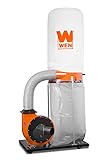
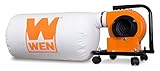
A single-stage collector can be a sensible budget choice for a small shop using one tool at a time. It costs less and often takes up less room, but chips and dust go directly into the filter bag or cartridge. As the filter loads, airflow falls. These collectors also tend to be poor at handling long duct runs or multiple open blast gates.
A shop vacuum remains useful for a track saw, sander, trim router, and other tools with a 1-1/4- or 2-1/2-inch port. It produces higher pressure through a narrow hose than a typical dust collector, but it does not move enough air for a wide table-saw hood or planer. A HEPA shop vacuum is usually the cheaper and better first purchase when your tool list is mostly portable power tools.
| Collector type | Best use | Main limitation |
|---|---|---|
| Shop vacuum | Sanders, routers, track saws, small portable tools | Insufficient airflow for large stationary tools |
| Single-stage collector | One stationary tool at a time on a modest budget | Filter loads quickly; weak with restrictive ductwork |
| Two-stage cyclone | Several stationary tools and frequent planing or jointing | Higher cost, noise, and floor-space requirement |
| Central vacuum with dedicated ducting | Larger shops with permanent tool locations | Expensive and inconvenient if the layout changes |
Airflow Matters More Than the Motor Badge
Manufacturers often quote “maximum CFM” with no hose, filter, or duct attached. That number is useful for comparing motors, but it does not represent real collection performance. A table saw typically needs roughly 350 to 500 CFM at the tool. A planer or jointer may need 500 to 800 CFM, depending on its port and chip volume. A sander can collect well with far less airflow if the hood seals tightly.
Use 4-inch hose for portable or compact tools, but use 5- or 6-inch smooth-wall duct for a main run when the collector supports it. A long 4-inch flex hose creates substantial resistance. Keep flex hose as short as practical, use broad-radius bends, and avoid unnecessary reducers. Every sharp elbow and leaking joint costs airflow.
For a basement installation, a short main duct with blast gates is generally safer than trying to connect every tool permanently. Close the gates on unused branches. An open branch can consume a large part of the collector’s airflow and leave the active tool underperforming. If you change the shop layout often, surface-mounted ducting is easier to revise than pipe buried behind walls.
Do Not Ignore Fine-Dust Filtration
Chip collection and air cleaning are different jobs. A collector can remove visible shavings while allowing fine particles to escape through a poor filter or leaking bag. For indoor basement use, choose a cartridge filter rated for fine dust, preferably with a stated filtration efficiency around 1 micron or better. A true HEPA filter is useful, but it can restrict airflow if the collector is not designed to handle it.
Clean the filter before suction drops. A clogged filter makes the motor work harder while reducing pickup, and the warning sign is often a thin layer of dust around the machine or tool rather than an obvious cloud. A separate woodworking air filtration system can remove suspended dust after cutting, but it cannot replace collection at the source. Run it during the work and for at least 30 minutes afterward, with the room unoccupied if practical.
Basement Installation and Noise
Put the collector as close as possible to the main group of tools. A basement corner is convenient, but do not crowd the intake or exhaust. Leave enough clearance to remove the collection drum and clean the filter. A cyclone and drum can require more than 6 feet of vertical clearance, so measure stairs, doors, and ceiling height before buying.
Noise travels through basement framing. Rubber isolation pads help with vibration, but they will not make a loud collector quiet. If you build an enclosure, leave generous intake and exhaust openings and never seal the motor in a box that can overheat. A remote switch is worthwhile: it keeps you from walking across the shop with a running tool to start the collector.
Basement air is part of the house’s air supply. Do not vent dusty exhaust into a finished room, wall cavity, or furnace area. If the collector exhausts outdoors, provide make-up air and check local requirements. Otherwise, use a properly sealed fine-dust filter and monitor the room for escaped dust. Never place a collector where its exhaust can blow directly toward a furnace, water heater, or return-air grille.
Safety Details That Prevent Failure
Use conductive or static-dissipative hose where appropriate, bond metal duct sections, and ground the system according to local electrical practice. Grounding reduces nuisance static shocks; it is not a substitute for proper electrical protection. Plug the collector into a correctly rated circuit, and avoid running a high-draw collector and heater on the same branch circuit.
Fine wood dust is combustible. Do not vacuum hot metal, fireplace ash, solvents, or anything that could ignite the dust. Empty the drum before it becomes so full that chips reach the filter. Check hoses for splits, inspect blast gates for buildup, and clean the tool’s internal passages. If a planer suddenly throws chips onto the floor, look first for a blocked hood, collapsed hose, full drum, or clogged filter.
Practical Buying Recommendations
For a basement shop centered on a sander, router, and track saw, buy a quality HEPA shop vacuum, a cyclone pre-separator, and tight tool adapters. The cheaper option is fine because those tools need pressure and modest airflow.
For a mixed shop with a table saw, jointer, and planer, choose a two-stage cyclone with a cartridge filter, a 5- or 6-inch main duct, and a short flexible connection at each machine. A cyclone dust collector costs more initially, but it is usually cheaper than repeatedly replacing clogged filters and cleaning dust from the basement.
If budget is tight, start with the tool that produces the most chips and add branches later. Buy the best filter and hose you can afford before paying extra for a larger motor. In a basement, a sealed, correctly sized system will outperform a powerful collector connected through leaky, undersized ductwork.