What's inside
As an Amazon Associate I earn from qualifying purchases. This post may contain affiliate links at no extra cost to you.
Running two workshop machines at once changes the dust-collection problem. A collector that works well on a planer by itself may leave one machine spraying chips when a second hose is opened. The right setup depends on the machines, chip volume, hose size, and whether both tools run continuously or only for short overlaps.
As an Amazon Associate we earn from qualifying purchases at no extra cost to you.

Start With the Machines, Not the Collector
Two benchtop sanders or a router table and a small bandsaw do not need the same system as a planer and table saw. Fine sanding dust needs good filtration and steady airflow. A planer or jointer produces large chips and needs a high-volume collector that will not clog or stall when the chips arrive in batches.
For two machines used at the same time, plan around roughly 800 to 1,200 CFM of real airflow at the tools, not the collector’s advertised free-air number. “Free-air” ratings are measured without hoses, filters, blast gates, or duct resistance. Actual airflow can be several hundred CFM lower.
A practical minimum is usually a 2-horsepower dust collector with a 5- or 6-inch main inlet, a pleated cartridge filter, and enough filter area to maintain airflow as dust accumulates. A 1-horsepower unit can be fine for one machine at a time, but it is usually a compromise for two open blast gates.
Which Collector Type Makes Sense?
A single-stage bag collector is the least expensive way to move a lot of air. It is suitable for chips from a planer, jointer, or table saw, especially in a small shop where the collector is used intermittently. The drawbacks are poorer separation, faster filter loading, and more dust exposure when emptying the lower bag.
A two-stage cyclone separates heavy chips before they reach the filter. That keeps airflow more consistent and makes the system much less frustrating when two machines are used during a long session. Cyclones cost more and take up more floor space, but they are the better long-term choice for a production-oriented shop or anyone who uses a planer regularly.
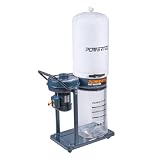
For a two-machine setup, compare 2 HP cartridge-filter dust collectors by filter area, inlet size, and real-world airflow rather than horsepower alone. A large motor attached to a restrictive filter is not automatically a strong system.
| Collector type | Best use | Typical two-tool limitation | What to look for |
|---|---|---|---|
| 1 HP single-stage | Small tools, one machine at a time | Usually cannot support two open 4-inch lines | Good filter, short hose runs, low cost |
| 2 HP single-stage | General woodworking and chip collection | Fine dust loads the filter faster | Cartridge filter and 5- or 6-inch inlet |
| 2 HP cyclone | Frequent planer, jointer, and saw use | Higher price and larger footprint | Large cyclone cone, adequate filter area, easy drum removal |
| Shop vacuum with separator | Routers, sanders, and portable tools | Not enough volume for large chip-producing tools | HEPA filtration and a sealed separator |
Build the Ducting for Two Open Lines
Do not run two long 2-1/2-inch shop-vac hoses from a large collector and expect good results. Small hose creates high resistance, and two branches multiply that problem. Use a 5- or 6-inch main duct from the collector, then reduce near each machine only when necessary.
For many home shops, a 6-inch main with 4-inch branches is a sensible compromise. Keep the main short and smooth. Avoid sharp 90-degree elbows, unnecessary reducers, and corrugated flex hose. Flexible hose is useful at the machine, but a long run can cut airflow dramatically. Use rigid metal duct or conductive dust-collection hose where practical.
Install a blast gate at every branch. When both tools are operating, open both gates and accept that airflow will divide between them. When one machine is producing the majority of the dust, partially closing the other gate can improve pickup. A gate that leaks badly also wastes airflow, so choose sturdy gates and keep them accessible.
Use 6-inch dust-collection ducting and blast gates for the main run. Grounding and bonding metal duct is good practice for static control, but it does not make an unsafe system safe. Never rely on a thin wire wrapped around plastic hose as a substitute for proper installation.
Filtration Matters More Than the Bag
Chip capture is visible, but fine dust is the bigger health and cleanup issue. Look for a pleated cartridge filter rated around 1 micron or better, preferably with a cleaning mechanism. A shaker or paddle cleaner helps restore airflow, but it does not eliminate the need to empty the drum and clean the filter.
A collector exhausting into the room needs a reliable filter and a well-sealed housing. If the filter is damaged, poorly fitted, or coated in dust, the machine may still appear to collect chips while sending fine particles back into the shop. Wear a properly fitted respirator during filter cleaning and bag changes.
For a random-orbit sander, trim router, or track saw, a HEPA shop vacuum with a dust separator is often better than tying the tool into a large collector. The cheaper option is fine when the tool has a small port and is used alone. It is not a substitute for high-volume collection at a planer or jointer.
How to Shop Without Overbuying
Check the collector’s airflow at a stated static pressure, ideally around 2 to 4 inches of water. If a listing only gives a large, unqualified CFM number, treat it as marketing rather than a design specification. Also measure the collector’s inlet, filter area, drum capacity, noise level, and footprint.
A 30- to 55-gallon drum reduces interruptions when two machines produce chips continuously. A smaller drum is easier to move but can fill quickly; a full drum can restrict airflow or collapse a collection bag. Choose a unit with a clear sight window or an easy way to check the fill level.
Finally, control the electrical load. A 2 HP collector may draw substantial current at startup, and running it with two machines can trip a shared 15-amp circuit. Put the collector on a suitable circuit according to its manual, and avoid extension cords that are too long or too light. Keep the collector outside the immediate work area if noise and fine dust are problems, but leave enough access to clean the filter and empty the drum.