What's inside
As an Amazon Associate I earn from qualifying purchases. This post may contain affiliate links at no extra cost to you.
Downdraft Table vs Overhead Hood for Workshop Sanding Dust
For sanding dust, a downdraft table is usually the better dust-capture tool. It pulls dust away from the work surface and toward a filter or dust collector, rather than waiting for airborne dust to rise into a hood. An overhead hood can still be useful, especially for large workpieces or occasional sanding, but it is easier to install incorrectly and easier to defeat with cross-drafts.
The right choice depends on what you sand, how often you sand it, and whether you already have a collector with enough airflow. Neither option makes a poorly filtered shop safe. Fine wood dust can remain airborne after the visible cloud disappears, so collection, ventilation, and respiratory protection still matter.
As an Amazon Associate we earn from qualifying purchases at no extra cost to you.


How the two systems capture dust
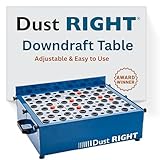
A downdraft table uses a perforated or slotted work surface. Air moves downward through the table, carrying sanding dust away from the operator’s breathing zone. The collector may be underneath the table, or connected through a duct to a separate dust collector. This works particularly well for flat panels, cabinet doors, drawer parts, and small components.
An overhead hood or canopy hangs above the work area and pulls air upward. It is similar in principle to a kitchen exhaust hood, but workshop sanding produces dust at the surface and in the operator’s hands. Much of that dust travels sideways before it rises. The hood must therefore move a large amount of air and be positioned close to the work without interfering with the workpiece.
For hand sanding, a downdraft table can capture dust at the point where it falls. For random-orbit sanding, connect the sander itself to a vacuum whenever possible. A table or hood is secondary protection; it should not replace the sander’s built-in dust port.
Downdraft table and overhead hood compared
| Factor | Downdraft table | Overhead hood |
|---|---|---|
| Best use | Flat parts and hand sanding | Large parts, irregular work, general ambient capture |
| Capture location | Directly below the work | Above and behind the work |
| Typical airflow need | About 500–1,000 CFM for a small table, depending on size and leaks | Often 800–1,500 CFM or more for useful room-area capture |
| Effect of drafts | Moderate; air is pulled downward | High; fans, open doors, and movement can carry dust away |
| Work-surface flexibility | Limited by table size and suction pattern | Works over a larger area |
| Installation | Requires a sealed plenum and a sturdy work surface | Requires overhead mounting and ducting |
| Main weakness | Large workpieces can block airflow | Weak capture at the source and high airflow demand |
Airflow and sizing mistakes
Published CFM numbers are not enough by themselves. A collector’s rating is often measured with no hose, filter loading, or duct resistance. A small table with a 4-inch outlet may perform acceptably with a short, smooth hose, yet lose much of its airflow through a long run, undersized fittings, or a clogged filter.
As a practical starting point, a compact downdraft table around 24 by 36 inches may need roughly 500 to 1,000 CFM at the table, measured under working conditions. A larger table needs either more airflow or a divided plenum with separate zones. If the workpiece covers most of the perforated surface, the open area becomes small and suction can concentrate in the uncovered edges instead of passing through the dust.
Overhead hoods need more volume because capture gets weaker as distance increases. A hood mounted 12 inches above the work is substantially more effective than one 30 inches above it. Keep the hood low enough to capture dust but high enough that boards, clamps, and your hands cannot strike it. Do not assume a shop-vac will run a large overhead canopy effectively; a dedicated collector with a suitable filter is normally the better match.
When a downdraft table is the better buy
Choose a downdraft table if you regularly sand cabinet parts, doors, trim pieces, or small furniture components at a fixed bench. It is also a good choice when the shop has limited ceiling height or when you want a quieter, more localized system. A well-sealed table can collect dust without pulling a large volume of conditioned room air outdoors.
Look for a replaceable or cleanable perforated top, a rigid plenum, and an outlet large enough for the intended collector. MDF dust can clog a filter quickly, so a downdraft sanding table with an accessible filter or blast gate is easier to maintain than a permanently sealed DIY box.
A DIY table is fine for occasional work. A simple version can use a sealed plywood box, a replaceable top, and a central outlet. The common failure is leaving gaps around the sides or using a top with too few openings. Air follows the easiest path, so leaks under the table can reduce suction at the sanding surface dramatically.
When an overhead hood makes sense
An overhead hood is useful when workpieces are too large for a table, when sanding happens at several locations, or when the hood can supplement tool-connected extraction. It can also help collect residual dust after rough sanding, provided the hood is close to the source and the room air is not turbulent.
It is the cheaper option if you already own a suitable collector and only need a hood, duct, and ceiling brackets. A basic workshop dust collection hood can be adequate for occasional sanding in a small shop. It is not a good excuse to sand without connecting the tool itself.
Keep doors and windows from creating a cross-draft across the sanding area. Position the hood behind or slightly above the work, not directly between your face and the workpiece. If the hood pulls dust through your breathing zone before capture, its location is wrong even if the collector sounds powerful.
Safety details that matter
Use a fine-dust cartridge filter rated for the collector, and check for leaks at the lid, hose couplers, and filter seal. Empty collection containers before they become packed; a full container reduces airflow and can send dust back through the filter. A differential pressure gauge or airflow indicator is useful on a frequently used system.
Bond and ground metal ducting where static buildup is a concern, and avoid ordinary household extension cords or improvised electrical connections around dust-producing equipment. Never use compressed air to blow dust off clothing or benches. Vacuum it with a HEPA shop vacuum and wear a properly fitted respirator when sanding, particularly with hardwood, painted surfaces, or unknown finishes.
For most dedicated sanding benches, buy or build the downdraft table. Select an overhead hood when flexibility and large workpieces matter more than capture efficiency, and treat it as supplemental extraction rather than the primary defense.