What's inside
As an Amazon Associate I earn from qualifying purchases. This post may contain affiliate links at no extra cost to you.
Cutting plywood, MDF, melamine and other composite panels creates a different dust problem from planing solid lumber. The chips are smaller, the dust is often finer, and a circular saw or track saw throws material forward and sideways instead of dropping it neatly below the blade. A workable setup combines source capture, an appropriate collector, and a cutting method that does not leave the panel unsupported or the hose in the way.
As an Amazon Associate we earn from qualifying purchases at no extra cost to you.

Start at the cutting point
The best dust collector cannot compensate for poor capture. A shop vacuum connected directly to the tool is usually the right first move for a track saw, jigsaw, router, or portable circular saw. Use a short, smooth hose where possible; a 1-1/4-inch hose is convenient, while a 2-1/2-inch hose generally moves more air but is harder to handle.
For a table saw, connect the blade guard’s upper port as well as the lower cabinet port if the saw supports both. The lower port catches dust falling through the blade slot, while the upper port captures dust thrown above the table. A 2-1/2-inch hose at the guard and a 4-inch connection at the cabinet is a common arrangement. If you can use only one port, prioritize the upper guard when cutting sheet goods with an exposed blade; it keeps more dust out of your breathing zone.
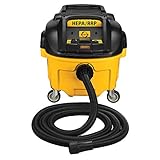
A HEPA shop vacuum is a good fit for portable tools. Look for a model with a sealed filter system, automatic tool switching, and a washable or replaceable HEPA filter. “HEPA-style” is not the same as a tested HEPA filter. The vacuum’s automatic switch should be rated for the connected tool’s amperage, and the hose should not collapse under suction.
Match the collector to the tool
Dust collectors are commonly advertised by maximum cubic feet per minute (CFM), measured without a hose, filter loading or tool restriction. That number is useful only as a rough comparison. A portable vacuum may claim 100 to 150 CFM at its inlet but deliver much less through a long hose and a clogged filter. A two-horsepower single-stage collector may advertise 1,000 CFM or more, but it is intended for larger ducts and machines rather than a tiny router port.
| Tool or setup | Practical starting point | Main limitation |
|---|---|---|
| Track saw, circular saw, jigsaw | HEPA shop vacuum; short 1-1/4 or 2-1/2 inch hose | Filter clogs quickly when cutting MDF |
| Router table | Shop vacuum for the bit guard; larger collector for cabinet capture | Two capture points can need a blast gate and more airflow |
| Table saw | 1-1/2 to 2 HP collector with 4-inch cabinet duct, plus guard capture | Leaks around the blade and open stand reduce performance |
| Panel saw or track-saw bench | Vacuum at the saw, with a fully supported cutting surface | Long hoses and narrow ports restrict airflow |
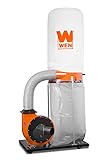
For a fixed shop, a cyclone dust collector is usually a better investment than a larger shop vacuum. The cyclone drops heavier particles before they reach the filter, maintaining airflow longer. It does not eliminate fine dust, however. Use a pleated cartridge filter rated around 1 micron or finer, and empty the collection drum before it becomes difficult to move.
Build a clean cutting station
For breaking down full sheets, a sacrificial foam cutting board is inexpensive and often more effective than a dedicated panel saw. Place the sheet on rigid foam insulation, support it across the entire surface, and set the blade depth only 1/8 to 1/4 inch below the panel. This reduces splintering and prevents the blade from cutting deeply into the support. Keep the hose behind the saw and route it over a simple hook or overhead arm so it does not drag across the cut line.
Do not lay plywood across a few sawhorses with the middle unsupported. The sheet can sag, pinch the blade, and kick the saw backward. Composite panels are particularly prone to chipping when the cut line vibrates. A grid-style cutting table with replaceable strips works well if you break down sheets regularly. Add a sacrificial top rather than cutting directly on the table frame.
A track saw dust hose adapter can improve capture, but check that it does not reduce the tool’s port to an unnecessarily small opening. Every sharp bend, reducer and quick-connect fitting adds resistance. If the saw loses power or the hose pulls it off the guide rail, the setup is too restrictive or poorly supported.
Control fine dust after collection
MDF and particleboard produce a large amount of fine resin-containing dust. The filter may look clean while airflow has already dropped significantly. Watch for dust escaping from the vacuum exhaust, a change in motor pitch, or dust collecting on nearby horizontal surfaces. Clean or replace the filter according to the manufacturer’s instructions; do not beat a HEPA filter against concrete, which can damage the media and release a dust cloud.
Use a disposable collection bag when the vacuum supports one. The bag makes emptying cleaner and protects the main filter from rapid loading, though it costs more over time. A cyclone separator ahead of a shop vacuum is worthwhile for repeated sheet breakdown, but it must have airtight connections and a container that will not collapse under vacuum.
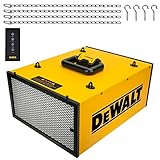
An ambient air cleaner can reduce the dust that escapes initial capture, but it is a secondary device. It does not replace a hose at the blade or router, and it may take 30 minutes or more to cycle the air in a small shop. Choose a unit with a filter area suited to the room and leave it running after cutting rather than pointing a fan across the workpiece.
Use the collector without creating new hazards
Wear a properly fitted P100 or at least an N95 respirator while cutting and cleaning. Eye protection is mandatory, and hearing protection is sensible around saws and collectors. Never use compressed air to blow MDF dust off the bench or your clothing; it turns settled dust into an airborne cloud. Vacuum first, then wipe surfaces with a damp cloth.
Grounding and static control matter with long flexible ducting, especially in dry weather. Use electrically suitable hose and follow the collector manufacturer’s grounding instructions rather than improvising a wire inside the hose. Keep hoses out of walkways, use blast gates on unused branches, and disconnect power before clearing a jam. The cheaper shop-vac setup is fine for occasional cuts, but frequent cabinet work justifies better filtration, a cyclone and a fixed collector with enough airflow for the ports you actually use.