What's inside
As an Amazon Associate I earn from qualifying purchases. This post may contain affiliate links at no extra cost to you.
Fine dust left in the air after sawing, sanding, or routing is a different problem from chips on the floor. A dust collector should capture debris at the tool; a workshop air cleaner, also called an ambient air cleaner or air scrubber, removes the dust that escaped capture. That second step matters because the smallest particles stay suspended longest and are the easiest to breathe.
The best setup uses source collection first, followed by a properly sized air cleaner. An air scrubber is not a substitute for a connected dust extractor, a sealed hose, or a good respirator during dusty work.
As an Amazon Associate we earn from qualifying purchases at no extra cost to you.
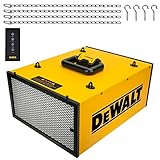


What an Air Cleaner Needs to Do
Look for a unit with a true HEPA filter or a clearly stated fine-particle rating, plus a published airflow figure. “HEPA-style” is not the same as certified HEPA. For a small woodshop, the most useful specifications are clean-air delivery rate, filter efficiency, noise, and replacement-filter cost.
Airflow is usually listed in cubic feet per minute (CFM). To estimate whether a machine is large enough, calculate the room volume and divide by the unit’s effective airflow:
Air changes per hour = (CFM × 60) ÷ room volume in cubic feet.
For example, a 20-by-20-foot shop with an 8-foot ceiling contains 3,200 cubic feet. A cleaner moving 400 CFM provides about 7.5 air changes per hour. That is a reasonable target for clearing residual dust after machine use. A larger, leakier, or frequently used shop may need 600 to 1,000 CFM, or two smaller units.
Be cautious with maximum airflow claims. A blower may move 800 CFM with a clean pre-filter, but substantially less after the filter loads with dust. A unit with a lower advertised number but a larger filter and better airflow under load can perform better in daily use.
Best Types for a Workshop
| Type | Best use | Main advantage | Main drawback |
|---|---|---|---|
| Ceiling-mounted ambient cleaner | Permanent woodworking shop | Moves air without using floor space | Harder to service and less useful if mounted poorly |
| Portable HEPA air scrubber | Garage shops and renovation work | Can be placed close to the dusty area | Uses floor space and may be easier to knock over |
| Box fan with furnace filter | Occasional, low-cost cleanup | Very inexpensive and easy to assemble | Usually leaks around the filter and lacks a sealed HEPA path |
| Room air purifier | Small enclosed hobby room | Quiet and compact | Often too little airflow for a working shop |
A ceiling-mounted unit is convenient when the shop has a fixed bench layout and enough headroom. Mount it so the intake is away from a wall or corner, and leave the manufacturer’s required clearance around the housing. A portable unit is more flexible: put it downwind of the operator, but not directly beside the dust source where it can pull chips away from the tool’s collection hood.
For a small shop used only on weekends, a workshop air filtration system with a washable or replaceable coarse pre-filter may be enough. Run it during the job and for at least 30 to 60 minutes afterward. If sanding MDF, plywood, or hardwood every day, step up to a unit with higher airflow, a sealed filter compartment, and a readily available fine-particle filter.
HEPA Filters and Filter Costs
A HEPA filter is useful for fine dust, but it creates resistance. That resistance makes the blower work harder and reduces airflow as the filter loads. A two-stage design is preferable: a coarse pre-filter catches larger debris while the fine filter handles the particles that matter most.
Do not wash a disposable HEPA filter unless the manufacturer specifically says it is washable. Compressed air can damage the media and spread concentrated dust through the room. Replace the pre-filter when it is visibly loaded or when airflow drops. Replace the main filter when the unit’s indicator says to do so, airflow becomes weak, or the filter is visibly damaged.
Check replacement prices before buying. A cheap cleaner that needs a $70 filter every few months may cost more than a better-sealed unit with a $35 filter that lasts a year. Keep a spare filter sealed in a plastic bag; running a clogged machine for hours only wastes power and adds noise.
Placement and Operating Practice
Air cleaners work best when they create a slow circulation pattern through the room. Keep the intake several feet from walls, lumber stacks, and stored tools. Aim the outlet across the room rather than straight at a dusty bench. Do not place it where the outlet blows settled dust back onto a workbench or into your breathing zone.
Close doors and windows while the cleaner is working if outdoor air is dusty or the room has uncontrolled drafts. Conversely, never block required ventilation for fuel-burning equipment. A shop heater, gas water heater, or engine exhaust needs proper combustion air and exhaust clearance; an air cleaner does not make carbon monoxide safe.
Use the highest practical speed during cutting and sanding, then reduce it for background operation. If the unit is too loud to run, it will not protect the shop. Look for low-speed noise around 50 to 60 decibels when possible. Even then, wear hearing protection near saws, routers, and planers.
When a Cheap Option Is Enough
A box-fan filter arrangement can be acceptable for occasional cleanup in a garage, particularly if the main dust collector already captures most chips. Use a correctly sized pleated furnace filter, seal gaps with foil tape, and inspect the fan and filter regularly. It is not a sealed HEPA system, and the motor may not be designed for continuous dusty service.
For a safer, more durable purchase, compare portable HEPA air scrubbers by airflow at a stated filter condition, not just the biggest CFM number. A basic replacement filter supply should be easy to find before you commit to the machine.
Finally, wear a properly fitted respirator while the dust is being made. Let the air cleaner handle residual airborne dust after the tool stops; it cannot protect you from the concentrated cloud produced at the cutter or sanding pad.