
What's inside
- Metabo vs. Metabo HPT: Which Brand Are You Actually Buying?
- Head-to-Head Spec Comparison
- How to Choose By Your Situation
- Decision Matrix: Which Saw Fits Which User
- Worked Calculation: Will It Fit and Is Cordless Worth It?
- Durability and Ownership Realities
- What Comes in the Box and What to Add
- Bottom Line: Pick by Capacity and Storage, Not Just Power
- Related Guides
As an Amazon Associate I earn from qualifying purchases. This post may contain affiliate links at no extra cost to you.
The best Metabo table saw for most buyers in 2026 is the Metabo HPT C10RJ for corded jobsite work and the Metabo HPT C3610DRJ if you need cordless MultiVolt flexibility, while the European-built Metabo TS 254 M is the better choice for a semi-stationary shop saw with a sliding carriage — your pick should come down to rip capacity, stand type, and whether you need battery power.
As an Amazon Associate we earn from qualifying purchases at no extra cost to you.
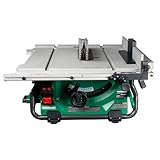

Metabo vs. Metabo HPT: Which Brand Are You Actually Buying?
Shoppers searching for “Metabo table saw” see two distinct brands. Metabo (green, German-made) sells the TS 254 and TS 254 M cabinet-style saws primarily in Europe. Metabo HPT (formerly Hitachi Power Tools, green and black) sells the C10-series jobsite saws widely available in North America. They share no current table saw lineup, warranty network, or accessories, so confirm the badge before you compare specs or buy blades and stands.
For this guide, we cover both because both appear under the Metabo name in search results, but we note which is which so you can match the model to the right support channel.
Head-to-Head Spec Comparison
Rip capacity, weight, and fence design matter more than motor amps alone. This table uses manufacturer-published specs for current 10-inch / 254mm models:
| Model | Power | Blade / Speed | Rip Capacity (Right / Left) | Max Depth @ 90° / 45° | Weight (Tool Only) | Stand / Footprint | Fence System |
|---|---|---|---|---|---|---|---|
| Metabo TS 254 M | 1500W corded (230V) / 13A 120V version where available | 254mm (10 in) / 4,200 RPM | 630 mm / 24.8 in with extension (310 mm / 12.2 in without) | 87 mm / 3.43 in / 54 mm / 2.13 in | 33.5 kg / 74 lbs | Fixed legs, integrated extension table; 970 x 730 mm / 38.2 x 28.7 in footprint | Rack-and-pinion with sliding carriage and angle fence |
| Metabo 36V TS 36-18 LTX BL 254 (Cordless) | 18V x 2 (36V) Brushless, MultiVolt platform | 254mm (10 in) / 4,200 RPM | 630 mm / 24.8 in with extension | 87 mm / 3.43 in / 54 mm / 2.13 in | 32 kg / 70.5 lbs (without batteries) | Fixed legs, collapses for transport; same 970 x 730 mm footprint | Rack-and-pinion, parallel guide with fine adjustment |
| Metabo HPT C10RJ | 15A corded, 4,500 RPM | 10 in / 4,500 RPM | 35 in / 889 mm (Right) / 22 in / 559 mm (Left with extension) | 3-1/8 in / 79 mm / 2-1/4 in / 57 mm | 58 lbs / 26.3 kg (saw only); 96 lbs / 43.5 kg with fold & roll stand | Fold-and-roll stand; 30 x 29 in / 762 x 737 mm standing, 30 x 22 in / 762 x 559 mm folded | Telescoping rack-and-pinion with cam lock |
| Metabo HPT C3610DRJ (MultiVolt Cordless/Corded) | 36V MultiVolt battery or AC adapter, brushless | 10 in / 4,500 RPM | 25 in / 635 mm (Right) / 18.5 in / 470 mm (Left) | 3-1/8 in / 79 mm / 2-1/4 in / 57 mm | 65 lbs / 29.5 kg (saw only); 103 lbs / 46.7 kg with stand | Fold-and-roll stand; 32 x 27 in / 813 x 686 mm standing | Rack-and-pinion with micro-adjust |
What the numbers mean in practice: The TS 254 M and its cordless twin give you the deepest cut at 90 degrees and a true European sliding table for crosscutting panels, but only 24.8 inches of rip even with the side extension fully deployed. Both Metabo HPT jobsite saws trade a few millimeters of depth for 25 to 35 inches of rip to the right, which is what lets you rip a full 4×8 sheet lengthwise with the fence, and they fold to roll through a standard 30-inch doorway.
How to Choose By Your Situation
Match your workspace and workflow to the saw, not the other way around:
1. Rip Capacity and Sheet Goods
If you break down plywood or MDF regularly, rip capacity is the deciding factor. A 35-inch right rip (C10RJ) lets you cut a 24-inch cabinet side from a 48-inch sheet with the offcut supported. A 25-inch rip (C3610DRJ and TS 254 M) requires you to cut sheets down with a track saw or circular saw first, then finish on the table saw. For trim, flooring, and ripping solid stock under 12 inches wide, the compact 24.8-inch capacity is sufficient and gives you better fence rigidity.
Also check left-side capacity: The C10RJ’s slide-out extension rail adds usable left-side support to 22 inches, helpful for wide miter cuts. The TS 254 M relies on its sliding carriage (up to 16-3/4 in / 425 mm crosscut width) rather than a left fence extension.
2. Stand, Storage, and Portability
Fixed-leg saws (TS 254 M, TS 36-18 LTX BL 254) are stable and dampen vibration, but they do not fold. Plan for a permanent 38 x 29-inch footprint plus 48 inches of infeed and outfeed clearance. The fold-and-roll stands on the Metabo HPT models collapse to about 22 inches deep and stand upright against a wall. Measured in a typical single-car garage (12 x 20 ft), a folding saw saves roughly 8 to 10 sq ft of floor space when stored, which often matters more than the 15 to 20 lbs weight difference.
If you carry the saw up stairs or load it solo, tool-only weight is deceptive. Add stand weight and consider wheel size: The C10RJ and C3610DRJ use 8-inch wheels that roll over extension cords and thresholds; the TS series has no wheels and must be lifted.
3. Fence Adjustability and Accuracy
All four saws use rack-and-pinion fences, but execution differs. The Metabo HPT fences telescope on steel rails and lock with a single cam lever — fast to set, but you should verify squareness at 10, 20, and 35 inches after transport, as rail flex can introduce 1/64 to 1/32-inch drift at full extension. The Metabo TS fences run on an extruded aluminum rail with a fine-adjustment knob that moves the fence 0.1 mm per click, making it easier to dial in glue-line rips and maintain parallelism after years of use.
If you do repetitive narrow rips (1-1/2 to 3-1/2 inches for face frames), a micro-adjust fence reduces test-cut waste. If you do varied site work, a quick cam lock and a fence that self-aligns when you slam it matters more.
4. Power Source and Dust
Corded 15A saws deliver continuous power for hardwoods and stacked dado cuts. Cordless 36V saws deliver equivalent peak power for about 20 to 30 minutes of continuous cutting on a pair of 5.0Ah batteries, or roughly 150 to 200 linear feet of 3/4-inch plywood ripping per charge. With the AC adapter, the C3610DRJ and TS 36-18 LTX BL 254 run as corded saws without swapping tools.
Dust collection also separates them: The TS 254 M has a 35mm / 1-3/8-inch top port plus a 58mm / 2-1/4-inch rear port and collects well with a shop vacuum. The jobsite saws use a 2-1/2-inch dust port and benefit from a dust bag or vacuum, but expect more airborne fine dust without an enclosure.
Decision Matrix: Which Saw Fits Which User
| Your Situation | Best Fit | Why |
|---|---|---|
| Small shop, permanent station, focus on furniture and accurate crosscuts | Metabo TS 254 M | Sliding carriage, fine-adjust fence, and extension table handle panels without a track saw; quieter and more stable than jobsite chassis |
| Garage shop, must fold and store after each use | Metabo HPT C10RJ | Widest rip (35 in), lightest fold-and-roll package, standard 15A power; lowest general market price range of the four |
| Jobsite, service, or no reliable corded power | Metabo HPT C3610DRJ or Metabo TS 36-18 LTX BL 254 | 36V brushless with AC fallback; run all day on batteries plus adapter. Choose HPT for max rip, Metabo for sliding table precision |
| First table saw on a tight budget and limited help moving it | Metabo HPT C10RJ | Lowest weight as a system, common 10-inch blades and dados, readily available parts and fences in North America |
| You already own Metabo 18V / CAS or Metabo HPT MultiVolt batteries | Stay in that platform | Battery cost often exceeds saw cost; staying in-system saves $150-$300 in general market range for batteries and charger |
Worked Calculation: Will It Fit and Is Cordless Worth It?
Use two quick checks before you buy:
1. Footprint check: Measure your storage wall width. A folded C10RJ needs 30 inches wide x 22 inches deep x 33 inches tall. Add 4 inches on each side for hands and fence overhang. If your wall is under 36 inches wide, the fixed-leg TS 254 M (38.2 inches wide) will block walkways even when not in use.
2. Runtime cost per use: If you choose cordless, estimate battery cycles. Example: You rip 100 linear feet of 3/4-inch oak per weekend. A pair of 5.0Ah MultiVolt batteries yields ~175 linear feet per charge. That is ~0.57 charge per session. At ~500 charge cycles per battery set, one set lasts ~875 sessions (about 16 years of weekend use). Even at a general market range of $180-$250 per battery pair, battery cost per session is under $0.30. For daily professional use (500 linear feet/day, ~3 charges/day), the same set lasts ~166 workdays — factor replacement into your yearly consumables budget.
Durability and Ownership Realities
Beyond the spec sheet, this is what tends to wear or cause frustration:
- Fence faces and rail wear: Aluminum fence faces dent if you drop material on them. Check for nicks that catch workpieces and file them smooth. Rack gears collect pitch — brush them with a nylon brush monthly, never oil them, as oil attracts dust and creates backlash.
- Throat plate and riving knife alignment: The plate sits 0.1-0.2 mm proud from the factory on some units. Level it with set screws so it sits just below table height; a proud plate lifts small offcuts and causes burn marks. Always align the riving knife to within 0.5 mm of the blade plane.
- Carriage and slide play (TS 254 M): The sliding carriage uses gibs that loosen with vibration. If you feel lateral play, tighten the gib screws in quarter-turn increments until the carriage glides without side shake.
- Wheels and stand latches (C10RJ/C3610DRJ): Plastic stand latches crack if the saw is dropped while folded. Store the stand locked open or locked folded; leaving it half-latched stresses the pins.
- Common mistakes: Using a 24-tooth rip blade for plywood crosscuts causes tear-out and overloads cordless motors; keep a 40-tooth general purpose and a 60-tooth fine-finish blade. Over-tightening the blade nut warps thin-kerf blades — snug with the wrench, then 1/8 turn.
- Cleaning: Blow out the motor housing from the dust port side outward, not into the motor. Vacuum the trunnion area weekly in heavy use; packed dust raises elevation efforts and can stall the lift on jobsite saws.
Consumables to budget for: a spare throat plate ($15-$30 general market range), one or two quality 10-inch blades per year for hobby use (3-5 for pro use), and for cordless models, a second battery pair if you cannot tolerate mid-day charging.
What Comes in the Box and What to Add
Metabo TS 254 M typically includes the sliding carriage, extension table, parallel fence, angle fence, push stick, and a 24-tooth or 40-tooth carbide blade depending on region. Metabo HPT C10RJ and C3610DRJ include the fold-and-roll stand, 40-tooth blade, blade guard with anti-kickback pawls, push stick, and miter gauge; the AC adapter for the C3610DRJ is often sold separately, so verify the kit code (DRJ vs DR). None include a dado stack or insert — dado capacity is 13/16 inch on the Metabo HPT models and not supported on the European TS 254 M without a special flange.
Worth adding at purchase: a zero-clearance insert for thin strips, a quality miter gauge upgrade if you cut miters often (stock gauges typically have 0.5 to 1 degree of slop), and a 2-1/2-inch to 35mm dust hose adapter if you mix brands.
Bottom Line: Pick by Capacity and Storage, Not Just Power
Choose the Metabo TS 254 M or its cordless twin when you want shop accuracy and a sliding table and can give the saw a permanent spot. Choose the Metabo HPT C10RJ when you need maximum rip capacity and the smallest stored footprint for the general market price. Choose the Metabo HPT C3610DRJ when you need that same portability without a cord, with the option to plug in when power is available.