
What's inside
As an Amazon Associate I earn from qualifying purchases. This post may contain affiliate links at no extra cost to you.
The best bench drill press for woodworking is the one whose throat depth, quill travel, and table clearance fit your largest parts—not simply the one with the biggest motor. For most small shops, a 12- to 13-inch swing model with about 3 inches of quill travel is a useful starting point; choose a larger machine when wide panels, long bits, or frequent deep drilling make that capacity limiting.
As an Amazon Associate we earn from qualifying purchases at no extra cost to you.
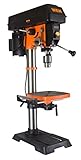


Bench drill press picks by shop and workpiece
These are established product lines to compare, not a claim that one model suits every shop. Specifications and configurations can vary by model year and market, so verify the exact manual before buying. Prices are broad U.S. market ranges, not fixed quotes.
| Pick | Typical swing | Quill travel | Best fit | General price range |
|---|---|---|---|---|
| WEN 4212T | 10 in. | About 2 in. | Small parts, occasional holes, tight budget | About $150–$250 |
| JET JDP-15B | 15 in. | About 3⅛ in. | General furniture work and larger fixtures | About $800–$1,200 |
| Nova Voyager DVR 18 in. | 18 in. | About 6 in. | Deep drilling, large workpieces, frequent use | About $2,500–$3,500 |
These figures describe representative configurations; check the manufacturer’s current specifications for throat depth, chuck capacity, speed range, table size, and weight. A product name or advertised swing alone does not tell you how much room you will have beneath the chuck.
Best for a tight budget: WEN 4212T
A 10-inch bench drill press is a sensible choice for small shop projects, hardware holes, and parts that can be brought close to the column. It can handle many furniture-making tasks, but its limited swing is the deciding constraint: a 10-inch swing provides roughly 5 inches from the spindle centerline to the column. That limits how far into a wide panel you can drill without repositioning or using another setup.
Choose this class if most parts are narrow and drilling is intermittent. It is less suitable for mortised table legs or cabinet panels where the hole must sit well away from an edge. Compare table movement and clamping options too; a low-cost press is much more useful when the work can be secured safely.
Best for a versatile small shop: JET JDP-15B
A 15-inch swing gives about 7½ inches from spindle centerline to column, a noticeable increase in reach over a 10-inch machine. With around 3⅛ inches of quill travel, this class is a practical middle ground for furniture parts, drilling jigs, and deeper holes that would otherwise require repositioning.
It is a strong candidate when a bench-top drill press would be cramped but a large floor model would consume too much space. Check the machine’s footprint and weight before purchase: “bench” does not mean easy to lift, and a heavy press needs a rigid, well-anchored stand or bench.
Best for large or deep work: Nova Voyager DVR 18 in.
An 18-inch swing provides about 9 inches of reach from the spindle centerline to the column. Its longer quill travel is useful for deep boring and reduces the need to reset the table or workpiece during a drilling operation. Variable-speed control can also make it easier to select an appropriate speed for different bits and materials.
This capacity makes sense for a shop that regularly drills large components, builds substantial furniture, or uses long bits. For occasional small-hole work, the extra size and cost are hard to justify. Also account for the machine’s height, mass, and electrical requirements before treating it as a simple upgrade.
Size the press to the actual job
Swing is reach, not workpiece width. A press advertised as 15 inches has approximately 7½ inches between the spindle centerline and the column. A hole must fit within that radius, measured from the part’s edge nearest the column. For example, if a panel needs a hole 8 inches in from an edge, a 15-inch press may not reach it in one orientation; rotating the panel or using a larger swing may be necessary.
Quill travel is the spindle’s downward stroke. It is not the same as the distance from the chuck to the table. A 2-inch stroke can drill a deeper hole through repeated plunges, but long bits, Forstner bits, and tall workpieces can require more vertical clearance. For a mortise in a leg, consider both the required depth and the room needed for the bit and chuck to approach the work.
Chuck-to-table distance determines vertical fit. Lowering the table creates space for a tall leg or panel, but the base may become the support surface. Raising the table shortens the available clearance. Measure your tallest workpiece plus the length of the bit extending below the chuck; compare that total with the available distance at the table positions you can actually use.
Match the machine to your shop
| Your situation | Capacity to prioritize | Practical choice |
|---|---|---|
| Occasional drilling; narrow parts; limited budget | About 10 in. swing; compact footprint | Entry-level bench model |
| Regular furniture work; legs and medium-width panels | About 15 in. swing; roughly 3 in. or more of quill travel | Mid-size press with a stable stand |
| Wide workpieces or deep holes are routine | 18 in. swing or greater; longer stroke and generous clearance | Large, variable-speed press |
| Very wide panel glue-ups | Reach to the hole location, plus enough table support | Measure first; consider a floor model or a different drilling setup |
Panel glue-ups expose a common sizing mistake: a large table does not increase swing. If the hole is far from the panel edge, the limiting dimension is the spindle’s reach from the column. Supporting an oversized panel on auxiliary rollers or a larger platform can help with weight, but it does not move the spindle closer to a distant hole.
What to check before buying
- Speed range and changes: Wood bits often need different speeds depending on diameter and material. Confirm that the press reaches a suitable low speed for larger cutters and that changing speed is manageable for you.
- Runout and quill play: A chuck that wobbles or a loose quill can compromise hole accuracy. Inspect the machine if possible, or review the return policy and service support.
- Table adjustment: Check how easily the table tilts, rotates, and locks. A table that shifts under load makes repeatable angled or jigged drilling harder.
- Stand and footprint: The press needs a stable base, space for the workpiece to rotate, and room to operate the handle. Include the stand, not just the machine head, in your space plan.
- Chuck capacity: Make sure it accepts the shank sizes you use. A press’s advertised drilling capacity is not a promise that every bit or cutter will fit its chuck.
Ownership details that affect accuracy
Wood dust and pitch can collect on the table, column, and quill. Keep sliding surfaces clean and use a light protective coating on exposed cast iron to discourage rust; wipe away excess so it does not transfer to workpieces. Periodically check that the table, head, and stand fasteners remain secure, especially after moving the machine.
The chuck is a wear item, and neglected cutters can make an otherwise sound press seem inaccurate. Keep bits sharp, remove chips from deep holes rather than forcing the feed, and clamp small parts instead of holding them by hand. A spinning workpiece can injure you and damage the bit. For repeatable woodworking, a simple fence or drill-press table with a replaceable insert can also protect the machine table and make setup easier.
Before choosing the best bench top drill press for woodworking, write down the widest part, the farthest hole location from its edge, the deepest hole, and the tallest setup you expect to drill. Pick the smallest press that clears all four with a little room to spare. That approach usually gives better value than paying for a larger motor when the real limitation is reach or vertical clearance.