
What's inside
As an Amazon Associate I earn from qualifying purchases. This post may contain affiliate links at no extra cost to you.
Quick verdict: Which WEN scroll saw should you choose?
For most hobbyists, the WEN 3921 is the sensible WEN scroll saw to buy: its 16-inch throat and variable speed suit common fretwork and small-shop projects without paying for a larger machine you may not need. Choose the 3922 if you regularly cut wider work, the 3923 if you want a larger cutting capacity and are comfortable with a heavier saw, and the 3920 if low cost matters more than variable speed.
These are benchtop saws generally found below $200, though prices vary by retailer and sale. The key differences are not just capacity: speed control, table tilt, and how securely the base sits on your bench affect whether a model feels appropriate for your projects.
As an Amazon Associate we earn from qualifying purchases at no extra cost to you.
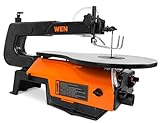

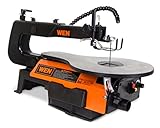
WEN 3920 vs. 3921 vs. 3922 vs. 3923
Published specifications can vary slightly by listing or revision. The figures below reflect commonly stated manufacturer specifications; confirm the manual for the exact model and version before buying. “Throat” is the distance from the blade to the rear frame, which limits the width of material you can rotate around the blade. Maximum thickness is a separate capacity and does not guarantee that the saw will cut thick stock quickly or cleanly.
| Model | Throat depth | Speed range | Table tilt | Approx. weight | Best fit |
|---|---|---|---|---|---|
| WEN 3920 | 16 in. | Fixed, about 550 strokes/min. | 45° left | About 25 lb. | Infrequent, budget-focused cutting |
| WEN 3921 | 16 in. | Variable, 400–1,600 strokes/min. | 45° left | About 25 lb. | General hobby use and mixed materials |
| WEN 3922 | 16 in. | Variable, 550–1,600 strokes/min. | 45° left | About 28 lb. | Frequent work where added mass is welcome |
| WEN 3923 | 16 in. | Variable, 550–1,600 strokes/min. | 45° left | About 28 lb. | Buyers prioritizing the model’s capacity and feature package |
All four are commonly listed with a maximum cutting capacity of up to 2 in. at 90° and 1 in. at 45°. Treat those as limits, not recommended everyday stock thicknesses: blade choice, wood species, feed pressure, and the cut’s shape all affect results. The 3922 and 3923 are often described as offering a 16-by-16-inch table, while the 3920 and 3921 listings commonly specify a 16-by-10-inch table. Check the exact listing or manual when table area is a deciding factor.
Pick by the work you actually do
- Choose the 3920 for occasional, simple work. If your projects are mostly small ornaments, basic curves, or practice cuts, a fixed speed can be enough. Its lower price leaves room in the budget for spare blades and scrap wood. The trade-off is less control when switching between delicate cuts and faster rough shaping.
- Choose the 3921 for a first serious scroll saw. Its broad variable-speed range is useful when learning to control tight curves, working with different wood thicknesses, or cutting materials that benefit from a slower pace. For many beginners, that adjustment is more valuable than extra machine weight.
- Choose the 3922 if you value a larger table and a steadier-feeling setup. Its extra mass can help reduce movement compared with a lighter saw, but it is not a substitute for securing the machine. This is a better fit for a dedicated bench than for someone who needs to put the saw away after every session.
- Choose the 3923 when its package and price make sense for your shop. It shares the 16-inch throat and variable-speed approach of the larger models. Compare its actual included features and table dimensions with the 3922 listing; model names alone do not tell you whether a particular package is worth the difference.
What the numbers mean at the bench
Throat depth: useful, but not a promise of large-project capacity
Because these models share a 16-inch throat, none has a clear advantage for rotating a workpiece around the blade. That dimension matters for interior cutouts and broad panels: a 16-inch throat gives a theoretical reach of about 16 inches from the blade to the frame, but the shape of the work and clearance around the table may reduce what is practical. If your projects regularly exceed that reach, consider a larger-throat saw rather than paying extra for another model in this lineup.
Speed range: why variable control helps
The 3921, 3922, and 3923 let you adjust speed to the material and cut. A slower setting can make it easier to follow a tight line and reduce the tendency to rush through a delicate turn; a faster setting can suit straightforward cuts in suitable wood. More speed is not automatically better. Excessive feed pressure, a dull or unsuitable blade, or trying to turn too sharply can still lead to rough edges or a broken blade.
Table tilt and base stability
The listed 45-degree left tilt supports bevel work, but tilting the table is less convenient for many angled cuts than keeping the table level and tilting the workpiece—especially when the workpiece is large or awkward. Check the manual’s guidance and make a test cut before committing to a finished part.
Weight helps, but a heavier saw can still vibrate on a flexible or uneven bench. A lighter model may shift more under the same conditions. Place the saw on a rigid, level surface and bolt it down if the manual and your bench setup allow. If you cannot bolt it in place, test it at operating speed and use an appropriate non-slip mat only if it does not block ventilation or interfere with safe operation.
Budget for blades, setup, and upkeep
Blade changes are part of scroll-saw ownership, not an occasional exception. Fine, intricate work and dense or abrasive materials can wear blades faster than simple cuts in softwood. Set aside money for compatible replacement blades and expect to use different tooth patterns or sizes for different work. Confirm blade type and clamping requirements in the model’s manual; compatibility should not be assumed from the brand name alone.
Before the first project, install the saw on a stable bench, check that the blade is correctly seated and tensioned, and make practice cuts in scrap. A blade that is loose, installed backward when its tooth direction matters, or poorly suited to the material can wander or break. Unplug the saw before changing a blade or cleaning near moving parts. Clear dust and small offcuts from the table and accessible areas after use, and inspect the blade and clamps regularly. Replace damaged blades rather than trying to finish a cut with one.
Bottom line
The WEN 3921 is the strongest all-round pick for a buyer who wants variable speed at a modest price. The 3920 is a reasonable budget choice for occasional, uncomplicated cuts; the 3922 and 3923 make more sense when their larger-table package, added weight, or current price better suits a dedicated bench. Since throat depth is shared across the lineup, pay for the features and work habits that differ—not the assumption that a higher model number means a larger cutting reach.