
Our Top Picks


What's inside
As an Amazon Associate I earn from qualifying purchases. This post may contain affiliate links at no extra cost to you.
My small garage woodworking shop is a single-car bay, roughly 11 by 19 feet, and the car still parks in the driveway because I lost that argument with myself years ago. Everything in there has to earn its footprint. When I started, I bought tools based on YouTube videos and a vague sense that a real shop needed one of everything. Then I spent two winters shuffling machines around to reach a board, and I finally accepted that floor space is the real budget, not dollars.
So this is not a list of what a shop should have. This is what I put my hands on most weeks, what I use maybe twice a year, and what I would sell tomorrow if a neighbor knocked on the door with cash. I also work with noise limits, because my garage shares a wall with a bedroom and my neighbors are about twenty feet away. That constraint shapes more of my decisions than any woodworking book ever did.
| Tool | How often I use it | Why it stays or goes |
|---|---|---|
| Track saw | Weekly | Replaces a full sheet-goods table saw setup in a tight bay |
| Cordless drill/driver pair | Weekly | Two tools means no bit swapping mid-assembly |
| Random orbit sander | Weekly | The only sanding machine I truly need |
| Benchtop planer | Monthly | Lets me buy rough lumber and skip the jointer |
| Router in a small table | Monthly | Edge work, joinery, dados without a dado stack |
| Miter saw | Every few months | Honestly the most overrated tool in my shop |
| Oscillating spindle sander | Twice a year | Great when I need it, dead weight otherwise |
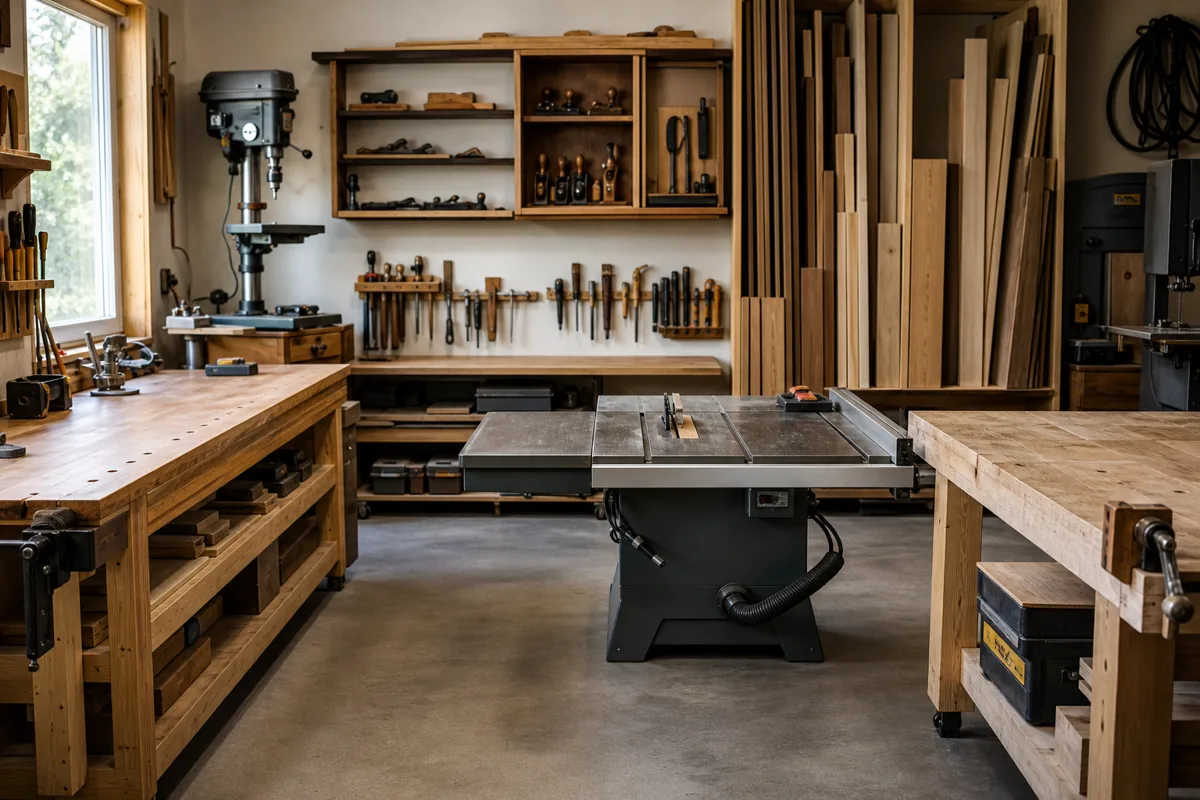
The Four Tools I Touch Almost Every Session
A track saw is the first thing I recommend to anyone in a garage. My old setup was a contractor table saw shoved against the wall, which meant every plywood cut turned into a fifteen-minute furniture-moving exercise before I even flipped the switch. With a track saw I cut sheets on foam board on the floor, or on a cheap cutting grid I made from 2x4s. The cut quality off a good blade is clean enough to glue up directly. Cordless models with brushless motors handle three quarters of an inch of plywood without complaint, and the dust collection through a shop vac is genuinely decent, which matters when your shop is also where the laundry lives.
Second is a pair of cordless drivers. Not one drill with a quick-change chuck. Two tools, one with a countersink bit, one with a driver bit. This sounds indulgent until you assemble a cabinet carcass and realize you just saved yourself sixty bit swaps. I stayed in one battery platform on purpose. The 18V and 20V max lines from the major brands are all good enough now that the smarter decision is picking one and staying loyal so your batteries and chargers work across everything.
Third is a random orbit sander with a five inch pad. I own a quarter sheet sander and a belt sander. I use neither. The random orbit does 95 percent of what I need if I keep enough grits on hand and hook it to a vacuum. Fourth is a shop vacuum with a decent cyclone separator in front of it. That separator was the cheapest upgrade that changed the most in my shop, because I went from replacing filters constantly to emptying a bucket.
Cordless Track Saw
If you have a one-car garage and cut plywood, buy this before you buy a bigger table saw. Look for a plunge mechanism that feels smooth without slop, a riving knife or anti-kickback feature, and a track that clamps without shifting. Budget for a second track and a set of connectors if you plan to rip full eight-foot sheets in one pass.
How I Work Without a Jointer
I do not own a jointer and I do not plan to. Not because jointers are bad, but because a six inch jointer eats a chunk of floor and only does one job. Instead I run three workarounds. For narrow stock, I flatten one face with a hand plane, taking the high spots off diagonally until a straightedge sits flat, then send it through the benchtop planer to bring the other face parallel. It is slower and I have absolutely wrecked boards learning to read grain direction. For edges, I joint on the track saw by clamping the track along the board and taking off a thin sliver. That gives a straighter edge than my old table saw fence ever did.
The third workaround is the one I actually use most: I buy S2S or S4S lumber from a local hardwood dealer and pay the surcharge. My time in the garage is limited to a few evenings a week. Spending one of those evenings flattening rough oak by hand is romantic in theory and frustrating in practice. That admission bothered me for a long time, and then I built more furniture in one year than in the three before it.
A benchtop planer is the compromise machine that makes all this work. Thirteen inch models live on a rolling cart in my shop and get pulled to the middle of the floor when needed. They are loud, and I mean genuinely unpleasant, so planing happens on Saturday afternoons and never after eight at night. Snipe exists on every one of them. You manage it with longer stock and support tables, not by chasing a snipe-free machine that does not exist at this price.
- ✔ Track saw plus a good bench beats a big table saw in a tight bay
- ✔ One battery platform keeps costs and clutter down
- ✔ Benchtop planer plus S2S lumber removes the need for a jointer
- ✔ Rolling carts turn a cramped shop into a reconfigurable one
- ✘ No jointer means paying more per board foot at the lumberyard
- ✘ Hand planing has a real learning curve and I ruined stock learning it
- ✘ Planers and routers are loud enough to limit when you can work
- ✘ Track saw cuts are slower than repeat rips on a table saw fence
The Tools I Regret Buying
My biggest miss was a twelve inch sliding compound miter saw. It is a fine machine and it takes up a permanent four-foot section of wall because a miter saw needs infeed and outfeed to be useful. For the crosscuts I actually make, a decent ten inch model or even the track saw with a square would cover it. If I were rebuilding my shop from scratch I would buy the smallest miter saw that handles my typical stock and put that wall space toward lumber storage.
Second regret: a cheap benchtop drill press with too much runout and a table that would not stay square. I use a drill press for shelf pins, dowels and occasional metal work. A wobbly spindle undermines the entire point of owning one. I would rather have saved another few months and bought a solid used floor model off Craigslist, which is how I have bought most of my best machines.
Third: three separate sanders when one would do, as I mentioned. And an oscillating multi-tool, which I love for remodeling work and almost never touch for furniture. Not a bad tool, just the wrong tool for what I actually build.
Benchtop Thickness Planer
The single machine that makes a jointer-free shop workable. Look for a two-knife or helical head, a cutterhead lock to reduce snipe, and enough table length that you are not fighting every board. Put it on a rolling cart with a locking wheel and plan on a dust hose, because these throw an enormous volume of chips.
What Matters More Than Tools in a Small Shop
My bench is the most important thing in the garage and it is not a tool you buy in a box. Mine is a torsion box top on a 2×4 base, 30 by 60 inches, with a face vise and dog holes. It doubles as an assembly table and an outfeed surface. If you are choosing between a nicer table saw and building a genuinely flat, heavy bench, build the bench.
Second is mobility. Every machine over forty pounds in my shop sits on a mobile base or a shop-made cart with locking casters. That is what lets an eleven-foot-wide bay work like a bigger space. Third is dust and air. In a closed garage, fine dust hangs for hours after you stop working. A shop vac with a cyclone at the source plus a box-fan filter running during and after a session made a noticeable difference in how the air feels. I also wear a respirator when sanding, which I ignored for years and regret.
Fourth is lighting and outlets. I added shop lights until the space stopped having shadows, and I ran outlets at bench height so I am not crawling behind machines. Neither is exciting. Both changed how much I enjoy being in there.
Shop Vacuum with Cyclone Separator
Dust collection is where small-shop owners under-spend and then wonder why their garage is always hazy. A mid-size shop vac paired with a cyclone separator catches the bulk of chips before they hit the filter, which means better suction for longer and fewer filter replacements. Check hose diameter compatibility with your sander and track saw ports before ordering.
FAQ
Can I really build furniture in a one-car garage? Yes, and the limiting factor is usually assembly space, not cutting capacity. I build in sub-assemblies and finish pieces in the driveway when weather allows. The projects I struggle with are large casework where a fully glued carcass has nowhere to sit while the glue cures. Plan your builds around knockdown joinery or staged assembly and the space stops being the problem.
Should my first big purchase be a table saw or a track saw? If you mostly work with plywood and sheet goods, I would take the track saw. If you mostly work with solid lumber and need repeatable rips, a table saw is hard to replace. I chose the track saw because breaking down sheets alone in a small space was the thing that made me avoid the shop. Consider what task currently stops you from starting projects.
How do I keep noise from annoying my neighbors? I sort my work by volume. Planing, routing and miter cuts happen midday on weekends. Hand tool work, sanding with a vacuum, glue-ups and finishing happen on weeknights. Closing the garage door helps more than you would expect, and a rubber mat under machines cuts the vibration that travels through a slab. It costs nothing to ask a neighbor what they can actually hear.
If I were starting my shop over with the knowledge I have now, I would buy fewer machines, build the bench first, and spend the difference on lumber and dust control. Everything on my weekly list earns its space. Everything I regret was bought to fill a gap I imagined rather than one I had hit.
Check prices on Amazon →