What's inside
As an Amazon Associate I earn from qualifying purchases. This post may contain affiliate links at no extra cost to you.
Choosing between a clamp-on work light and a fixed bench light comes down to whether your detailed work moves around. A clamp light is easy to reposition and inexpensive; a fixed light is quicker to use every day and can be set up to illuminate one bench reliably. Neither solves every lighting problem. The wrong placement can leave shadows across a cut line or send glare straight back at your eyes.
As an Amazon Associate we earn from qualifying purchases at no extra cost to you.
![[ETL Listed] Cable Matters Portable LED Clamp Light for Workshop, 6ft](https://m.media-amazon.com/images/I/41c-WwwwSOL._SL160_.jpg)


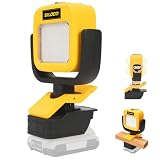
What detailed work needs from a light
For sanding, sharpening, soldering, layout, and small-part assembly, aim for even light across the work rather than a bright spot surrounded by a dim bench. A useful starting point is roughly 500 to 1,000 lux on the work surface; fine inspection may benefit from more. Lux meters are inexpensive, but you can also compare the bench with a phone app as a rough guide.
Color rendering matters when judging wood defects, wire colors, or finish coverage. Look for a light with a stated CRI of 90 or higher if accurate color is important. A color temperature around 4,000K to 5,000K gives a neutral-to-cool appearance; warmer light can feel comfortable, but may make subtle color differences harder to see.
Place the light so your head and hands do not block it. For right-handed work, a light coming from the left often reduces hand shadows, though the best side depends on the task and your bench layout. Diffusion helps, too: a bare, exposed LED can create harsh glare on polished metal and glossy finishes.
Clamp-on versus fixed bench light
| Consideration | Clamp-on work light | Fixed bench light |
|---|---|---|
| Best fit | Shared benches, changing tasks, temporary work areas | One main bench used for repeatable tasks |
| Typical cost | Often about $15–$50 | Often about $40–$150, depending on arm and light head |
| Setup | Fast to move, but must be clamped and aimed each time | More installation up front; ready when you return |
| Main weakness | Clamp can slip, obstruct the bench edge, or be knocked out of position | Less flexible; an arm or head may not reach every area |
| Space impact | Clamp occupies an edge or shelf | Wall- or bench-mounted options can free the work surface |
| Power and safety | Loose cord may cross the work area | Cord can be routed neatly, but mounting must be secure |
When a clamp-on light is the better buy
Choose a clamp-on light if you use several benches, need to illuminate the inside of a cabinet, or want to test a lighting position before drilling holes. It is also a sensible low-cost choice for occasional detail work. A clamp-on LED work light with an adjustable arm is usually more useful than a fixed-head lamp because you can bring the light closer and change its angle.
Check the clamp opening against the thickness of your bench, shelf, or tool stand before buying. The jaw needs enough depth to grip securely, and the clamp should have a protective pad so it does not dent finished wood. A small clamp on a thin shelf can flex under the weight of the arm. If the light slowly droops, tighten its joints or move it closer to the clamp; extending an arm fully puts more leverage on both the joint and the bench edge.
Clamp lights trade permanence for flexibility. Their cord can snag on a board or catch a moving tool, so route it behind the bench and leave enough slack for adjustment. Do not clamp a lamp where it blocks a vise handle, drawer, or machine guard. If you frequently knock the lamp out of position, the convenience is no longer worth much.
When a fixed light makes sense
A fixed light suits a dedicated assembly, electronics, or sharpening bench where the work area stays in roughly the same place. Once aimed, it provides consistent illumination without resetting the clamp for every job. A high-CRI adjustable-arm bench light can combine stable mounting with enough movement to reach across a wide surface.
Mount it to a sturdy bench, wall, or shelf rather than a thin panel that vibrates. Before drilling, check that the arm reaches the center and far corners of the bench without pulling the base loose. Keep the lamp head clear of cabinets and overhead tool storage. A fixed light can still cast a strong shadow if it shines from directly behind you, so test its position with your hands on the work before tightening the mount.
Fixed lighting has a higher setup cost and may be the wrong choice for a shared bench. If you switch between broad assembly work and close inspection, one fixed lamp may not reach both without frequent adjustment. A fixed light also does not replace general room lighting: relying on a bright pool at the bench while the rest of the shop is dark increases contrast and makes it harder to see hazards nearby.
Buying and mounting checklist
Compare light output, not just wattage. LEDs use less power than older bulbs, so wattage alone does not tell you how much light reaches the work. Prefer a lamp with a diffuser or a broad head, dimming if you do tasks at different distances, and a replaceable or serviceable power supply where available. An inexpensive light is fine for occasional use if its color, brightness, and arm stay adequate; spending more is worthwhile when you use it daily or need to inspect fine details.
Keep lamps away from chips, sanding dust, and finishing overspray. Dust can coat a lens and reduce output, while solvent or finish vapors may be unsuitable for a light not rated for that environment. Unplug before cleaning, and follow the manufacturer’s instructions rather than spraying cleaner into vents or joints.
If you are unsure about the mounting style, start with a clamp-mounted bench light with a diffused head, then move to a fixed mount only after you have confirmed the best position. For a bench used every day in one place, a fixed light is usually less fiddly. For occasional work or a changing setup, a clamp-on lamp is often enough—and costs less to replace if shop conditions are rough.