
Our Top Picks
 GRR-RIPPER+ by Microjig. Includes SafeRip Kit. Fully Adjustable7.9 x 3.9 x 7.9 InchesCheck on Amazon
What's inside
As an Amazon Associate I earn from qualifying purchases. This post may contain affiliate links at no extra cost to you.
- Top Pick: MICROJIG GRR-RIP BLOCK Smart Push Block
- Runner-up: Milescraft 3406 GrabberPRO
- Also consider: POWERTEC 71009 Push Block and Push Stick Set
On a jointer or router table, your hands pass close to a spinning cutter head or bit, and a good push block is what keeps them at a safe distance while the board stays flat and moving. The best push block sets for jointers and router tables combine a high-friction grip pad or a heel hook with a tall, offset handle, so one tool applies downward, forward and sideways pressure in a single motion. This guide compares five picks for face jointing, edge jointing and router table profiling, from a premium adjustable system with a stabilizing plate to a simple rubber-pad pair that stores flat in a drawer. Each pick is matched below to the stock sizes and machine work it handles best.
As an Amazon Associate, we earn from qualifying purchases.
Quick Answer
For most shops, the MICROJIG GRR-RIPPER+ is the most versatile pick, with a grip surface, stabilizing plate and SafeRip Kit for controlled feeding on jointers and router tables. The Milescraft GrabberPRO suits thin strips, the POWERTEC five-piece set covers the widest range of tasks, and the Fulton Gator Grip pair is the simple budget choice for face jointing.
Table of Contents
- Quick Answer
- MICROJIG GRR-RIPPER+ Push Block
- MICROJIG GRR-RIP BLOCK Smart Push Block
- Milescraft 3406 GrabberPRO
- POWERTEC 71009 Push Block and Push Stick Set
- Fulton Gator Grip Jointer Push Blocks, 2-Pack
- How to Choose
- Who Should Skip
- FAQ
- Final Verdict
- Product and ASIN Reference
MICROJIG GRR-RIPPER+ Push Block
The GRR-RIPPER+ sits at the premium end of this group and is the pick for woodworkers who run one tool across several machines. It arrives fully assembled with the SafeRip Kit included, and its Green GRIP non-slip surface holds the top face of the board while the stabilizing plate keeps the stock registered against the fence. On a jointer, that combination helps maintain even downward pressure through the cutter head. On a router table, the tunnel and plate arrangement feeds narrow stock past the bit with the hand riding high above the cutter. Because the system is adjustable, it adapts to different stock thicknesses instead of forcing one fixed grip height. Choose this one if you want a single, configurable pusher for jointing, routing and resawing support rather than a drawer of single-purpose blocks.
Specs:
- Model: GR-100+
- Grip surface: Green GRIP non-slip material
- Included parts: SafeRip Kit and stabilizing plate
- Assembly: fully assembled out of the box
- Machines: jointer, router table, band saw, table saw
- Warranty: 3-year manufacturer warranty
MICROJIG GRR-RIP BLOCK Smart Push Block

The GRR-RIP BLOCK takes a different approach from a flat pad block: instead of relying on friction alone, its auto-retracting heel hooks drop behind the end of the workpiece and push it forward, then retract as they clear the cutter. That hook action is valuable on a jointer, where a board can stall mid-pass on the outfeed side, and on a router table, where the end of a narrow piece needs positive drive past the bit. The Green GRIP podular surface adds friction on the top face, and the 90-degree flip guide supports vertical work such as resawing and beaded face frames. It is a mid-range, single-purpose tool rather than a full system, so it pairs well with a basic pad block for wide face jointing.
Specs:
- Heel hooks: auto-retracting smart hooks that engage the workpiece end
- Grip surface: Green GRIP podular pads
- Guide: 90-degree flip guide for vertical work
- Machines: router table, jointer, band saw, table saw
- Warranty: 3-year manufacturer warranty
Milescraft 3406 GrabberPRO
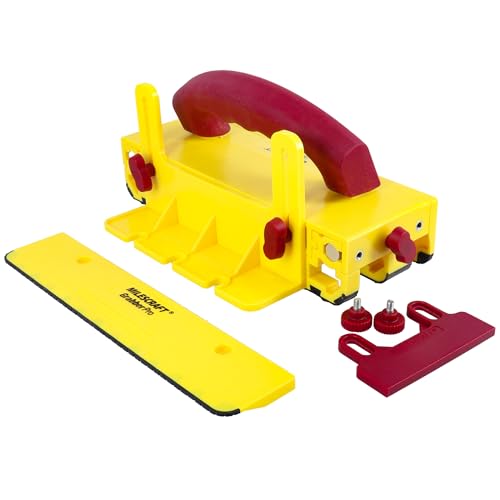
The GrabberPRO is built around interchangeable legs, which makes it the most adaptable pick here for varied stock widths. Four legs come in the box in 1 inch, 1/2 inch, 1/4 inch and 1/8 inch sizes, and they swap to match the strip being cut, with a stated cutting width range from 1/8 inch up to 5 inches. An angled support foot and an adjustable heel that can be lowered, and even cut through, keep the trailing end of the board under control on a router table or jointer. The handle is shaped to keep full contact on the workpiece through the end of the pass, which helps prevent the board from tipping as it leaves the cutter. The body is ABS plastic, so the tool stays light in the hand. Pick the GrabberPRO if your work mixes thin strips with mid-width boards and you want one mid-range tool that reconfigures instead of a separate block for each width.
Specs:
- Legs: four interchangeable legs, 1 in, 1/2 in, 1/4 in and 1/8 in
- Cutting width: 1/8 in minimum to 5 in maximum
- Heel: adjustable cut-through heel with angled support foot
- Body material: ABS plastic
- Warranty: 3-year manufacturer warranty
POWERTEC 71009 Push Block and Push Stick Set

The POWERTEC 71009 is the set to buy when you want coverage rather than a single specialized tool. The five pieces are one long hold-down push block, two short hold-down push blocks, one safe V push stick and one straight push stick. On the jointer, the long block suits face jointing wider boards while a short block follows behind it, and on the router table the V stick keeps the end of a workpiece moving through the cut while a short block holds it down against the table. The bright orange color is easy to spot against lumber and machine surfaces. At about two pounds for the whole set, it stores easily on a wall hook or in a bench drawer. This mid-range set is the practical choice for a first push tool purchase or for equipping a second workstation without buying pieces one at a time.
Specs:
- Contents: 1 long hold-down push block, 2 short hold-down push blocks, 1 safe V push stick, 1 straight push stick
- Color: high-visibility orange
- Set weight: about 2 lb
- Package size: 16 x 7 x 3 in
- Machines: jointer, router table, table saw, band saw
Fulton Gator Grip Jointer Push Blocks, 2-Pack
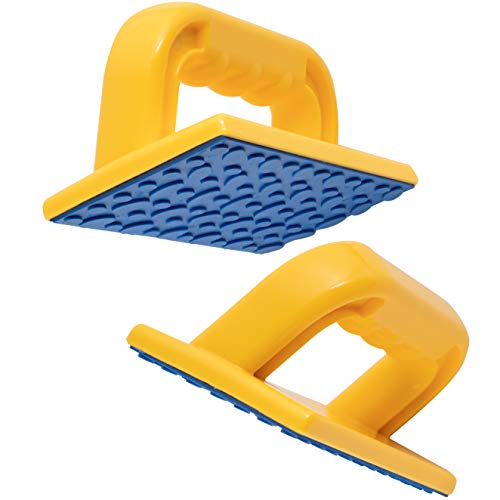
The Fulton Gator Grip pair is the budget pick and the simplest tool in this guide: two identical push blocks with a podular patterned rubber pad and a thick raised handle. The pad’s raised pods trap dust in the surface voids, which helps the rubber keep its grip on smooth or slightly dusty stock where a flat foam pad can skate. The base measures 6-3/8 inches by 3-1/4 inches, a useful footprint for face jointing boards of moderate width, and having two blocks means one can press near the cutter head while the other maintains pressure on the infeed side. The angled handle directs force downward and inward toward the fence. There are no legs, hooks or adjustments to set up, so the pair is ready the moment it comes out of the box. Choose it if your jointing is mostly face and edge work on cabinet-size stock and you want a low-cost pair that can live permanently at the jointer.
Specs:
- Base size: 6-3/8 in x 3-1/4 in
- Pad: podular patterned rubber grip pad
- Pack quantity: 2 push blocks
- Handle: thick raised handle with comfort grip
- Machines: jointer, router table, shaper, band saw
How to Choose
Start with grip style. Friction pads, like the Fulton rubber pods and the MICROJIG Green GRIP surfaces, excel at face jointing because they spread downward pressure over a wide area. Heel hooks, like the ones on the GRR-RIP BLOCK, add positive forward drive for narrow stock and end-of-pass control. Adjustable leg systems, like the GrabberPRO, suit shops that cut strips in many widths and want the tool to straddle the cutter path.
Match base size to your stock. A push block should cover enough of the board to keep it flat without rocking; wide face jointing favors a long block or a pair used together, while narrow edging favors a compact block or a leg kit. Check handle height as well: a taller handle keeps knuckles clear of the fence and cutter guard on low-profile machines.
Finally, think about how you work. A single premium system reduces clutter and setup changes, while a multi-piece set like the POWERTEC covers more situations at once and leaves a spare at each machine. Whichever style you choose, plan to clean the pad regularly, since a dust-loaded pad loses grip quickly.
Who Should Skip
Skip this category if your push tool needs are only at the table saw and you already own a dedicated table saw push block setup, since jointer and router table blocks are shaped for flat, fence-guided feeding rather than rip fence work. Skip the adjustable systems if you joint the same few board widths every session; a fixed pad pair will be faster to grab and use. Skip push blocks entirely if your jointer has a power feeder fitted, because the feeder already controls downward and forward pressure. And if your router table work is mostly large panel raising with a horizontal table or a sled, a dedicated sled or coping jig will control the workpiece better than any hand-held block.
FAQ
Do I need one push block or two on a jointer?
One block is enough for narrow edge jointing. For face jointing wider boards, two blocks work better: one maintains pressure ahead of the cutter head while the other follows through, so the board never sits unsupported mid-pass. A two-pack like the Fulton Gator Grip covers this without buying a second tool later.
What is the difference between a push block and a push stick on a router table?
A push block presses down and forward with a wide pad or legs, which suits flat stock passing the bit. A push stick pushes from behind with a notched end, which suits narrow pieces and end pressure. Sets like the POWERTEC 71009 include both because router table tasks alternate between the two motions.
How do I keep a push block pad gripping?
Wipe the pad clean whenever dust builds up, since a loaded pad loses friction. Rubber and podular pads can be cleaned with a damp cloth or a quick wipe with alcohol, depending on the maker’s guidance. Store blocks pad-side up or hanging, and replace a block when the pad stays slick after cleaning.
Can a push block replace a featherboard?
No. A featherboard holds stock sideways against a fence or down against a table along the whole pass, while a push block is a hand-guided tool that moves with the board. Many shops use both together on a router table: the featherboard sets the lateral pressure and the push block feeds the workpiece through.
Final Verdict
For a single do-everything tool, the MICROJIG GRR-RIPPER+ earns the top spot with its grip surface, stabilizing plate and included SafeRip Kit. The Milescraft GrabberPRO is the better fit for thin strips and mixed widths, and the GRR-RIP BLOCK adds positive heel-hook drive for narrow work. The POWERTEC 71009 set is the value play for full coverage in one box, and the Fulton Gator Grip pair is the straightforward budget choice for everyday face jointing. Any of the five keeps hands clear of the cutter while holding stock flat and moving, which is the whole job of a push block on a jointer or router table.
Related guides
More from Amazon
Programs that pair well with the guide above. Offers and eligibility are set by Amazon and may change.
A free business account with business pricing and bulk-buying tools for work, shop or home office.
Create a business accountFree shipping on eligible items, Prime Video and more. Eligible new members can start with a free trial.
Start a Prime free trialAudiobooks and podcasts to listen to on the go. Eligible new members can start with a free trial.
Try Audible freeAd-free music streaming. Eligible new subscribers can start with a free trial.
Try Music Unlimited freeAs an Amazon Associate we earn from qualifying purchases.


