What's inside
As an Amazon Associate I earn from qualifying purchases. This post may contain affiliate links at no extra cost to you.
A monitor can tell you whether airborne particles are building up in a woodworking shop. It cannot capture dust, prove that a respirator fits, or make a poorly vented shop safe. Treat it as a feedback tool alongside source capture, cleanup, and appropriate respiratory protection—not as a substitute for them.
As an Amazon Associate we earn from qualifying purchases at no extra cost to you.


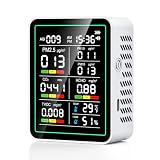
What a shop air-quality monitor can measure
For woodworking, the most useful readings are particulate matter (PM), especially PM2.5 and PM10. PM2.5 estimates particles 2.5 micrometers or smaller; PM10 includes larger particles. Many consumer monitors use an optical sensor that estimates particle levels by shining light through sampled air. These readings are useful for spotting trends—such as a spike during sanding or a slow decline after cleanup—but they are not a direct measurement of all wood dust or an occupational exposure assessment.
Some monitors also track carbon dioxide (CO2), temperature, and relative humidity. CO2 can flag poor ventilation when people are in the room, but it does not measure dust. A volatile organic compound (VOC) reading may help identify changes after using finishes or solvents, though low-cost VOC sensors are broad indicators, not reliable detectors for a particular chemical. Check which pollutants a device actually measures rather than buying based on a long feature list.
Compare monitor types
| Type | Good fit | Trade-off |
|---|---|---|
| Basic PM monitor | Checking whether dust-control changes reduce particle spikes | Usually lacks CO2 or VOC readings; sensor accuracy varies |
| Multi-sensor indoor monitor | Tracking PM alongside ventilation clues such as CO2 and humidity | Costs more; extra readings do not necessarily improve dust control |
| Portable, battery-powered monitor | Moving between a shop, finishing area, or jobsite | Needs charging, and readings may be less convenient to review over time |
| Professional aerosol instrument | Formal investigations or repeatable measurement work | Expensive and often unnecessary for routine hobby-shop decisions |
For most home shops, a fixed or portable consumer monitor with a PM reading is a reasonable starting point. A PM2.5 air-quality monitor is the cheaper choice if your main question is whether a tool or cleanup routine creates a particle spike. Paying extra for CO2 makes sense if the shop is enclosed and occupied for long stretches, or if you want to assess ventilation as well.
Features worth paying for
Look for a clearly stated PM measurement, a readable display or usable app, and a way to see recent readings rather than only a single number. A graph makes it easier to compare tasks: run the monitor through a sanding session, then repeat after improving extraction or moving the air cleaner. A unit that logs data is more useful than one that simply displays a color when readings cross a threshold.
Do not assume a consumer monitor’s alert limit is a woodworking safety limit. Consumer devices can differ in sensor design, calibration, sampling rate, and reporting. Their numbers are best used to compare conditions on the same device in the same room. If two monitors disagree, that does not necessarily mean one is defective; their sensors may respond differently to particle size, humidity, or airflow.
For a small shop, a compact monitor with PM and a display may be enough. If you also want CO2 and VOC trends, compare the sensor descriptions and ongoing app requirements before paying more. A multi-sensor air-quality monitor can be convenient, but do not treat a general VOC score as proof that a finish is safe to use without ventilation.
Where to put it
Place the monitor near the work area, roughly at breathing height, but not directly beside a dust outlet, open window, or air-cleaner intake. A direct blast of dust can overwhelm the sensor and produce readings that say little about the air where you stand. Keep it away from the floor, where settled dust can be kicked up, and follow the manufacturer’s clearance guidance.
For repeatable comparisons, keep the monitor in the same location and avoid moving it between tests. Record the task, extraction setup, and approximate time. Take a baseline reading before work, watch the reading during the task, then note how long it takes to drop afterward. That gives you a practical measure of whether your controls are helping, without pretending it is a certified exposure test.
Use readings to improve dust control
If the reading rises during sanding, first check capture at the tool: a loose hose, clogged filter, full bag, or poor hood position can send dust into the room. A shop vacuum and tool-specific port may be adequate for some small tools, while larger machines often need a dust collector with suitable airflow and ducting. An ambient air cleaner can reduce airborne dust after it escapes, but it does not replace collection at the source.
Do not judge an air cleaner by its advertised room size alone. Filter condition, actual airflow, placement, and room layout affect performance. As a rough setup, position a portable cleaner so it circulates air through the work area without blowing dust across the shop. Check filters regularly; a loaded filter can restrict airflow even while the unit continues to run. For shops where airborne dust remains a concern, compare woodworking shop air-filtration systems by airflow, filter access, and replacement-filter cost.
Let readings settle before drawing conclusions. Optical sensors can react to humidity, cooking aerosols, or other particles, and some units update slowly. A number that falls after opening a door may reflect dilution, but outdoor air can also bring in smoke, pollen, or other pollution. Verify improvements across several similar work sessions rather than relying on one unusually low reading.
Limits and buying advice
Wood dust is a health hazard, including dust from some hardwoods, and a consumer monitor cannot tell you exactly what you inhaled or certify that exposure is below a workplace limit. Follow tool and dust-collector guidance, keep extraction maintained, clean with a suitable vacuum rather than dry sweeping, and use properly selected respiratory protection when needed. For a formal exposure question, consult an industrial hygienist or occupational-health professional.
Choose the least complicated monitor that answers your question. If you only need to see whether dust control is improving, a basic PM unit is usually the sensible purchase; skip costly multi-sensor features you will not use. Spend more for logging, CO2, or portability only when those functions fit a real shop need. Whatever you buy, use it to find bad habits and weak capture—not to justify working in visible dust.