Our Top Picks
 Walker's Razor Slim Passive Earmuff for Range ShootingOne Size1 x 1 x 1 inches0.1 poundsCheck on Amazon
 Walker's Razor Patriot Hearing Protection Ear MuffsOne Size1 x 1 x 1 inches0.8 poundsCheck on Amazon
What's inside
As an Amazon Associate I earn from qualifying purchases. This post may contain affiliate links at no extra cost to you.
Every earmuff rating assumes the cushion seals flat against your head, and a glasses temple arm breaks that seal exactly where the cushion needs to sit. In a woodworking shop the problem is unavoidable: the planer, jointer and router demand hearing protection at the same moment your prescription glasses or safety glasses are on your face. So the real decision is not which box prints the biggest number, but which cup shape, cushion depth and headband style keep a working seal over the frames you already wear.
This roundup covers three kinds of buyers: woodworkers who wear prescription glasses all day, those who only pull safety glasses on at the machine, and anyone who wants electronic awareness or radio during long milling sessions. Every pick below was chosen from the product names and specifications published on its Amazon page, with an eye for slim cups and cushions that can settle around a temple arm instead of fighting it.
Quick Picks
As an Amazon Associate we earn from qualifying purchases.
| Product | Best for | Key spec from title |
|---|---|---|
| Walker’s Razor Slim Passive Muff | The strongest passive rating in a slim cup | NRR 27 dB |
| Walker’s Razor Slim Electronic Muff | Hearing voices and machine cues between cuts | NRR 23 dB |
| ProCase Hearing Protection Ear Muffs | Deep, soft cushions over thicker frames | NRR 28 dB |
| PROHEAR 033 Bluetooth Hearing Protection | Radio and Bluetooth for long shop sessions | NRR 25 dB |
How to Choose
Cup Profile and Cushion Depth
The cup is where glasses and hearing protection collide. A slim, low-profile cup puts less bulk beside the temple arm, so the frame stays where your ears hold it instead of being pushed forward. Cushion depth matters just as much: a deep, soft cushion can swallow a thin temple arm and close behind it, while a shallow, firm cushion bridges over the arm and leaves a leak channel. When a listing states its cup style and cushion construction, weigh those lines more heavily than the headline rating, because a well-sealed modest muff outperforms a leaking strong one.
Headband Pressure and Band Path
Clamping force holds the seal, but it also presses the temple arm into the side of your head, and that pressure point is what makes glasses wearers rip muffs off mid-task. Wire-frame headbands spread the load along a thin band and tend to feel lighter over a long session, while padded bands cushion the crown but sometimes clamp harder at the cups. If you wear glasses with thicker acetate arms, favor designs that state a lighter frame or softer cushion. Check the listing’s stated fit notes too, because several slim muffs are sized toward smaller heads.
Match the Rating to Your Loudest Machine
A thickness planer, a jointer and a router table sit at the loud end of a home shop, well above a drill press or a sander. Because a glasses frame already costs you some real-world attenuation, choose a rating with margin above your loudest machine rather than one that barely covers it. Ratings here run from 23 dB on the electronic pick to 28 dB on the ProCase, and that spread is the honest trade: slimmer cups and electronics give back a few decibels, so match the pick to the machine, not to the average noise in the room.
Passive Simplicity or Electronic Awareness
Passive muffs do one job, need no batteries and keep the same seal every time you put them on. Electronic muffs add microphones and speakers that pass through voices and machine sounds at safe levels while compressing the dangerous peaks, which helps when a helper is calling out measurements or you listen for a blade’s change in pitch. The cost is a lower stated rating and batteries to manage. For glasses wearers there is a second electronic benefit: you can keep the muffs on between cuts instead of breaking and remaking the seal around your frames all afternoon.
The 4 Best Options
Walker’s Razor Slim Passive Muff
This is the pick for glasses wearers who want passive protection without a bulky cup shoving their frames around. The listing describes ultra low-profile cups with a rubberized coating on a metal wire frame headband, so the muff sits close to the head and folds flat for storage. Its stated 27 dB rating is the second highest here, which gives useful margin over a planer or router once you allow for the small leak any temple arm causes. There are no batteries, no controls and nothing to adjust: settle the cushions around your glasses, and the seal you get is the seal you keep for the whole session.
Specs
- Model: GWP-RSMPAS
- Type: Passive over-the-head earmuff
- Noise Reduction Rating: 27 dB
- Ear cups: Ultra low-profile with rubberized coating
- Headband: Metal wire frame
- Folding: Yes
- Warranty: 2-year manufacturer warranty
- Weight: not stated
Best for: Glasses wearers who want a strong passive rating in the slimmest cup here.
Watch out for: The listing frames the fit around smaller heads, so check its size notes carefully if you usually need a large fit.
ASIN: B06VWJL9LG
Walker’s Razor Slim Electronic Muff
The electronic version of the Razor Slim keeps the same slim, rubberized low-profile cups and adds two hi-gain omnidirectional microphones with full dynamic range HD speakers. Sound-activated compression lets conversation and machine cues through at safe levels while clamping down on the planer’s scream, so you can hear a helper call a measurement without lifting a cup off your glasses and breaking the seal. A recessed volume knob, an external battery door and a 3.5 mm audio jack round out the listing. The trade is the stated 23 dB rating, the lowest here, which suits intermittent cutting better than hours of continuous planing.
Specs
- Type: Electronic over-the-head earmuff
- Noise Reduction Rating: 23 dB
- Microphones: Two hi-gain omnidirectional microphones
- Speakers: Full dynamic range HD speakers
- Compression: Sound-activated compression
- Audio input: 3.5 mm jack
- Power: 2 AAA batteries (included)
- Ear cups: Ultra low-profile with rubberized coating
- Weight: not stated
Best for: Glasses wearers who need to hear voices and machine cues between cuts.
Watch out for: The 23 dB rating leaves the least margin here, so treat it as an intermittent-cut pick rather than an all-day planing muff.
ASIN: B01MR1JV4E
ProCase Hearing Protection Ear Muffs

ProCase takes the opposite route from the slim Walker’s cups: an adjustable metal frame with thickened, soft ear pads that give a temple arm somewhere to sink instead of a hard edge to bridge over. The listing states a 28 dB NRR under ANSI S3.19 and a 33 dB SNR under EN 352-1, the strongest passive figures in this roundup, and the ABS shell folds for storage. At a stated 9 ounces it is not the lightest pick, but the deeper cushion is the point for wearers of thicker prescription frames: more foam around the arm means a better chance the seal closes behind it.
Specs
- Noise Reduction Rating: 28 dB (ANSI S3.19)
- Single Number Rating: 33 dB (EN 352-1)
- Certifications: ANSI S3.19 and CE EN 352-1
- Headband: Adjustable metal frame with padding
- Ear cushions: Thickened soft padding
- Shell material: ABS plastic
- Folding: Yes
- Weight: 9 ounces
Best for: Thicker prescription frames that need a deep, soft cushion to seal around.
Watch out for: The snug fit is how it seals, so check the listing’s fit guidance if standard muffs already feel tight on you.
ASIN: B0H8S65NMP
PROHEAR 033 Bluetooth Hearing Protection
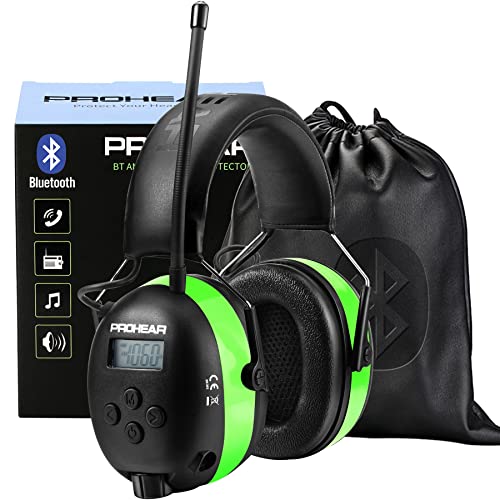
The PROHEAR 033 is the long-session pick: an electronic muff with Bluetooth and an AM/FM radio, powered by a rechargeable 2000 mAh battery, so a day of milling, sanding and glue-ups passes with music or talk radio instead of repeated trips to take your protection off. Its listing states a 31 dB SNR and a 25 dB NRR, a mid-pack rating that covers most shop machines with some margin. The cups are full-size rather than slim, which is the honest trade for the electronics inside: glasses still fit under the cushions, but thin wire frames pair more comfortably with this muff than thick acetate arms do.
Specs
- Noise Reduction Rating: 25 dB
- Single Number Rating: 31 dB
- Connectivity: Bluetooth and AM/FM radio
- Battery: Rechargeable 2000 mAh
- Type: Electronic over-the-head earmuff
- Weight: not stated
Best for: Long shop days where radio or Bluetooth keeps protection on instead of off.
Watch out for: Its full-size cups press more than the slim picks, so expect thick temple arms to make themselves felt over a full day.
ASIN: B07YSH8QL9
Which One Fits Your Situation
You Wear Prescription Glasses All Day
Start with the ProCase. Its thickened cushions give your temple arms room to settle in, and its 28 dB rating leaves margin for the small leak frames cause. If your frames are thin and wire-style, the Walker’s Razor Slim Passive is the lighter alternative: its slim cup presses less, and the wire frame headband spreads what pressure there is over the whole session.
You Only Put Safety Glasses On at the Machine
The Walker’s Razor Slim Passive suits the on-and-off rhythm of machine work. It folds flat beside the saw, goes on in one motion and has no batteries to check before a cut. Settle the cushions over your safety glasses once, make the cut, and hang the muff up again; the slim cup means the frames are less likely to get knocked askew each time you repeat that cycle.
You Work With a Helper or Teach in the Shop
Choose the Walker’s Razor Slim Electronic. Its microphones pass voices through at safe levels, so instructions and warnings reach you without lifting a cup and breaking the seal around your glasses. The slim cups keep the same glasses-friendly profile as the passive version. Just respect the 23 dB rating and step up to a stronger passive muff for long planing runs.
You Spend Whole Days at Loud Machines
The PROHEAR 033 earns its place when the session, not the single cut, is the problem. Radio and Bluetooth give you a reason to leave protection on through milling, sanding and cleanup, and the rechargeable battery removes the battery-swap excuse. Its 25 dB rating covers most shop machines; for extended jointer or planer work, its full-size cups still trail the ProCase on pure rating.
Common Mistakes
- Trusting the printed NRR while a temple arm holds the cushion open and leaks sound straight past it.
- Choosing the bulkiest high-rated cup, then pushing your glasses off your nose every time you lean over the bench.
- Stacking a cap, glasses and earmuffs until the combined pressure breaks the seal you were trying to protect.
- Leaving flattened, worn-out cushions in place for years instead of replacing them when the foam stops springing back.
- Yanking muffs off between every cut to hear speech, instead of picking an electronic model that passes voices through.
Frequently Asked Questions
Why do earmuffs protect less when I wear glasses?
The rating is measured with the cushion sealed directly against bare skin. A temple arm props the cushion a few millimeters open, and sound takes that gap like any other opening. Slim cups and deep, soft cushions reduce the leak by closing around the arm, which is why this roundup favors those designs over headline numbers alone.
Is a 23 dB electronic muff enough for a thickness planer?
It depends on the machine and the session length. A planer is among the loudest tools in a home shop, and a 23 dB rating leaves the least margin here once glasses cost you some seal. For short planing passes it can serve, but for long milling sessions the higher-rated passive picks are the safer match.
Can I wear earplugs under my earmuffs?
Yes, and for the loudest machines it is a sensible pairing, because plugs sit in the ear canal where glasses cannot interfere with them at all. The combination adds protection beyond either device alone, though not the full sum of both ratings. It also makes voices harder to hear, so save double protection for planing, jointing and routing rather than the whole day.
How can I tell whether the seal is holding with my frames on?
Put the muffs on over your glasses, then press each cup gently and listen: a good seal feels even all the way around, with no single spot where the temple arm tents the cushion up. If one side feels propped open, reseat that cushion so the foam settles behind the arm, or switch to a deeper cushion design like the ProCase.
Related guides
More from Amazon
Programs that pair well with the guide above. Offers and eligibility are set by Amazon and may change.
A free business account with business pricing and bulk-buying tools for work, shop or home office.
Create a business accountFree shipping on eligible items, Prime Video and more. Eligible new members can start with a free trial.
Start a Prime free trialAudiobooks and podcasts to listen to on the go. Eligible new members can start with a free trial.
Try Audible freeAd-free music streaming. Eligible new subscribers can start with a free trial.
Try Music Unlimited freeAs an Amazon Associate we earn from qualifying purchases.