What's inside
As an Amazon Associate I earn from qualifying purchases. This post may contain affiliate links at no extra cost to you.
The real choice: quick access or controlled rewind
A wall hook is a place to hang a cord. A cord reel is a way to store and deploy one. That difference matters most in a busy shop, where a cable left across a walkway can snag a cart, catch a boot, or get run over. For a short extension cord used occasionally, a hook is usually enough. For a long cord that gets pulled out and put away several times a day, a reel can save time and keep more cable off the floor.
Neither option makes an undersized or damaged cord safe. Check the cord’s rating against the tool, its length, and the reel’s instructions. Reels can trap heat when a cord is left coiled under heavy load, so follow the manufacturer’s limits on using it wound up. If a tool draws substantial current, uncoil the cord unless the reel specifically allows operation while wound.
As an Amazon Associate we earn from qualifying purchases at no extra cost to you.



When wall hooks are the better buy
Hooks are cheap, simple, and hard to break. They work well for a handful of cords that are used now and then, especially when each cord has its own labeled spot near the tool or outlet where it is used. A large hook or rounded cord hanger is kinder to the jacket than a narrow nail or sharp screw, which can create a permanent kink or cut through insulation over time.
Coil the cord in broad loops rather than wrapping it tightly around your elbow. A loop roughly 12 to 18 inches across is manageable for many shop cords, though thicker or longer cables need more room. Secure the coil with a reusable strap, then hang it so the plug is not bearing the cord’s full weight. Before storing, inspect for crushed sections, cuts, loose plugs, and heat damage.
The main failure mode is poor winding. A loose coil can slide off, and a tight bundle can tangle when pulled free. Hooks also do little to control a cord while it is in use. If the cord must cross a walking route, use a safer route overhead or along a wall where possible; don’t assume that neat storage solves an in-use trip hazard.
When a cord reel earns its space
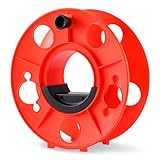
A reel is useful when one cord sees frequent use and a clear path can be planned from the reel to the work area. A retractable unit makes cleanup quick; a manual reel is simpler and often less expensive. For shop use, compare the cord length and gauge, electrical rating, mounting method, reel capacity, and any stated limits on use while wound. A longer cord is not automatically better: extra length adds resistance and creates more cable to manage.
Retractable reels have moving parts and a spring that can fail or retract the cord too fast. Guide the cord back instead of letting it snap in, and keep fingers away from the winding path. A reel mounted too high can be awkward to pull and may swing; one mounted too low can leave a loop at ankle height. Place it where the cord reaches the work without stretching across a door, machine path, or dust-collection hose.
For a fixed work area, consider a heavy-duty extension cord reel sized for the cord and load you actually use. Check the reel’s label and manual rather than relying on a broad “heavy-duty” description. Some reels include an outlet block or circuit breaker; those features do not replace checking the cord rating or using a properly protected circuit.
Hooks vs. reels at a glance
| Factor | Wall hooks | Cord reel |
|---|---|---|
| Upfront cost | Low; simple hangers are inexpensive | Higher, especially for retractable units |
| Best use | Occasional use and several different cords | Frequent use of one cord in a defined area |
| Put-away time | Requires coiling and hanging | Fast; retractable models wind the cord in |
| Common problem | Tangles, loose coils, or jacket damage from a sharp hook | Spring or guide wear, poor mounting, or overheating if misused |
| Installation | Usually straightforward, but mount to a stud or suitable backing | Needs a secure mount and a useful cord path |
| Flexibility | Easy to rearrange as storage needs change | Fixed position can limit where the cord reaches |
Mounting and routing matter more than the mechanism
Mount a hook or reel to a wall stud, solid blocking, or another support rated for the load. Don’t rely on drywall alone for a heavy reel that will be tugged repeatedly. If mounting overhead, confirm the hardware and structure can hold the unit, and keep it clear of lights, garage-door tracks, and dust pipes. A reel that pulls at an angle may bind or wear its guide faster.
Plan the route with the cord fully extended before drilling. Make sure it reaches the farthest intended work position without putting tension on the plug. Keep cord paths away from sharp sheet-metal edges, hot equipment, rotating shafts, and places where stock or carts will crush the jacket. If you need to cross a floor temporarily, a rated cord protector is more appropriate than a loose cable; for frequent crossings, change the layout instead.
For a few cords, a wall-mounted extension cord hanger is a sensible low-cost choice. Choose a smooth, wide support and leave enough space for the coil to come off without dragging over sharp edges. Labels help when several cords look alike, particularly if some are rated for lighter loads than others.
Choose for the way the shop runs
Buy hooks if you store multiple cords, use them only occasionally, or want a low-cost system that is easy to move. Spend more on a reel when one cord is used repeatedly at a predictable station and the time spent coiling it is a real nuisance. If you’re unsure, start with hooks: they are inexpensive, and you can add a reel later at the station that proves it needs one.
Whichever setup you choose, retire a cord with exposed conductor, a split jacket, a loose plug, or repeated overheating. Storage is not a repair, and a reel should never be used to conceal damage. Keep cords dry, visible, and out of traffic; good storage makes inspection easier as well as cleanup faster.