What's inside
As an Amazon Associate I earn from qualifying purchases. This post may contain affiliate links at no extra cost to you.
A clamp rack should make the right clamp easy to grab without turning the wall into a crowded pile. Before buying or building one, count your clamps by type and measure the longest pair. A rack that holds 20 short F-style clamps may be useless for four 48-inch pipe clamps if the rails are too short or the mounting is weak.
As an Amazon Associate we earn from qualifying purchases at no extra cost to you.


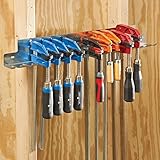
Choose a rack by clamp type
F-style and bar clamps store well on horizontal arms or slotted rails, with the bars hanging down and handles kept clear of one another. Pipe clamps are heavier and can be awkward to lift, so they benefit from deeper, sturdier supports. Spring clamps and small hand clamps can go in bins or on pegs; they do not need the same rack as long bar clamps.
Measure the clamp’s full length and the space needed to lift it off the rack. For a 48-inch clamp, allow roughly 52–54 inches of usable rail length so the end hardware does not crowd the edges. Leave about 3 inches between neighboring handles as a starting point, then adjust for bulky trigger grips or clamps with swiveling pads.
Rack options at a glance
| Rack type | Best for | Advantages | Limitations |
|---|---|---|---|
| Wall-mounted horizontal arms | F-style and bar clamps | Simple, visible, uses little floor space | Needs solid mounting; clamps can overlap if crowded |
| Wall-mounted pipe-clamp rack | Pipe clamps and heavier bar clamps | Supports weight close to the wall | Often less flexible for mixed clamp shapes |
| Freestanding rack or cart | Large collections or rented shops | Moveable; avoids wall installation | Takes floor space and can tip if overloaded high |
| DIY wood rack | Small budgets and custom layouts | Easy to size for your own clamps | Build quality and capacity depend on the mounting |
Wall racks: the practical default
For most small shops, a wall rack is the best starting point. Commercial wall-mounted woodworking clamp racks are compact and quick to install. Check the arm spacing and maximum clamp length rather than relying on a stated clamp count: capacity claims may assume narrow clamps arranged tightly, which is not how many people actually store them.
Mount the rack into studs or a properly installed plywood backer. Drywall anchors are a poor choice for a loaded rack: repeated lifting can loosen them even when the initial static weight seems modest. If the rack has two mounting points, use both, and check that the screws are long enough to get solid purchase in the stud after passing through the rack and any backer.
Keep the rack at a height where you can remove a clamp without lifting it over your head. A heavy 48-inch pipe clamp is manageable at chest height; overhead, it becomes an awkward load that can swing into a nearby tool or your face. Leave a clear landing space below for clamps you are sorting or returning.
Give pipe clamps a sturdy home
Pipe clamps concentrate more weight in a small area than many F-style clamps. A rack with shallow hooks may let them roll or twist, especially when several are stored together. Look for a design that supports the pipe in two places or has a lip that prevents the clamp from walking off. If you use different pipe lengths, store them by length so you can pull one out without dragging its neighbors along.
A dedicated pipe-clamp storage rack is worthwhile when pipe clamps make up a substantial share of your collection. If you only own a few, a stout pair of wall-mounted supports may be enough. Avoid narrow slots that are difficult to use with the clamp’s fixed head still attached.
When a freestanding rack makes sense
A floor rack or cart is useful when wall space is full, you need clamps near an assembly area, or you cannot drill into the shop walls. Before buying, check the base width and how the rack is meant to be loaded. Put the heaviest clamps low; loading long, heavy clamps high can make a narrow rack unstable. Lockable casters help on a smooth floor, but they do not compensate for a top-heavy design.
Freestanding storage also consumes working space. Measure the footprint with the longest clamps installed and account for the clearance needed to lift them out. A rack that fits between benches on paper may block a walkway once clamps project past its frame. Keep routes and exits clear, and do not use a mobile rack as a substitute for a bench or sawhorse.
A simple DIY rack can be enough
If you have basic tools and a small collection, a wood rack is inexpensive and easy to tailor. A plywood backer fixed to studs can carry a pair of hardwood or construction-lumber arms; add a small raised edge to keep bars from rolling. Sand the contact surfaces so clamps do not catch, and round sharp corners that might snag sleeves or hoses.
Do not guess at the load capacity. Test the rack with the clamps you own, adding weight gradually while watching for flex, loose screws, or movement at the wall. If an arm bends noticeably or a fastener shifts, unload it and reinforce the mounting before use. A cheap homemade rack is fine when it is securely fastened and easy to inspect; it is not a bargain if it relies on a couple of short screws into drywall.
Check fit, access, and shop conditions
Before ordering, compare the rack’s dimensions with your longest clamps and the wall space available. Check whether the clamps hang by their bars, pipes, or handles; the wrong orientation can make them hard to remove. For mixed collections, separate racks or zones reduce tangles and make it easier to spot a missing clamp.
Woodworking shops collect dust, so avoid designs with tight, hard-to-clean pockets if they will sit near a sander or saw. Keep clamps away from machine controls, electrical panels, and dust-collection ductwork that needs service access. Whatever rack you choose, return clamps to consistent positions and leave enough room to put them back one-handed. That small bit of order is more useful than a rack advertised to hold the most clamps.