Key takeaways
- Find the best oil-lubricated shop air compressors for pneumatic tool stations, with sustained airflow, two-stage pumps and large tanks for steady shop work.
What's inside
As an Amazon Associate I earn from qualifying purchases. This post may contain affiliate links at no extra cost to you.
Key takeaways
- A two-stage, oil-lubricated compressor with a 60-gallon or larger tank and strong airflow at 90 PSI keeps a pneumatic tool station running without long pauses for recovery.
A pneumatic tool station lives or dies on sustained airflow. Nailers, impact wrenches, sanders and spray guns each draw air in a different pattern, and a compressor that only keeps up in short bursts will leave tools waiting while the tank refills. Oil-lubricated pumps handle this kind of work well because the oil film keeps the pump cool and reduces wear over long sessions, which is why most fixed shop compressors use them.
The five compressors below all use oil-lubricated pumps and hold at least 60 gallons of air. They differ in airflow, pump design and tank size, so the right pick depends on how many tools run at once and how much air the hungriest tool needs at working pressure. Match the compressor to the tool with the highest airflow demand, and the rest of the station will follow.
Quick Picks
As an Amazon Associate, we earn from qualifying purchases.
| Product | Best for | Key spec |
|---|---|---|
| DeWALT DXCMV5048055 | Large stations with several tools running at once | 80-gallon tank, 17.9 CFM at 100 PSI |
| Quincy QT-54 | Steady high-pressure air all day | 60-gallon tank, 15.2 CFM at 175 PSI |
| DeWALT DXCM603.COM | High airflow in a lighter 60-gallon unit | 14.6 SCFM at 90 PSI, 237 lb |
| Ingersoll Rand 2340L5-V | Heavy pneumatic work with high-pressure tools | 14.3 CFM at 90 PSI, 175 PSI max |
| Ingersoll Rand SS3L3 | Smaller stations that still want a fixed 60-gallon tank | 11.3 CFM at 90 PSI, 300 lb |
How to Choose
Sustained airflow at working pressure
The airflow figure that matters is the one at the pressure your tools actually use, usually 90 PSI. Compare every compressor on that figure, not on tank size or horsepower alone. A unit that delivers 14 CFM at 90 PSI will keep a sander or a spray gun fed far longer than one that delivers 11 CFM, even if the tanks are the same size. Add up the airflow of the tools that run at the same time, then pick a compressor that clears that total with room to spare.
Two-stage or single-stage
Two-stage pumps compress air in two steps, which lets them reach higher maximum pressure and run cooler at that pressure. They suit stations where tools need 150 PSI or more, or where the compressor runs for long stretches. Single-stage pumps are simpler and lighter, and they work well when the station runs at 135 PSI or below and the tools cycle on and off. For a busy station, two-stage is usually the safer choice.
Tank size and recovery time
A larger tank stores more air, so the motor cycles less often and tools see steadier pressure between cycles. An 80-gallon tank gives a station noticeably longer run time between motor cycles than a 60-gallon tank at the same airflow. But tank size cannot fix a pump that is too small: if the pump cannot match the tools, even a large tank will drain and the station will wait for recovery. Size the pump first, then let the tank add breathing room.
Pump life and duty cycle
Oil-lubricated cast-iron pumps are built for long service, and the pump life figure on the listing is a useful way to compare them. A pump with a long stated service life and a continuous duty cycle is made to run through a full workday without a forced cool-down. Check the duty cycle on the listing: a continuous-duty pump keeps up with a station that runs tools back to back, while a pump with a limited duty cycle needs rest breaks built into the day.
The 5 Best Options
1. DeWALT DXCMV5048055
OUR TOP PICK
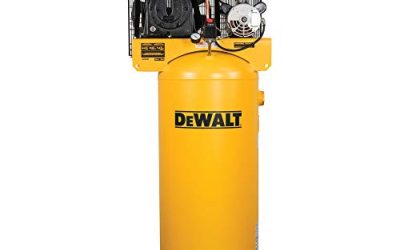
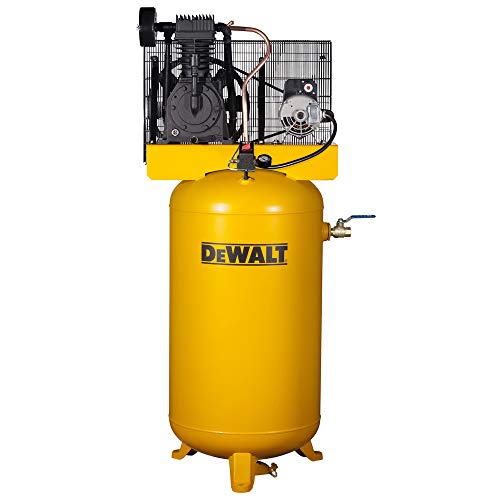
The DXCMV5048055 is the largest compressor in this guide, and it earns the top spot on sheer capacity. Its 80-gallon tank and two-stage pump deliver 17.9 CFM at 100 PSI and 17.0 CFM at 175 PSI, which is enough airflow to feed several pneumatic tools at once without the station stalling. The cast-iron, oil-lubricated pump is built for continuous use, so it suits a station that runs tools through a full workday.
At 470 lb, this is a fixed installation, not a unit that moves around the shop. It needs a 230V circuit and a permanent spot with room for airflow around the pump and for draining the tank. For a station that anchors the shop and feeds a full set of tools, that trade is worth it.
- Specs:
- Tank: 80 gallons
- Motor: 5 HP, 230V
- Airflow: 17.9 CFM at 100 PSI, 17.0 CFM at 175 PSI
- Maximum pressure: 175 PSI
- Pump: cast-iron, oil-lubricated, two-stage
- Weight: 470 lb
- Duty: continuous use
- Best for: large stations with several tools running at once
- Watch out for: the weight and fixed installation; confirm the airflow figures on the live listing, since a second source lists lower figures for this model
2. Quincy QT-54

The QT-54 pairs a 60-gallon tank with a four-cylinder V two-stage pump that is splash-lubricated, a design Quincy backs with a 30,000-hour pump life. Its Baldor 5 HP motor runs on 230V and the pump delivers 15.2 CFM at 175 PSI on a continuous duty cycle, which makes it a strong match for stations that hold high pressure all day.
This compressor is aimed at shops that treat air as a utility: it runs, it recovers, and it keeps running. The weight is around 430 lb, so plan a fixed spot near the tool station with a clear path for the power feed and the air line.
- Specs:
- Tank: 60 gallons
- Motor: 5 HP Baldor, 230V
- Airflow: 15.2 CFM at 175 PSI
- Pump: four-cylinder V two-stage, splash-lubricated
- Pump life: 30,000 hours
- Duty: continuous duty
- Weight: about 430 lb
- Best for: steady high-pressure air all day
- Watch out for: no published airflow figure at 90 PSI on the listing, so compare it on the 175 PSI figure
3. DeWALT DXCM603.COM

The DXCM603.COM packs 14.6 SCFM at 90 PSI into a 60-gallon unit that weighs 237 lb, which is far lighter than the other 60-gallon compressors in this guide. Its 5 HP motor runs on 208 to 230V and the tank holds 175 PSI maximum pressure, so it covers the same high-pressure work as the heavier units while being easier to place in the shop.
That lighter weight makes it a good fit for a station that may move when the shop layout changes. The airflow at 90 PSI is strong enough for sanders and spray guns as well as nailers, which is the combination most pneumatic stations need.
- Specs:
- Tank: 60 gallons
- Motor: 5 HP, 208 to 230V
- Airflow: 17 SCFM at 40 PSI, 14.6 SCFM at 90 PSI
- Maximum pressure: 175 PSI
- Weight: 237 lb
- Best for: high airflow in a lighter 60-gallon unit
- Watch out for: check current availability on the listing before ordering
4. Ingersoll Rand 2340L5-V

The 2340L5-V is a two-stage unit built around the cast-iron Type-30 pump, a long-running design in Ingersoll Rand’s shop lineup. Its 5 HP motor runs on 240V, the 60-gallon tank holds 175 PSI maximum pressure, and the pump delivers 14.3 CFM at 90 PSI on a continuous duty cycle. That combination suits stations where high-pressure tools run for long stretches.
At 435 lb it is a fixed unit, and it belongs near the station it feeds so the air line stays short and pressure loss stays low. The two-stage pump runs cooler at high pressure than a single-stage pump of the same size, which helps when the station works through a long day.
- Specs:
- Tank: 60 gallons
- Motor: 5 HP, 240V
- Airflow: 14.3 CFM at 90 PSI
- Maximum pressure: 175 PSI
- Pump: two-stage cast-iron Type-30
- Duty: continuous duty
- Weight: 435 lb
- Best for: heavy pneumatic work with high-pressure tools
- Watch out for: recent checks show it ships on lead time, so confirm timing on the listing
5. Ingersoll Rand SS3L3

The SS3L3 is the smallest compressor in this guide, and it suits a station that wants a fixed 60-gallon tank without the weight and power draw of a 5 HP unit. Its 3 HP motor runs on 230V, the single-stage cast-iron pump is oil-lubricated, and it delivers 11.3 CFM at 90 PSI with a 135 PSI maximum pressure on a continuous duty cycle.
At 300 lb it is still a fixed unit, but it is the easiest of the five to place. The lower airflow means it fits stations where tools run one at a time or cycle on and off, rather than stations where a sander and a spray gun run together.
- Specs:
- Tank: 60 gallons
- Motor: 3 HP, 230V
- Airflow: 11.3 CFM at 90 PSI
- Maximum pressure: 135 PSI
- Pump: single-stage cast-iron, oil-lubricated
- Duty: continuous duty
- Weight: 300 lb
- Dimensions: 20 x 23 x 66 in
- Best for: smaller stations that still want a fixed 60-gallon tank
- Watch out for: lower airflow and lower maximum pressure than the two-stage units here; recent checks show it ships on lead time
Which One Fits Your Situation
A station with several tools running at once
Pick the DeWALT DXCMV5048055. Its 80-gallon tank and 17.9 CFM at 100 PSI give the station the most stored air and the most sustained airflow in this guide, so two or three tools can run together without the tank draining.
A station built around framing and roofing nailers
Pick the DeWALT DXCM603.COM or the Quincy QT-54. Nailers draw air in short bursts, so recovery speed and high maximum pressure matter more than raw airflow. Both units hold 175 PSI and recover quickly, and the DeWALT is the lighter of the two to place.
A station with sanders, grinders and spray guns
Pick the Ingersoll Rand 2340L5-V or the DeWALT DXCMV5048055. These tools draw air continuously, so they need the highest sustained airflow at 90 PSI. The 2340L5-V delivers 14.3 CFM at 90 PSI and the DeWALT delivers even more, which keeps continuous-draw tools fed.
A smaller station with lighter, intermittent use
Pick the Ingersoll Rand SS3L3. Its 3 HP motor and 11.3 CFM at 90 PSI cover one tool at a time, and its 135 PSI maximum pressure is enough for nailers and blow-off work. It is the lightest fixed unit here, which makes placement simpler.
Common Mistakes
- Buying on tank size alone and ignoring the airflow figure at 90 PSI, which is what actually feeds the tools.
- Matching the compressor to the smallest tool instead of the hungriest one, so the station stalls when the sander or spray gun begins.
- Putting a 230V or 240V compressor on a circuit that cannot carry it, then finding the breaker trips under load.
- Skipping oil level checks on an oil-lubricated pump, which shortens pump life faster than any other oversight.
- Running a long air line from a compressor placed far from the station, which drops pressure before the air reaches the tools.
Frequently Asked Questions
What does oil-lubricated mean for a shop compressor?
It means the pump uses oil to lubricate its moving parts and to carry heat away from the pump. Oil-lubricated pumps run cooler and usually last longer than oil-free pumps of the same size, which is why they are common in fixed shop compressors. They need regular oil level checks and oil changes on the schedule in the manual.
How much airflow does a pneumatic tool station need?
Add up the airflow figures of the tools that run at the same time, all measured at 90 PSI, and pick a compressor that clears that total. A station with one nailer needs far less than a station where a sander and a spray gun run together. When in doubt, pick the compressor with more airflow at 90 PSI rather than more tank capacity.
Is a two-stage compressor always better than a single-stage unit?
Not always. Two-stage pumps reach higher maximum pressure and run cooler at that pressure, which helps busy stations and high-pressure tools. A single-stage pump is simpler and lighter, and it works well when the station runs at 135 PSI or below and the tools cycle on and off. Match the pump to the pressure the tools need.
How often should the oil be changed?
Follow the schedule in the manual for the specific model. As a rule, check the oil level before each session and change the oil on the interval the manual states, which is usually measured in running hours. A compressor that runs every day needs oil changes far more often than one that runs once a week.
Final Thoughts
For a pneumatic tool station, sustained airflow at 90 PSI is the figure that decides everything else. The DeWALT DXCMV5048055 leads this guide on capacity, the Quincy QT-54 and Ingersoll Rand 2340L5-V lead on long-duty high-pressure work, and the Ingersoll Rand SS3L3 covers smaller stations well. Pick the unit that clears the airflow of the tools that run together, confirm the listing details before ordering, and the station will keep up with the work.
Related guides
- 5 Best Triple-Output Bench Power Supplies for Engineering Workbenches (November 2026)
- 5 Best Quiet Shop Air Compressors for Woodworking Shops (November 2026)
- 5 Best Programmable DC Bench Power Supplies for Engineering Workbenches (November 2026)
- 5 Best Pancake Air Compressors for Woodworking Shops (November 2026)
More from Amazon
Programs that pair well with the guide above. Offers and eligibility are set by Amazon and may change.
A free business account with business pricing and bulk-buying tools for work, shop or home office.
Create a business accountFree shipping on eligible items, Prime Video and more. Eligible new members can start with a free trial.
Start a Prime free trialAudiobooks and podcasts to listen to on the go. Eligible new members can start with a free trial.
Try Audible freeAd-free music streaming. Eligible new subscribers can start with a free trial.
Try Music Unlimited freeAs an Amazon Associate we earn from qualifying purchases.