Key takeaways
- Find the best oil-lubricated shop air compressors for woodworking shops, with long-life cast-iron pumps, large tanks and steady airflow for shop tools.
What's inside
As an Amazon Associate I earn from qualifying purchases. This post may contain affiliate links at no extra cost to you.
Key takeaways
- A 60-gallon, oil-lubricated compressor with a cast-iron pump and strong airflow at 90 PSI gives a woodworking shop long pump life and steady air for nailers, sanders and spray guns.
Woodworking shops run compressors hard: a sander can draw air for an hour without a break, and a spray gun needs steady pressure from the first pass to the last. Oil-lubricated pumps suit that pattern because the oil film keeps the pump cool and cuts wear over long sessions, and cast-iron pumps are built for years of daily use. A 60-gallon tank is the usual size for a fixed shop compressor, since it stores enough air to smooth out the peaks between tool cycles.
The five compressors below all use oil-lubricated cast-iron pumps and hold 60 gallons. They differ in airflow, pump design and duty cycle, so the right pick depends on how many tools run at once and how long the shop runs each day. Match the airflow at 90 PSI to the hungriest tool, and the tank will take care of the rest.
Quick Picks
As an Amazon Associate, we earn from qualifying purchases.
| Product | Best for | Key spec |
|---|---|---|
| DeWALT DXCMV5076055 | A busy shop that runs tools all day | Over 15 CFM at 100 PSI, 65 dB(A) |
| Quincy QT-54 | Steady high-pressure air all day | 60-gallon tank, 15.2 CFM at 175 PSI |
| Ingersoll Rand SS3L3 | A smaller shop that wants a fixed 60-gallon tank | 11.3 CFM at 90 PSI, 300 lb |
| Industrial Air ILA3606056 | Strong airflow with a two-year warranty | 11.5 CFM at 90 PSI, 155 PSI max |
| Campbell Hausfeld VT6395 | A straightforward single-stage shop unit | 10.2 CFM at 90 PSI, 135 PSI max |
How to Choose
Airflow at 90 PSI for shop tools
The airflow figure that matters is the one at the pressure the tools use, usually 90 PSI. A sander or spray gun draws air continuously, so it needs a compressor that can match that draw for as long as the tool runs. Compare every compressor on its 90 PSI figure and add up the tools that run at the same time. A unit that delivers 13 CFM at 90 PSI covers far more than one that delivers 10 CFM, even when the tanks are the same size.
Two-stage or single-stage
Two-stage pumps compress air in two steps, reach higher maximum pressure and run cooler at that pressure. They suit shops where the compressor runs for long stretches or where tools need 150 PSI or more. Single-stage pumps are simpler and usually lighter, and they work well when the shop runs at 135 PSI or below and the tools cycle on and off. For a shop that runs a sander all day, two-stage is usually the safer choice.
Pump life and cast-iron construction
An oil-lubricated cast-iron pump is the long-life choice for a fixed shop compressor, and the pump life figure on the listing is a useful way to compare units. A pump with a long stated service life and a continuous duty cycle is made to run through a full workday. Check the duty cycle too: a continuous-duty pump keeps up with a shop that runs tools back to back, while a pump with a limited duty cycle needs rest breaks built into the day.
Noise and placement
A 60-gallon compressor is a fixed unit, so its noise figure matters every day. The noise figure on the listing, measured in dB or dBA, is the way to compare: a 65 dB(A) unit is far easier to work beside than an 87 dB(A) unit. Place the compressor where the noise bothers the shop least, keep the air line short to limit pressure loss, and leave room around the pump for airflow and for draining the tank.
The 5 Best Options
1. DeWALT DXCMV5076055
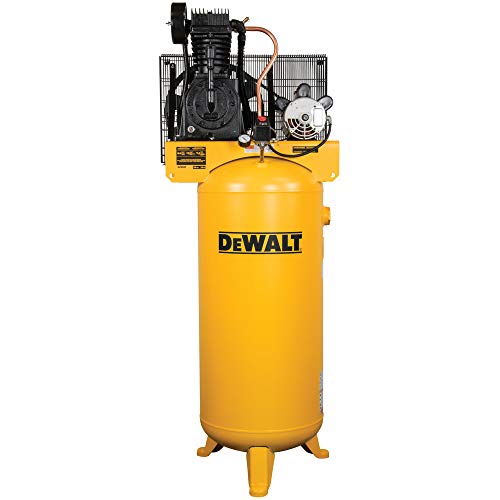
OUR TOP PICK
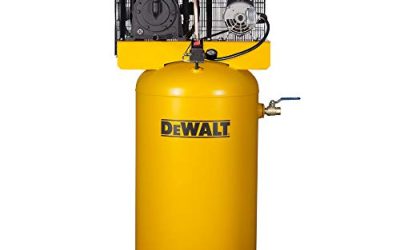
The DXCMV5076055 pairs a 60-gallon tank with a two-stage oil-lubricated pump that delivers more than 15 CFM at 100 PSI and 13.5 SCFM at 175 PSI, with a 175 PSI maximum pressure. Its 5 HP motor runs on 240V, and the unit is listed at 65 dB(A), which is quiet for a compressor of this size. That combination of airflow, pressure and low noise makes it the strongest all-round pick for a woodworking shop.
It suits a shop where the compressor sits near the work and runs through the day. The two-stage pump handles continuous-draw tools such as sanders and spray guns, and the low noise figure means the shop can work beside it without shouting over the pump.
- Specs:
- Tank: 60 gallons
- Motor: 5 HP, 240V
- Airflow: over 15 CFM at 100 PSI, 13.5 SCFM at 175 PSI
- Maximum pressure: 175 PSI
- Pump: two-stage, oil-lubricated
- Noise: 65 dB(A)
- Best for: a busy shop that runs tools all day
- Watch out for: the full listing title was not captured in our check, so confirm the model details on the live listing
2. Quincy QT-54

The QT-54 pairs a 60-gallon tank with a four-cylinder V two-stage pump that is splash-lubricated, a design Quincy backs with a 30,000-hour pump life. Its Baldor 5 HP motor runs on 230V and the pump delivers 15.2 CFM at 175 PSI on a continuous duty cycle, which makes it a strong match for shops that hold high pressure all day.
This compressor is aimed at shops that treat air as a utility: it runs, it recovers, and it keeps running. The weight is around 430 lb, so plan a fixed spot near the tool area with a clear path for the power feed and the air line.
- Specs:
- Tank: 60 gallons
- Motor: 5 HP Baldor, 230V
- Airflow: 15.2 CFM at 175 PSI
- Pump: four-cylinder V two-stage, splash-lubricated
- Pump life: 30,000 hours
- Duty: continuous duty
- Weight: about 430 lb
- Best for: steady high-pressure air all day
- Watch out for: no published airflow figure at 90 PSI on the listing, so compare it on the 175 PSI figure
3. Ingersoll Rand SS3L3

The SS3L3 is the smallest compressor in this guide, and it suits a shop that wants a fixed 60-gallon tank without the weight and power draw of a 5 HP unit. Its 3 HP motor runs on 230V, the single-stage cast-iron pump is oil-lubricated, and it delivers 11.3 CFM at 90 PSI with a 135 PSI maximum pressure on a continuous duty cycle.
At 300 lb it is still a fixed unit, but it is the easiest of the five to place. The lower airflow means it fits shops where tools run one at a time or cycle on and off, rather than shops where a sander and a spray gun run together.
- Specs:
- Tank: 60 gallons
- Motor: 3 HP, 230V
- Airflow: 11.3 CFM at 90 PSI
- Maximum pressure: 135 PSI
- Pump: single-stage cast-iron, oil-lubricated
- Duty: continuous duty
- Weight: 300 lb
- Dimensions: 20 x 23 x 66 in
- Best for: a smaller shop that wants a fixed 60-gallon tank
- Watch out for: lower airflow and lower maximum pressure than the two-stage units here; recent checks show it ships on lead time
4. Industrial Air ILA3606056

The ILA3606056 is a 60-gallon single-stage unit with a cast-iron twin-cylinder oil-lubricated pump. Its 3.7 HP motor runs on 240V and delivers 13.4 CFM at 40 PSI and 11.5 CFM at 90 PSI, with a 155 PSI maximum pressure. It weighs 228 lb, measures 27 x 31 x 70 in and carries a two-year warranty.
It sits between the 3 HP and 5 HP units in this guide on airflow, and its 155 PSI maximum pressure covers more high-pressure work than the 135 PSI units. A recent check showed it in stock, which makes it a practical pick for a shop that wants a 60-gallon unit without stepping up to a 5 HP motor.
- Specs:
- Tank: 60 gallons
- Motor: 3.7 HP, 240V
- Airflow: 13.4 CFM at 40 PSI, 11.5 CFM at 90 PSI
- Maximum pressure: 155 PSI
- Pump: single-stage cast-iron twin-cylinder, oil-lubricated
- Weight: 228 lb
- Dimensions: 27 x 31 x 70 in
- Warranty: 2 years
- Best for: strong airflow with a two-year warranty
- Watch out for: confirm current availability on the live listing before ordering
5. Campbell Hausfeld VT6395

The VT6395 is a straightforward 60-gallon single-stage unit. Its 3.7 HP motor runs on 240V at 15.7A, the cast-iron twin-cylinder pump is oil-lubricated, and it delivers 11.5 CFM at 40 PSI and 10.2 CFM at 90 PSI with a 135 PSI maximum pressure. It weighs 255 lb, runs at 87 dB(A) and carries a one-year warranty.
The duty cycle is 80 percent, which means it needs rest breaks in the day rather than continuous running. It suits a shop where tools cycle on and off and the compressor gets pauses between jobs, rather than a shop where a sander runs for hours without a break.
- Specs:
- Tank: 60 gallons
- Motor: 3.7 HP, 240V, 15.7A
- Airflow: 11.5 CFM at 40 PSI, 10.2 CFM at 90 PSI
- Maximum pressure: 135 PSI
- Pump: single-stage oil-lubricated cast-iron twin-cylinder
- Duty: 80 percent duty cycle
- Noise: 87 dB(A)
- Weight: 255 lb
- Warranty: 1 year
- Best for: a straightforward single-stage shop unit
- Watch out for: the 87 dB(A) noise figure is the loudest here, and the 80 percent duty cycle needs rest breaks
Which One Fits Your Situation
A busy shop that runs tools all day
Pick the DeWALT DXCMV5076055. Its two-stage pump, 175 PSI maximum pressure and 65 dB(A) noise figure cover long days with continuous-draw tools, and it is quiet enough to work beside.
A shop that holds high pressure all day
Pick the Quincy QT-54. Its 30,000-hour pump life, continuous duty cycle and 15.2 CFM at 175 PSI suit a shop that treats air as a utility and runs tools back to back.
A smaller shop with one tool at a time
Pick the Ingersoll Rand SS3L3. Its 3 HP motor and 11.3 CFM at 90 PSI cover one tool at a time, and its 300 lb weight makes it the easiest fixed unit here to place.
A shop that wants strong airflow without a 5 HP motor
Pick the Industrial Air ILA3606056. Its 3.7 HP motor delivers 11.5 CFM at 90 PSI with a 155 PSI maximum pressure and a two-year warranty, which sits between the 3 HP and 5 HP units in this guide.
Common Mistakes
- Buying on tank size alone and ignoring the airflow figure at 90 PSI, which is what actually feeds the tools.
- Matching the compressor to the smallest tool instead of the hungriest one, so the shop stalls when the sander or spray gun begins.
- Running a pump with a limited duty cycle as if it were continuous-duty, which shortens pump life.
- Skipping oil level checks on an oil-lubricated pump, which shortens pump life faster than any other oversight.
- Placing a loud compressor next to a bench where fine work happens, instead of placing it where the noise bothers the shop least.
Frequently Asked Questions
Why choose oil-lubricated for a woodworking shop?
Oil-lubricated pumps run cooler and usually last longer than oil-free pumps of the same size, which matters when a sander or spray gun draws air for long stretches. The trade is maintenance: the pump needs regular oil level checks and oil changes on the schedule in the manual, and the air line needs a filter if the air feeds a spray gun, since oil mist can mark a finish.
How much airflow does a woodworking shop need?
A finish nailer needs only a small airflow, while a random orbital sander or a spray gun can need several CFM at 90 PSI on a continuous basis. Add up the tools that run at the same time and pick a compressor that clears that total at 90 PSI. For most shops, 11 to 13 CFM at 90 PSI covers a sander and a nailer together.
Is a two-stage compressor always better than a single-stage unit?
Not always. Two-stage pumps reach higher maximum pressure and run cooler at that pressure, which helps busy shops and high-pressure tools. A single-stage pump is simpler and lighter, and it works well when the shop runs at 135 PSI or below and the tools cycle on and off. Match the pump to the pressure the tools need.
How often should the oil be changed?
Follow the schedule in the manual for the specific model. As a rule, check the oil level before each session and change the oil on the interval the manual states, which is usually measured in running hours. A compressor that runs every day needs oil changes far more often than one that runs once a week.
Final Thoughts
For a woodworking shop, the DeWALT DXCMV5076055 leads this guide on airflow, pressure and low noise, the Quincy QT-54 leads on long-duty high-pressure work, and the Industrial Air ILA3606056 covers the middle ground well. Pick the unit that clears the airflow of the tools that run together, confirm the listing details before ordering, and keep the oil topped up so the pump lasts.
Related guides
- 5 Best Triple-Output Bench Power Supplies for Engineering Workbenches (November 2026)
- 5 Best Quiet Shop Air Compressors for Woodworking Shops (November 2026)
- 5 Best Programmable DC Bench Power Supplies for Engineering Workbenches (November 2026)
- 5 Best Pancake Air Compressors for Woodworking Shops (November 2026)
More from Amazon
Programs that pair well with the guide above. Offers and eligibility are set by Amazon and may change.
A free business account with business pricing and bulk-buying tools for work, shop or home office.
Create a business accountFree shipping on eligible items, Prime Video and more. Eligible new members can start with a free trial.
Start a Prime free trialAudiobooks and podcasts to listen to on the go. Eligible new members can start with a free trial.
Try Audible freeAd-free music streaming. Eligible new subscribers can start with a free trial.
Try Music Unlimited freeAs an Amazon Associate we earn from qualifying purchases.