4 Best MIG Welders for New Welders (November 2026)
Find the best mig welder for beginners: simple 120V machines, flux-core and gas MIG picks, setup ease, and the safety basics every new welder needs at home.
Find the best mig welder for beginners: simple 120V machines, flux-core and gas MIG picks, setup ease, and the safety basics every new welder needs at home.
As an Amazon Associate I earn from qualifying purchases. This post may contain affiliate links at no extra cost to you.
A first MIG welder should make learning to weld easier, not harder, and that means simple controls, a forgiving arc, and a machine that runs on a standard household outlet. MIG welding suits beginners because the wire feeds automatically and the arc stays steady once the settings are close, so a new welder can lay a decent bead on the first day instead of fighting the machine. The right starter machine also grows with you, handling thicker steel as your projects get bigger and new processes as your skills grow.
This guide covers four beginner-friendly MIG welders that run on 120 volts, from a light flux-core unit to a multi-process machine that adds stick and DC TIG later. The four machines below were picked from the names and specifications on their Amazon listings. Compare the amperage range, the weight, and whether the machine needs shielding gas before choosing, and how much the full setup weighs.
Quick Picks
As an Amazon Associate we earn from qualifying purchases
Product
Best for
Key spec from title
Hobart Handler 140
First full-size MIG
115V wire feed welder
Lincoln Electric Weld-Pak 90i
Lightest starter machine
120V portable welder
Forney Easy Weld 140 FC-i
Gas-free flux-core welding
140 amp flux-cored welder
Lincoln Electric Power MIG 140MP
Multi-process growth
MIG, stick, and DC TIG
How to Choose
Start with 120-volt power
Every welder in this guide runs on a standard 120-volt household outlet, which keeps the first setup simple and avoids wiring a new circuit. Check the outlet rating on your circuit, since a 140-amp machine draws close to the limit of a 20-amp breaker at full output. A machine with a 20-amp to 15-amp adapter, like the Forney, helps when only a standard outlet is nearby. Plan the work area near the outlet, use a short heavy extension cord only when the manual allows it, and keep the circuit free of other large loads while welding. A short, heavy extension cord is safer than a long, light one when the outlet sits far away.
Flux-core or shielding gas
Flux-core wire needs no gas bottle, so it suits outdoor work and first projects where simplicity matters, though it leaves more spatter and slag to clean. Gas MIG with solid wire and a shielding gas bottle gives cleaner beads and less cleanup, and suits indoor work on thin steel and auto body panels. Some machines run both, which lets a beginner start with flux-core and add gas later without buying a second welder. Factor in the gas bottle, regulator, and hose when comparing the real cost of a gas setup against a flux-core-only machine. Ask the supplier about bottle rental or purchase before the first project.
Amperage and material thickness
Amperage decides how thick the steel you can weld in a single pass, so match the range to the projects you plan. A 90-amp machine handles sheet metal and light repairs, while a 140-amp machine reaches quarter-inch mild steel and covers most home and farm jobs. Look for a machine with a clear setting chart or tapped voltage steps, since beginners learn faster when the settings are easy to repeat. A machine that welds thin sheet without burn-through and still reaches thicker plate gives the widest useful range for a first purchase. Practice on scrap of the same thickness before welding the real joint.
Safety gear and setup habits
Welding produces intense ultraviolet light, hot spatter, and fumes, so a proper helmet, gloves, and long sleeves belong in the budget alongside the machine. An auto-darkening helmet helps beginners most, since it lets you see the joint before the arc starts and darkens the instant welding begins. Work in a ventilated area, keep flammable material away from the work zone, and clamp the ground lead to clean bare metal near the joint. Check cables and the torch for damage before each session, and let the machine cool within its duty cycle. Keep a fire extinguisher within reach whenever welding near wood or dry grass.
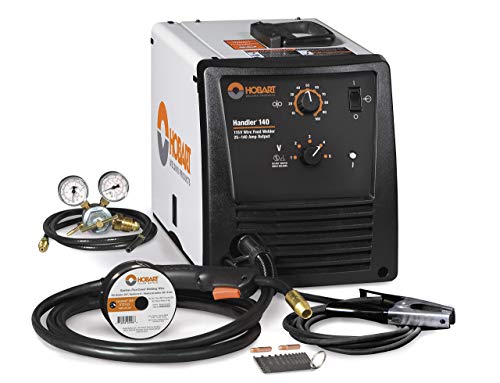
The Hobart Handler 140 is the classic first full-size MIG welder, and it has stayed popular because it does the basics well on a standard 115-volt outlet. It welds up to quarter-inch mild steel, comes with a dual-gauge regulator for gas MIG work, and carries a five-year limited warranty that outlasts most starter machines. At 57 pounds it stays put on a cart but still moves around the shop when needed. It suits beginners who want one machine that handles home repairs, farm work, and auto projects without outgrowing it in the first year. A cart and a gas bottle turn it into a complete home welding station.
The Lincoln Weld-Pak 90i is the lightest starter machine here, built around portability with a shoulder strap and a protective metal case. It runs on 120 volts and handles MIG and flux-core wire, so a beginner can carry it to a repair, weld, and pack it away in the case. The small size suits sheet metal, light repairs, and hobby projects, while the Lincoln name brings a support network and consumables that are easy to find. It is the pick for welders who value light weight and simple setup over maximum thickness. The case protects the machine in transport and in storage.
The Forney Easy Weld 140 FC-i keeps starting simple by running flux-cored wire with no gas bottle at all, which suits outdoor repairs and first projects. At 19 pounds it is easy to carry, and the 140-amp output reaches thicker material than the lightest starters. The box includes an 8-foot MIG gun, an 8-foot ground clamp, and a 20-amp to 15-amp adapter for standard outlets. It suits beginners who want to weld outside, on a fence or a trailer, without renting or buying a gas cylinder first. The light weight suits repairs on fences, trailers, and farm gates. Its simple controls help a first-time welder start quickly.
Lincoln Electric Power MIG 140MP Multi-Process Welder
Lincoln Electric Power MIG 140MP Multi-Process Welder
Multi-process MIG, stick, flux-cored, and DC TIG welder
The Lincoln Power MIG 140MP is the growth pick, combining MIG, stick, flux-cored, and DC TIG welding in one 120-volt machine. A beginner can start with simple MIG, then try stick for outdoor repairs or DC TIG for thin steel without buying another welder. The multi-process range runs from 30 to 140 amps for MIG, with DC TIG from 10 to 120 amps and stick from 25 to 90 amps. It suits buyers who want one machine that stays useful as skills grow and projects change. The machine grows with the welder, from first beads to thinner steel work.
Which One Fits Your Situation
First welder for home repairs
Choose the Hobart Handler 140 when the goal is a dependable first machine for general home and farm repairs. Its quarter-inch capacity covers most jobs, the five-year warranty adds confidence, and the gas MIG option keeps beads clean indoors. Set it up on a small cart with the gas bottle secured, and keep a spool of flux-core wire on hand for outdoor fixes where wind would blow shielding gas away. Keep the bottle secured upright.
Welding on the move
Pick the Lincoln Weld-Pak 90i or the Forney 140 FC-i when the welder travels to the work. The 90i suits light repairs and hobby jobs with its case and strap, while the Forney suits outdoor farm and trailer work with its gas-free flux-core setup and light weight. Both run on a standard outlet, so a repair at a friend’s garage or a remote shed needs no special wiring. Both machines pack away quickly after the repair.
Learning several processes
Buy the Lincoln Power MIG 140MP when you expect to move past MIG into stick or DC TIG within the first year. Starting with MIG builds the habit of steady travel speed and torch angle, then stick adds outdoor capability and DC TIG adds thin-steel finesse. Keep the setting chart nearby while learning, and practice each process on scrap before welding a real project. Practice each process on scrap before the real project.
Common Mistakes
Welding on painted or rusty metal without cleaning the joint to bare steel first with a grinder or wire brush.
Setting wire speed and voltage by guesswork instead of using the machine chart printed in the manual.
Skipping the ground clamp or clamping it to painted metal, which starves the arc.
Running flux-core wire with gas settings, or gas MIG without opening the bottle.
Ignoring the duty cycle and welding continuously until the thermal overload trips.
Frequently Asked Questions
Do I need shielding gas to start MIG welding?
No, flux-core wire welds without shielding gas, which is why the Forney in this guide suits beginners who want the simplest start. Gas MIG needs a bottle, regulator, and hose, and it gives cleaner beads with less spatter indoors. Many beginners start with flux-core, then add gas later when they want cleaner results on thin steel or auto body work.
What thickness can a 140-amp MIG welder handle?
A 140-amp machine on 120 volts typically welds mild steel up to about quarter-inch thick in a single pass, which covers most home, farm, and auto repairs. Thinner sheet needs lower settings to avoid burn-through, while thicker plate needs beveling and multiple passes. Check the machine chart for the thickness range and practice on scrap of the same thickness first.
Can a beginner weld aluminum with these machines?
Aluminum needs a spool gun or a push-pull torch and argon shielding gas, and most starter MIG machines need accessories to do it well. The machines in this guide focus on steel, which is the right place to learn torch control and settings. Learn on mild steel first, then add aluminum equipment once the basics feel natural and the budget allows.
How much should I budget beyond the welder itself?
Plan for a helmet, gloves, and protective clothing, plus wire, contact tips, and a gas bottle if you choose gas MIG. A welding cart, an angle grinder for cleaning joints, and a fire extinguisher also belong on the list. The machine is only part of the setup, and the safety gear matters as much as the welder for a beginner.
J
JD's Woodworks Editorial Team
We compare specs, warranty terms, long-term owner feedback and street pricing before anything earns a spot. Rankings are never paid.
Affiliate disclosure. As an Amazon Associate we earn from qualifying purchases at no extra cost to you. Prices accurate as of the date shown.
Miter saw vs table saw: compare crosscuts, rip cuts, accuracy, space, and value to choose the right saw for your shop and your first woodworking projects.
Compare five solar portable generators for shops, campsites, and outages, covering battery size, output, solar charging, outlets, and what to check first.
The best portable CNC machines for small shops and shared spaces, compared by footprint, weight, work area, and setup. Compact benchtop picks for wood, acrylic, and soft metal.
Find the best Penn Industries dust collector on Amazon: the PSI Woodworking DC3XX blower and the DC725 tabletop unit, compared on airflow, pressure, and shop fit.
Compare five large stationary horizontal metal band saws for fabrication shops on cutting capacity, motor, power supply, blade speed, and mitering before buying.
Find the best mortising chisel bits for clean square mortises in this guide: hollow-chisel sets and singles compared by size, shank, steel, and machine fit.
Find the best drill press base for your shop. Compare rolling stands and mobile bases by capacity, footprint, casters, locking, and setup before you buy.
Find the best dewalt planer dw734 blades for your 12-1/2-inch thickness planer. Compare OEM and aftermarket 3-knife sets, steel types, and fit before you buy.



 Lincoln Electric Power MIG 140MP Multi-Process Welder









