Wire Welder vs Arc Welder: Which One Fits Your Shop?
Wire welder vs arc welder compared head to head: wire feed against stick and TIG on beads, thickness, wind and running costs, with a pick for each side.
Wire welder vs arc welder compared head to head: wire feed against stick and TIG on beads, thickness, wind and running costs, with a pick for each side.
As an Amazon Associate I earn from qualifying purchases. This post may contain affiliate links at no extra cost to you.
The naming causes the confusion. Technically, every machine in this article is an arc welder, because all of them melt metal with an electric arc. In everyday shop language, though, the two labels point at different families. A wire welder feeds a continuous spool of wire through a gun, and that wire is both the electrode and the filler metal. An arc welder, as most buyers use the term, means a stick machine: a flux-coated rod clamped in a holder, burned down joint by joint. TIG belongs on the arc side of this comparison too, because its electrode is hand-held rather than spooled.
This guide compares the two families on the things that decide real projects: bead quality, learning curve, metal thickness, working outdoors, and the running costs nobody mentions at checkout. It then names a representative machine for each side, so you can see what the choice looks like in actual hardware.
As an Amazon Associate, we earn from qualifying purchases.
Quick Picks
Our Short List of 3
Editor’s Choice
Wire side: Hobart Handler 140 (500559)
Best for: Home shops that want one wire machine for sheet metal, tubing and light fabrication
Input power: 115 V on a 20 amp household circuit
Output range: 25 to 140 A
Capacity: mild steel up to 1/4 inch, per the listing
Wire feed (MIG and flux-core). A motor pushes wire off a spool, through the gun cable and out of the contact tip. The arc melts the wire and the workpiece together, so filler arrives continuously and the trigger hand does little more than steer and hold a steady travel speed. Solid wire needs shielding gas from a bottle to protect the molten pool. Flux-core wire is hollow and packed with flux; it shields itself as it burns, which removes the bottle but leaves a layer of slag to chip away.
Stick (SMAW). The electrode is a short rod with a flux coating, held in a clamp. The arc melts the rod into the joint while the coating burns into a shielding gas cloud and a slag blanket. When the rod burns short, you stop, swap in a fresh one and strike the arc again. Rods come in many types and diameters, they store for years, and changing the rod changes what the machine can do.
TIG (GTAW). A tungsten electrode makes the arc but does not melt into the joint. Filler rod is fed in by the other hand, a bottle of inert gas shields the pool, and heat is often controlled with a foot pedal. It is the slowest of the three and the most precise, and it sits on the arc side here because nothing is spooled: control lives entirely in your two hands.
Head to Head: Where Each Side Wins
Bead appearance and cleanup. TIG leaves the cleanest bead, with no spatter and nothing to chip. Gas-shielded MIG is close behind. Flux-core and stick both leave slag that must be chipped and brushed before paint, and stick beads take practice to make even.
Learning curve. Wire feed is the easiest route to a sound first weld: hold the gun angle, listen for a steady sizzle, and move. Stick demands control of arc length as the rod shortens, which takes longer to build. TIG asks both hands and often a foot to work independently, so it has the longest road to competence.
Thin metal versus thick metal. Wire feed and TIG handle thin sheet well, because heat is easy to keep low and filler arrives in small, controlled amounts. Stick rods in small diameters exist, but on thin sheet the arc tends to blow through. On thick sections the picture reverses: stick lays down deep-penetrating welds with large rods, and flux-core wire is a strong second.
Wind, rust and paint. This is where the arc side earns its keep. Bottle gas blows away in a breeze, so gas-shielded MIG and TIG suffer outdoors. Flux-core wire and stick carry their shielding with them, and stick in particular tolerates rusty, painted or galvanized surfaces that would contaminate a MIG weld.
Speed over long seams. Wire feed wins production work. The spool keeps the arc running for minutes at a time, while stick stops at every rod change and TIG moves slowly by design.
Aluminum. Neither basic family welds aluminum well out of the box. MIG needs a spool gun and pure argon; TIG needs AC output. A DC-only TIG machine, like the YESWELDER below, cannot TIG weld aluminum at all, which is a limit worth knowing before you buy.
How to Choose
Begin with your typical joint, not your dream project. If most of your work is sheet metal, brackets, exhaust tubing and light frames, wire feed covers it with the least frustration. If your work is thick plate, farm repairs, gates and structural steel, stick is the honest tool.
Be honest about where you weld. A sheltered bench favors gas-shielded processes. A driveway, a fence line or a windy yard pushes you toward flux-core or stick.
Count the running costs, not just the machine. Gas-shielded MIG and TIG need a cylinder, a regulator and refills. Wire feed consumes tips and liners as well as wire. Stick needs only rods and a chipping hammer, which is part of why old stick machines never really leave farms.
Check your power and the duty cycle. A 115 or 120 V machine plugs in anywhere but tops out on thickness. Dual-voltage machines give you household convenience now and full output on a 230 or 240 V circuit later. Duty cycle tells you how many minutes in ten the machine can weld at a given output before it needs to rest; low duty cycle is the hidden limit on many small machines.
Decide whether one box must do everything. Multiprocess machines blur this comparison on purpose: two of the picks below add a second process to their main one. That flexibility is real, but a machine that does three processes usually does its main one best.
Representative Machines for Each Side
Wire side: Hobart Handler 140 (500559)
Top Pick
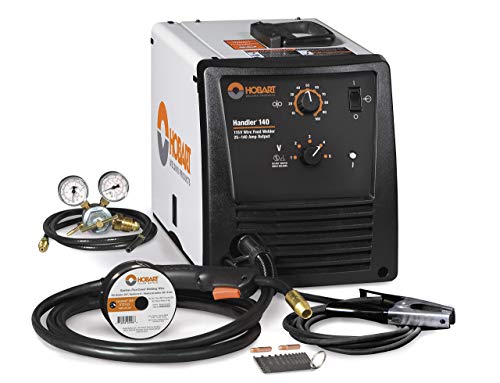
Wire side: Hobart Handler 140 (500559)
Best for: Home shops that want one wire machine for sheet metal, tubing and light fabrication
Input power: 115 V on a 20 amp household circuit
Output range: 25 to 140 A
Capacity: mild steel up to 1/4 inch, per the listing
The Handler 140 is the reference point for household wire feed: a 115 V machine that runs gas-shielded solid wire for clean indoor work and self-shielded flux-core wire when the job moves outside or the bottle runs dry. The listing rates it for mild steel up to 1/4 inch, and the included dual-gauge regulator means the gas setup is in the box rather than on a second shopping list. It is heavy for its class, which is the trade for a conventional, durable build.
Watch out for: The 115 V input caps thickness, and the weight makes it a bench machine rather than a carry-around tool
Wire side: YESWELDER FLUX-135PRO
Runner-Up
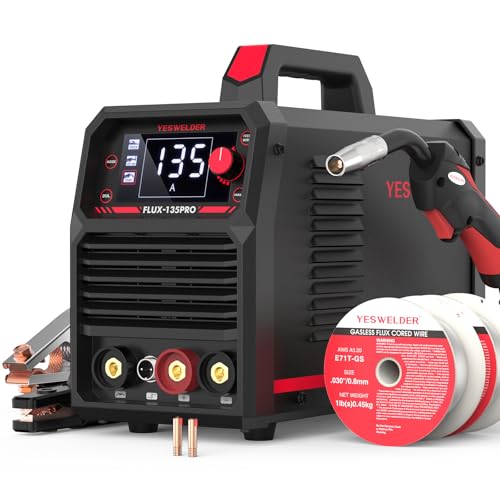
Wire side: YESWELDER FLUX-135PRO
Best for: Outdoor repairs, farm fixes and beginners who want wire welding without gas gear
Input power: 110 V
Output: up to 135 A
Processes: gasless flux-core MIG, stick, lift TIG (torch sold separately)
Wire: 2 lb spools of .030 and .035 inch flux-core wire
This is wire feed stripped to its simplest form: a small inverter that runs gasless flux-core wire only, so there is no cylinder to buy, fill or shelter from the wind. The Amazon listing for this ASIN describes a 135 A machine with a digital display, synergic wire feed control and a bonus spool of wire in the box. The same listing rates it for mild steel up to 3/32 inch, which tells you its lane honestly: light material, repairs and learning, not structural work. It also offers stick mode and lift TIG with a torch sold separately, but flux-core wire is plainly the main event.
Watch out for: Flux-core leaves slag to chip, the finish is rougher than gas MIG, and single-pass capacity is light
Arc side: ESAB MiniArc Rogue ES 180i
Arc side: ESAB MiniArc Rogue ES 180i
Best for: Thick steel, dirty metal, outdoor work and anyone who wants stick welding without an old transformer
Process: stick (SMAW); DC lift-arc TIG with optional torch
Output range: 10 to 180 A
Input power: dual voltage, 120 V and 230 V
Electrodes: up to 5/32 inch, including a dedicated 6010 mode
The Rogue ES 180i shows what a modern stick machine looks like: an inverter the size of a lunchbox that still drives electrodes up to 5/32 inch, with a dedicated mode for fast-freezing 6010 rods, adjustable arc force and arc initiation controls, and power factor correction that makes it friendly to generator power. Dual-voltage input means it runs from a household outlet for light rods and a 230 V circuit for full output. It can also run DC lift-arc TIG with an optional torch, though stick is clearly its purpose.
Watch out for: Stick has the steeper learning curve of the two families, and the TIG torch and gas gear for TIG mode cost extra
Arc side: YESWELDER TIG-205P
Arc side: YESWELDER TIG-205P
Best for: Steel and stainless work where bead appearance and heat control matter, such as tubing, tanks and visible joints
Processes: DC TIG, pulse DC TIG, stick
Input power: 110/220 V dual voltage, auto-sensing
TIG output: 10 to 200 A on 220 V (10 to 160 A on 110 V)
The TIG-205P represents the precision end of the arc family. It combines DC TIG with high-frequency arc ignition, pulse TIG for thin material, and a stick mode for rougher work, in a machine light enough to carry in one hand. Amperage is set digitally, input voltage senses itself between 110 and 220 V, and the pulse controls let you manage heat on thin stainless without warping it. Its one hard limit is chemistry: DC output only, so aluminum TIG is off the table entirely.
Watch out for: No AC output means no aluminum TIG, the foot pedal is sold separately, and TIG is the slowest process here
Which One Fits
Choose wire feed if you mostly weld sheet metal, tubing and light frames, want the shortest learning curve, and work under a roof where shielding gas stays put.
Choose flux-core wire if you like the wire-feed feel but weld outdoors, in wind, or on metal that is not perfectly clean, and you accept slag cleanup.
Choose stick if your work is thick, dirty or far from the shop, and you want the lowest running costs and the toughest tolerance for bad surfaces.
Choose TIG if the welds are visible, the metal is thin, or the joint has to be exactly right, and you are willing to trade speed for control.
Choose a multiprocess machine if your projects genuinely cross over, but judge it by its strongest process, not its longest feature list.
Common Mistakes
Buying by maximum amps alone. A headline number says nothing about duty cycle, and a machine that overheats after two minutes at high output will frustrate you more than a smaller one that runs steadily.
Forgetting the gas bottle in the budget. Gas-shielded MIG and TIG need a cylinder, regulator and refills. Buyers who skip that maths sometimes find the accessories rival the machine.
Choosing flux-core for visible finish work. It is a capable process, but the slag and spatter mean extra cleanup on anything that will be seen or painted.
Expecting DC TIG to weld aluminum. Aluminum TIG needs AC output. No setting on a DC-only machine changes that.
Running a small machine on a shared circuit. A 115 V welder at full output wants a dedicated 20 amp circuit; sharing with lights and tools invites tripped breakers mid-weld.
Judging stick by its oldest machines. Modern inverters like the Rogue above weigh a fraction of an old transformer welder and offer arc controls the old machines never had.
FAQ
Is a wire welder the same thing as a MIG welder?
Almost. MIG is the main wire-feed process, using solid wire and bottled gas. Flux-core is the close relative that feeds a hollow, flux-filled wire and needs no bottle. Both come off a spool, so both count as wire welders, while stick and TIG do not.
Can a stick welder handle thin sheet metal?
Only with difficulty. Small rods at low amps can work in skilled hands, but the arc tends to blow through thin sheet and the heat is hard to meter. Wire feed and TIG both control thin material far more easily, which is why auto body work belongs to them.
Which side is cheaper to run over time?
Stick, by a clear margin. Rods are inexpensive, store indefinitely and need no gas, and the machine itself has few wear parts. Wire feed adds wire, tips and liners, and gas-shielded processes add cylinder costs on top.
Can one machine cover both sides of this comparison?
Yes, multiprocess machines exist, and two picks above already cross the line: the FLUX-135PRO adds stick to a wire machine, and the TIG-205P adds stick to a TIG machine. The compromise is that secondary processes usually get simpler controls than a dedicated machine offers.
Final Verdict
There is no winner here, only a match between process and work. Wire feed is the faster, friendlier route for the thin, clean, indoor welding most home shops actually do, and the Hobart Handler 140 remains the safe benchmark for it. The arc side answers when the metal gets thick, dirty or far from a roof: stick for toughness and low running costs, TIG for precision. Decide by the joints you weld every month, not the one project you might attempt once, and either family will feel like the right purchase.
J
JD's Woodworks Editorial Team
We compare specs, warranty terms, long-term owner feedback and street pricing before anything earns a spot. Rankings are never paid.
Affiliate disclosure. As an Amazon Associate we earn from qualifying purchases at no extra cost to you. Prices accurate as of the date shown.
Miter saw vs table saw: compare crosscuts, rip cuts, accuracy, space, and value to choose the right saw for your shop and your first woodworking projects.
Compare five solar portable generators for shops, campsites, and outages, covering battery size, output, solar charging, outlets, and what to check first.
The best portable CNC machines for small shops and shared spaces, compared by footprint, weight, work area, and setup. Compact benchtop picks for wood, acrylic, and soft metal.
Find the best Penn Industries dust collector on Amazon: the PSI Woodworking DC3XX blower and the DC725 tabletop unit, compared on airflow, pressure, and shop fit.
Compare five large stationary horizontal metal band saws for fabrication shops on cutting capacity, motor, power supply, blade speed, and mitering before buying.
Find the best mortising chisel bits for clean square mortises in this guide: hollow-chisel sets and singles compared by size, shank, steel, and machine fit.
Find the best drill press base for your shop. Compare rolling stands and mobile bases by capacity, footprint, casters, locking, and setup before you buy.
Find the best dewalt planer dw734 blades for your 12-1/2-inch thickness planer. Compare OEM and aftermarket 3-knife sets, steel types, and fit before you buy.


 Arc side: YESWELDER TIG-205P









