As an Amazon Associate I earn from qualifying purchases. This post may contain affiliate links at no extra cost to you.
A wire welder and a stick welder both join steel, but they get there in opposite ways, and the wrong first machine makes learning slower than it needs to be. Wire feeding is the forgiving, fast process that suits thin metal, indoor shop work and clean finished beads. Stick welding is the rugged process that shrugs off wind, rust and thick plate, at the cost of a steeper first week. This comparison walks through the decision by job type, then lines up three wire welders and two stick welders that cover the realistic choices for a home shop or small farm.
Neither process wins outright. The right pick depends on the thickness you weld most, whether you work inside or outside, how dirty your metal is, and how much cleanup you are willing to do. Answer those four questions honestly and the process picks itself; the machines below then narrow down by budget tier and power supply.
As an Amazon Associate, we earn from qualifying purchases.
Quick Picks
Our Short List of 3
Editor’s Choice
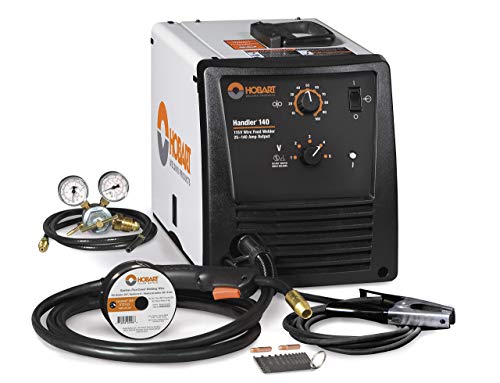
Hobart Handler 140 (500559)
Best for: Home shops wanting one wire welder for fabrication and repair up to 1/4 inch steel
Process: MIG (GMAW) and flux core (FCAW) wire welding
Know what each process actually does. A wire welder feeds a continuous spool of wire through a gun. With solid wire, a bottle of shielding gas protects the puddle; with flux core wire, the wire’s own core makes the shield, so no bottle is needed. A stick welder burns a flux-coated rod held in a stinger. The rod is both filler and shield, it is consumed as you weld, and you stop to swap rods every minute or so. That single mechanical difference drives everything else in this comparison.
Match the process to your metal thickness. Wire welding owns thin material. On auto body panels, exhaust tubing, sheet metal and thin-wall square tube, a small wire machine lets you stitch and pulse without blowing holes, especially with gas shielding. Stick welding owns thick material. A 1/8 inch 7018 rod on a 160 or 200 amp machine will happily join 1/4 inch and heavier plate, brackets and farm implements in a single pass where a household wire welder runs out of heat.
Decide where you will weld. Wind is the wire welder’s enemy when gas shielding is involved: a breeze strips the gas away and leaves porous, weak welds. Flux core wire tolerates outdoor work far better, and stick tolerates it best of all, because the flux shield forms right at the arc. If your welding happens in a driveway, a barn doorway or out on a fence line, stick or flux core should be your default. If you weld at a bench indoors, gas MIG gives the cleanest results of the three.
Be honest about surface condition. Stick rods burn through mill scale, light rust and paint contamination that would defeat a wire arc, which is why stick remains the repair welder’s process. MIG wants clean, ground metal to produce its best beads. Flux core sits in between. For new steel fabrication from clean stock, this matters little. For repairing a rusty trailer or a cracked mower deck, it matters a lot.
Weigh the learning curve. Wire welding is easier to learn: hold the gun at a steady angle, keep a consistent travel speed, and acceptable beads usually arrive on the first day. Stick demands more coordination, because you must feed the rod down as it burns while holding arc length steady, and every rod change interrupts your rhythm. Beginners with thin-metal projects should lean wire. Beginners whose work is thick steel and outdoor repair should accept the stick learning curve, because it is the process their jobs actually need.
Count the cleanup and the consumables. Gas MIG leaves almost no slag, so finished welds need little more than a wire brush. Flux core and stick both leave slag that must be chipped and brushed, and stick adds stub ends and rod storage to the routine; low-hydrogen rods such as 7018 also want dry storage. On the other side of the ledger, stick consumables are simple and compact, while wire welding ties you to spools, contact tips, drive rolls and, for gas MIG, a cylinder that needs refilling and a regulator that must match the wire size.
Check your power supply before the machine. Several machines here run on a household 115 or 120 volt circuit, which caps their output and therefore their thickness range. Dual voltage stick machines deliver their full amperage only on a 240 volt circuit, so a stick welder’s headline number assumes the bigger outlet. Decide which circuits you genuinely have, then compare machines on the output they deliver on that circuit, not on the box’s biggest figure.
Best Options
Hobart Handler 140 (500559)
Top Pick
Hobart Handler 140 (500559)
Best for: Home shops wanting one wire welder for fabrication and repair up to 1/4 inch steel
Process: MIG (GMAW) and flux core (FCAW) wire welding
The Handler 140 is the reference point for household wire welding: a transformer-style 115 volt machine with a 25 to 140 amp range that covers everything from sheet metal to 1/4 inch mild steel in a single pass with flux core wire. It runs solid wire with gas for clean indoor work or flux core wire for outdoor jobs, and the included dual-gauge regulator means the gas setup is complete out of the box.
Five output settings and a smooth wire drive make it easy to dial in, and the 10 foot gun gives reasonable reach around a bench or a vehicle. This is the wire welder to buy when the work is mixed home shop fabrication and repair and you want one machine that handles nearly all of it on a household circuit.
Watch out for: At 57 lb it is a bench machine, not a carry-around tool, and its ceiling on a 115V circuit is real on thick plate
Lincoln Electric Weld-Pak 90i MIG (K5256-1)
Runner-Up
Lincoln Electric Weld-Pak 90i MIG (K5256-1)
Best for: Small, mobile wire welding jobs in thin steel where portability matters more than power
Process: MIG (GMAW) and flux core (FCAW) wire welding
The Weld-Pak 90i is Lincoln’s compact inverter wire welder, built for small jobs that move around: a shoulder strap, a protective metal case and a 120 volt plug make it the wire machine you carry to the work instead of dragging the work to the machine. It welds with solid wire and gas for tidy indoor beads, or with flux core wire when the job is outside.
Output runs from 30 to 90 amps, which honestly limits it to sheet metal, thin tube and light brackets, and that is exactly the work it is meant for. If your welding life is exhaust patches, thin-wall frames, gates and hobby fabrication in thin stock, this size of machine is easier to live with than a full-size unit.
Watch out for: Ninety amps is a hard ceiling; thicker brackets and plate are beyond it, and gas results still suffer outdoors in wind
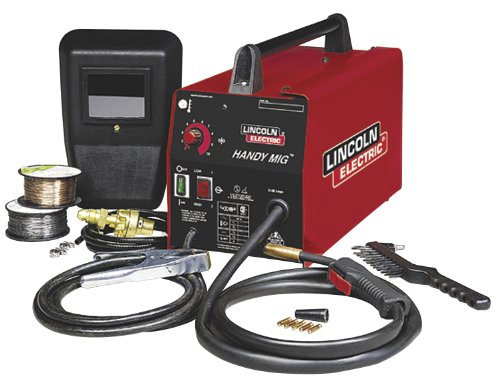
Lincoln Electric Handy MIG (K2185-1)
Lincoln Electric Handy MIG (K2185-1)
Best for: Beginners who want a guided, low-guesswork entry into wire welding on thin steel
Process: MIG (GMAW) and flux core (FCAW) wire welding
The Handy MIG is the simplest wire welder here: four tapped voltage settings, a continuous wire feed speed dial, and a settings chart inside the door that tells you where to set both for each thickness. For a first-time welder, that chart removes most of the guesswork that makes early beads frustrating.
It runs on a 115 volt, 20 amp outlet and welds mild steel up to 1/8 inch, with solid .025 inch wire for gas work and .035 inch flux core for gasless work. The cold contactor keeps the wire electrically cold until the trigger is pulled, a small safety detail that suits a beginner’s bench. It is a convenience welder rather than a power welder, and judged on those terms it does its job well.
Watch out for: Tapped settings give less fine control than a variable voltage machine, and 1/8 inch is the practical limit
Hobart Stickmate 160i (500570)
The Stickmate 160i is the brand-name stick option: a DC inverter machine from Hobart that runs on either 120 or 240 volt input, delivering 20 to 80 amps on the household circuit and the full 20 to 160 amps on 240 volts. DC output gives a smoother, easier arc than the old AC buzz boxes, and the machine handles the common rod sizes used for shop and farm repair.
At 15 lb it carries to the job easily, which is the natural habitat of a stick welder: the broken gate hinge, the cracked loader bracket, the trailer tongue that cannot come to the shop. Its arc ignition assistance helps rods light without repeated striking and sticking, and the build quality and support network are the reasons to choose it over a no-name inverter.
Specs
Process: stick (SMAW), DC output
Input: dual voltage 120/240V
Output range: 20 to 80 amps on 120V, 20 to 160 amps on 240V
Duty cycle: 65 amps at 20 percent on 120V input
Electrodes: 1/16 to 1/8 inch
Weight: 15 lb
Best for: Farm, ranch and shop repairs on thicker or weathered steel, with brand support behind the machine
Watch out for: Full output needs a 240V circuit; on 120V it is a light-duty machine, and stick cleanup and rod changes remain part of the deal
YESWELDER ARC-205DS
YESWELDER ARC-205DS
Best for: Buyers who want maximum stick amperage and dual voltage flexibility in a small inverter package
Process: stick (SMAW), with lift TIG capability using an optional torch
Input: dual voltage 110/220V
Output range: 20 to 205 amps on 220V input
Large LED display with hot start, arc force and anti-stick functions
Buyers who want maximum stick amperage and dual voltage flexibility in a small inverter package
Watch out for
The 205 amp figure needs the 220V circuit, leads and clamp are basic, and published figures for this class of machine are maker claims worth treating as a ceiling
The ARC-205DS is the value stick pick and the most powerful machine in this comparison: a dual voltage inverter offering 20 to 205 amps on 220 volt input, with a large LED display, adjustable hot start and arc force, and anti-stick protection. It runs the common rod families, 6010, 6011, 6013 and 7018, and it can also run a lift-arc TIG torch if you add one later.
The honest framing is that the headline output assumes a 220 volt circuit; on 110 volts the range tops out lower, which still covers 3/32 inch rods and most household repair work. For a first stick machine, or a portable backup for someone who already owns a wire welder, the capability per machine here is hard to argue with.
Watch out for: The 205 amp figure needs the 220V circuit, leads and clamp are basic, and published figures for this class of machine are maker claims worth treating as a ceiling
Which One Fits
Choose wire welding with the Hobart Handler 140 if your work mixes thin and medium steel indoors and you want one household-circuit machine that covers nearly everything up to 1/4 inch.
Choose the Lincoln Weld-Pak 90i if your wire welding is small, thin and mobile, and carrying the machine to the job matters more than maximum heat.
Choose the Lincoln Handy MIG if you are a true beginner on thin steel and want the machine to tell you its settings instead of the other way around.
Choose stick welding with the Hobart Stickmate 160i if your work is repair on thicker, rusty or painted steel, often outdoors, and you value a supported brand-name machine.
Choose the YESWELDER ARC-205DS if you want the most stick amperage and dual voltage range for the size, and you accept basic leads and accessories to get it.
Common Mistakes
Buying wire for outdoor repair work. Gas-shielded MIG in a breeze produces porous welds that can look acceptable and fail anyway. If the job lives outside, choose flux core or stick before you blame your technique.
Buying stick for auto body and thin sheet. A stick arc is hard to keep gentle enough for 20-gauge panels, and beginners burn holes faster than they learn. Thin metal is wire work; forcing stick onto it teaches frustration, not welding.
Comparing headline amps across different voltages. A dual voltage machine’s biggest number applies only on the higher-voltage circuit. Compare machines at the voltage you will actually plug into, or you will buy capacity you cannot use.
Ignoring the consumable system. Wire welding needs the right drive rolls, tips and wire diameter matched to each other, plus gas logistics for solid wire. Stick needs dry rod storage, especially for 7018. Budget and plan for the system, not just the machine.
Skipping slag cleanup between passes. Flux core and stick both deposit slag. Stacking a second pass over uncleaned slag traps inclusions and weakens the joint. Chip and brush every pass, every time.
FAQ
Is a wire welder or a stick welder better for a beginner?
It depends on the metal. For thin steel, sheet and indoor projects, a wire welder is easier to learn and more forgiving. For thick steel and outdoor repair, stick is the right process and its learning curve is worth climbing, because a wire machine would struggle with the work itself.
Can a wire welder weld thick steel?
Household wire welders top out around 1/4 inch in a single pass, and only the stronger 115V or dual voltage models reach that. Above that thickness, or for structural repair, a stick welder with a 1/8 inch rod is the more suitable and more economical tool.
Do I need a gas bottle for a wire welder?
Only for solid wire MIG welding. Flux core wire makes its own shielding and needs no bottle, at the cost of slag cleanup and more spatter. Many home wire welders run both, so you can weld gasless today and add a cylinder later for cleaner indoor work.
Why do stick welders advertise such high amps cheaply?
Small inverter stick machines are simple and light, so high peak output is inexpensive to offer. Check the output available on your actual circuit and treat headline figures as a ceiling. Amps also are not the whole story: arc quality, duty cycle and build support separate the machines in daily use.
Final Verdict
Pick the process by the job, then pick the machine by your circuit. Thin metal, clean stock and indoor work point to wire: the Hobart Handler 140 for range, the Lincoln 90i for portability, the Handy MIG for the easiest first week. Thick metal, dirty surfaces and outdoor repairs point to stick: the Hobart Stickmate 160i for supported brand quality, the YESWELDER ARC-205DS for maximum dual voltage output in a small box. Welders who do both kinds of work honestly need both processes eventually, and the sensible order is to buy for the work you have today.
J
JD's Woodworks Editorial Team
We compare specs, warranty terms, long-term owner feedback and street pricing before anything earns a spot. Rankings are never paid.
Affiliate disclosure. As an Amazon Associate we earn from qualifying purchases at no extra cost to you. Prices accurate as of the date shown.
Miter saw vs table saw: compare crosscuts, rip cuts, accuracy, space, and value to choose the right saw for your shop and your first woodworking projects.
Compare five solar portable generators for shops, campsites, and outages, covering battery size, output, solar charging, outlets, and what to check first.
The best portable CNC machines for small shops and shared spaces, compared by footprint, weight, work area, and setup. Compact benchtop picks for wood, acrylic, and soft metal.
Find the best Penn Industries dust collector on Amazon: the PSI Woodworking DC3XX blower and the DC725 tabletop unit, compared on airflow, pressure, and shop fit.
Compare five large stationary horizontal metal band saws for fabrication shops on cutting capacity, motor, power supply, blade speed, and mitering before buying.
Find the best mortising chisel bits for clean square mortises in this guide: hollow-chisel sets and singles compared by size, shank, steel, and machine fit.
Find the best drill press base for your shop. Compare rolling stands and mobile bases by capacity, footprint, casters, locking, and setup before you buy.
Find the best dewalt planer dw734 blades for your 12-1/2-inch thickness planer. Compare OEM and aftermarket 3-knife sets, steel types, and fit before you buy.


 YESWELDER ARC-205DS









