What's inside
As an Amazon Associate I earn from qualifying purchases. This post may contain affiliate links at no extra cost to you.
Templates, jigs, and shop-made fixtures are awkward to store: they come in irregular shapes, need to stay flat, and are often useless if you can’t find them when a setup comes around. The best system is usually a mix of vertical storage for flat patterns, drawers or bins for small parts, and dedicated shelves for bulky fixtures. Choose based on what you own and how often you use it, not on a matching set of cabinets.
As an Amazon Associate we earn from qualifying purchases at no extra cost to you.


Sort before buying storage
Group items by how they’re used: flat templates and patterns, router or drilling jigs, and larger fixtures such as crosscut sleds and assembly supports. Then measure the largest pieces, including handles, clamps, and protruding knobs. Allow a little clearance around each item; a rack that fits a template exactly can make it difficult to remove without scraping its edges.
Set aside damaged duplicates and jigs for projects you’re unlikely to repeat. Label the keepers with the operation they perform, the tool they fit, and any important setup dimension. A template marked “cabinet door” is less useful than one marked “1/4-inch roundover, 3/8-inch guide bushing.”
Store flat templates on edge or flat
Thin templates made from MDF, plywood, or acrylic are easiest to manage in a vertical file rack. Dividers made from plywood scraps or plastic sheet keep patterns upright and separated; add a front stop so they cannot slide out. Leave room for the largest pattern and arrange pieces by task or project. This takes little floor space, but templates can bow if they lean unsupported or get squeezed tightly between dividers.
For valuable or delicate templates, a shallow drawer or flat shelf offers better support. Stack only a few at a time, and put a label on the edge of each one so you don’t have to lift the whole pile to identify a pattern. Keep paper templates inside a folder or sleeve, away from dust and moisture. If you use a wall rack, avoid mounting it where a swinging board or clamp can catch and break an exposed edge.
Give small jigs a home near the tool
Jigs used at the router table, drill press, or bandsaw are easiest to retrieve when stored near that station. A shallow cabinet, open shelf, or sturdy pegboard hooks can work, as long as the jig’s weight is supported and it cannot fall into the machine area. Heavy or oddly shaped jigs are better on a shelf than on a single hook.
Use drawers or divided bins for stops, bushings, spacers, and other small components. Separate sizes instead of tossing everything into one box: a mixed bin invites errors when two parts look similar. A label on the drawer front is usually enough; clear containers help when the contents are small. Don’t store oily or dusty scraps in the same bin as clean templates, since grit can scratch acrylic and transfer to workpieces.
Plan for large fixtures before they pile up
Crosscut sleds and router-table inserts need broad, stable support. A wall-mounted shelf or French cleat rack can clear floor space, but mount it into studs and check that the fixture cannot tip forward. For a heavy sled, a shelf with a lip is safer than two small hooks. Store sleds vertically only if they are supported along a substantial part of their height; a narrow contact point can encourage sagging over time.
Bulky fixtures can also live under a workbench, provided they stay dry and are not exposed to foot traffic or stored lumber. Measure the opening first. A sled that fits only when tilted may be hard to put away and can be damaged by repeated knocks. If you make fixtures frequently, leave one labeled shelf or bay empty for the next one rather than filling every available space.
Compare the common options
| Storage type | Best for | Main advantage | Watch out for |
|---|---|---|---|
| Vertical file rack | Flat templates and patterns | Small footprint; quick access | Unsupported panels may bow |
| Shallow drawers | Small jigs and components | Contains dust and loose parts | Deep drawers bury items |
| Wall shelf or cleat rack | Large, frequently used fixtures | Keeps bulky items off the bench | Needs secure mounting and a retention lip |
| Plastic project box | Occasional-use jigs and hardware | Low cost and portable | Stacked boxes are slow to search |
Buy only what your storage needs
For a small collection, plywood dividers and a labeled shelf are often all you need. A simple wall-mounted file organizer can save space, but check the compartment width and mounting method before ordering. Thin plastic organizers may flex under heavy plywood patterns.
If small parts keep disappearing, a small-parts drawer cabinet is useful when drawers are shallow enough that contents remain visible. For occasional-use items, labeled project boxes cost less and are perfectly adequate. They become frustrating when stacked several deep, so keep active jigs on an open shelf instead.
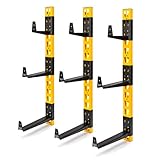
A heavy-duty wall shelf can handle larger fixtures if its rated capacity and anchors suit the wall and load. Don’t rely on drywall anchors for a loaded shelf of dense jigs; fasten into studs or use an appropriate masonry fixing. Keep shelves out of the path of dust-collection hoses, machine handles, and long stock.
Protect the edges and make storage usable
Templates and jigs work from their edges and reference faces. Keep sharp router bits, screws, and loose metal hardware away from those surfaces. Add a strip of soft material to a rack if acrylic or finished templates rub against it, but avoid thick padding that makes pieces unstable. Store plywood and MDF fixtures in a dry part of the shop; damp floors and exterior walls can lead to swelling or warping.
Labels should help you choose the right jig and return it to the same spot. Put the name on both the storage location and the fixture when practical. For a jig with adjustable settings, mark the usual setting or attach a short setup note. That small effort prevents a common failure: a well-made fixture that survives for years but gets remade because nobody can identify or locate it.