Key takeaways
- Our guide to the best dual fuel generators with electric start compares four gasoline and propane models for home backup, RV use, and workshop power.
What's inside
As an Amazon Associate I earn from qualifying purchases. This post may contain affiliate links at no extra cost to you.
As an Amazon Associate I earn from qualifying purchases.
The Short Answer
A dual fuel generator that starts at the push of a button removes the hardest part of backup power: getting the machine running when the lights are already out. Every pick in this guide runs on gasoline or propane and includes a battery-powered electric start, with a recoil cord kept as a backup. For most households, the Champion 100165 is the straightforward choice, with 7,500 running watts on gasoline, 6,750 on propane, and up to 8 hours of runtime at half load on a full 6.1-gallon gasoline tank. The Westinghouse WGen7500DF adds a wireless remote key fob for starting from inside the house. The DuroMax XP12000EH steps up to 9,500 running watts on gasoline for larger load lists. And the lighter Champion 201393 covers 3,800 running watts on gasoline for an RV or a small set of essentials. Read the sizing section before you buy: the right generator is the one that covers your starting watts, not just your running watts.
Our Top Picks
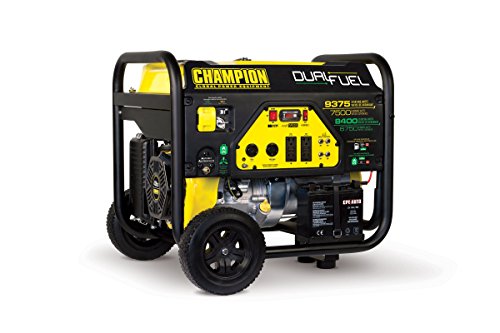
- Best overall: Champion Power Equipment 100165 — 7,500 running watts on gasoline, electric start with Cold Start Technology, and a full outlet set. Check on Amazon
- Best remote start: Westinghouse WGen7500DF — push-button and key fob start, transfer-switch-ready outlet, and up to 11 hours of runtime at half load. Check on Amazon
- Most power: DuroMax XP12000EH — 9,500 running watts on gasoline, a CO sensor, and transfer switch readiness. Check on Amazon
- Best compact RV pick: Champion Power Equipment 201393 — 3,800 running watts on gasoline, CO Shield, and RV-ready outlets in a lighter frame. Check on Amazon
Quick Comparison
| Generator | Gasoline watts (starting / running) | Propane watts (starting / running) | Fuel tank | Runtime at half load, gasoline | Start | Weight |
|---|---|---|---|---|---|---|
| Champion 100165 | 9,375 / 7,500 | 8,400 / 6,750 | 6.1 gal | Up to 8 hr | Electric + recoil | 202 lb |
| Westinghouse WGen7500DF | 9,500 / 7,500 | 8,550 / 6,750 | 6.6 gal | Up to 11 hr | Electric, remote + recoil | 194 lb |
| DuroMax XP12000EH | 12,000 / 9,500 | 11,400 / 9,025 | 8.3 gal | Up to 8 hr | Electric + recoil | 224 lb |
| Champion 201393 | 4,750 / 3,800 | 4,275 / 3,420 | 4.7 gal | Up to 14 hr | Electric + recoil | 133 lb |
How to Choose
Size it by starting watts, not running watts. A refrigerator, a well pump, or an air conditioner draws a short surge when its motor starts, and that surge can be two to three times its running draw. Add up the running watts of everything you want to power at once, then add the largest starting surge. If the total sits above the generator’s running watts, step up a size. A generator slightly larger than your load runs cooler and leaves room for one more tool later.
Remember that propane output is lower. Every dual fuel generator in this guide makes less power on propane than on gasoline, usually by around 10 watts in every 100. Size the machine on its propane numbers if propane is your main backup fuel. Keep a full 20-pound propane cylinder on hand.
Look after the starter battery. Electric start is only convenient while the battery holds a charge. Most of these generators charge the battery while the engine runs, so the simplest habit is to run the machine for 20 to 30 minutes every month or two, which also keeps fuel fresh and the engine lubricated. If the generator will sit unused for a season, disconnect the battery or put it on a maintainer made for small batteries.
Match the outlets to the job. A 120-volt household outlet covers lights, chargers, and small tools. A 120/240-volt locking outlet is what feeds a transfer switch or a well pump, and a TT-30R outlet is what an RV shore cord plugs into. Count the outlets you need before you buy, and confirm on the listing that the generator has the locking outlet your transfer switch or RV cord expects. Use heavy-gauge cords kept as short as practical.
Mind noise and placement. Open-frame generators in this class are listed at 68 to 74 dBA from 23 feet, which is about as loud as a vacuum cleaner. That is fine in a yard during an outage, but it matters if neighbors are close. Always run a generator outdoors, far from windows and doors, with exhaust pointed away from the house. Never run one in a garage, even with the door open, and fit battery-powered carbon monoxide alarms inside the home.
Runtime and tank size decide how often you refuel. The Champion 201393 runs up to 14 hours at half load on 4.7 gallons of gasoline, while the DuroMax XP12000EH carries 8.3 gallons for heavier loads. For outages lasting a day or more, store fuel in approved containers and rotate it so it stays fresh.
Check the safety features. Look for automatic low-oil shutdown, overload protection, and a carbon monoxide sensor or auto-shutoff where the listing shows one. A fuel gauge and an hour meter are small features that make a real difference during a long outage, because they tell you when to refuel and when maintenance is due. A 3-year limited warranty is standard across the picks in this guide.
The Picks in Detail
Champion Power Equipment 100165 — Best Overall
The Champion 100165 is the workhorse of this group, and it is the pick to buy when you want one generator to cover a house full of essentials. Its 439cc engine produces 9,375 starting watts and 7,500 running watts on gasoline, and 8,400 starting watts and 6,750 running watts on propane. The 6.1-gallon tank runs up to 8 hours at half load on gasoline and up to 5.5 hours on a 20-pound propane tank. Electric start comes with the battery included, and Cold Start Technology helps in cold weather, with a recoil cord as backup.
The outlet set is generous: a 120-volt 30-amp locking outlet, a 120/240-volt 30-amp locking outlet, and 120-volt 20-amp GFCI household outlets, so it can feed a transfer switch, a well pump, and household loads at the same time. Intelligauge tracks voltage, frequency, and run-time hours, Volt Guard guards against overloads, and a low-oil shut-off sensor protects the engine. A propane hose with regulator is included, and the folding handle and never-flat wheels help move a 202-pound machine. It carries a 3-year limited warranty and is EPA certified and CARB compliant.
Pros:
- Strong all-around output on both fuels
- Push-button electric start with cold-weather help
- Full outlet set including a 120/240-volt locking outlet
- Long gasoline runtime for its size
Cons:
- Heavy at 202 pounds, so plan where it will live
- Listed at 74 dBA, which is loud for close neighbors
- Propane runtime is shorter than gasoline runtime
- No remote start
Westinghouse WGen7500DF — Best Remote Start
The Westinghouse WGen7500DF is the pick for anyone who wants to start the generator without walking outside in the rain. Its 420cc 4-stroke OHV engine, built with a cast iron sleeve, produces 9,500 starting watts and 7,500 running watts on gasoline, and 8,550 starting watts and 6,750 running watts on propane. The 6.6-gallon tank runs up to 11 hours at half load on gasoline, the longest gasoline runtime in this group. Start it by push button, by the included wireless remote key fob, or by recoil cord.
The panel carries two GFCI 120-volt household duplex outlets and a transfer-switch-ready 120/240-volt 30-amp twist-lock outlet, plus a VFT data center showing voltage, frequency, and lifetime hours. A fuel gauge, automatic low-oil shutdown, and a battery charger are included, along with the propane hose, oil, funnel, and tool kit. The wheel kit and handle help move its 194 pounds. It carries a 3-year limited warranty.
Pros:
- Remote key fob start plus push-button start
- Longest gasoline runtime in this group
- Transfer-switch-ready 120/240-volt outlet
- Fuel gauge and digital hour meter included
Cons:
- Heavy at 194 pounds
- Carbon monoxide shutoff is not listed among the features shown on the listing, so confirm on the listing before you buy
- Propane runtime is not stated on the listing, so confirm on the listing
- Listed noise of 72 dBA is still loud for overnight use near bedrooms
DuroMax XP12000EH — Most Power
The DuroMax XP12000EH is the pick when the job is bigger than a few essentials. Its 457cc 4-stroke OHV engine produces 12,000 starting watts and 9,500 running watts on gasoline, and 11,400 starting watts and 9,025 running watts on propane. The 8.3-gallon tank runs up to 8 hours at half load. Electric start is by push button, with a recoil cord as backup, and the machine is transfer-switch-ready for home backup through a 120/240-volt connection.
This is the only pick in the guide with a CO sensor listed among its features, alongside low-oil shutdown and a foldable handle. MX2 technology lets the generator deliver full power through the 120-volt outlets. Six outlets cover household, RV, and transfer-switch connections. It weighs 224 pounds, so it needs a dedicated storage spot. It carries a 3-year limited manufacturer warranty and is EPA and CARB approved.
Pros:
- Most running watts in this guide
- CO sensor listed among its features
- Large 8.3-gallon tank for heavy loads
- Full 120/240-volt output for transfer-switch use
Cons:
- Heaviest pick at 224 pounds
- Listed at 74 dBA
- No remote start
- Large footprint needs dedicated storage
Champion Power Equipment 201393 — Best Compact RV Pick
The Champion 201393 is the pick for RV trips, tailgating, and a small set of home essentials. Its 224cc engine produces 4,750 starting watts and 3,800 running watts on gasoline, and 4,275 starting watts and 3,420 running watts on propane. The 4.7-gallon tank runs up to 14 hours at half load on gasoline and up to 10.5 hours on a 20-pound propane tank, the longest gasoline runtime in this guide. Electric start includes the battery, with Cold Start Technology and a recoil cord as backup.
The outlet set is built for RV use: a 120-volt 30-amp locking outlet, a 120-volt 30-amp RV outlet, and a 120-volt 20-amp household duplex outlet. CO Shield monitors carbon monoxide and shuts the engine down if levels rise, Intelligauge tracks voltage, frequency, and run-time hours, and a low-oil shut-off switch protects the engine. A 6.6-foot propane hose with regulator, an 8-inch wheel kit, and a fold-away handle are included. At 133 pounds it is the lightest pick here, and it is EPA certified and CARB compliant with a 3-year limited warranty.
Pros:
- Lightest pick in this guide at 133 pounds
- Longest gasoline runtime in this guide
- RV-ready outlet set
- CO Shield carbon monoxide auto-shutoff
Cons:
- Lowest output, so it will not run a whole house
- 120-volt outlets only, with no 240-volt outlet
- Noise level is not stated on the listing, so confirm on the listing
- Small tank means more frequent refills under heavy loads
Who Should Choose What
Choose the Champion 100165 if you want one generator for home backup that covers a refrigerator, lights, a sump pump, and a few tools without fuss. It is the balanced pick, with enough output for most essentials.
Choose the Westinghouse WGen7500DF if remote starting matters to you. The key fob is genuinely useful in bad weather or for anyone who finds a pull cord difficult, and the long gasoline runtime means fewer refills.
Choose the DuroMax XP12000EH if your load list is long: a well pump, a large refrigerator, a freezer, and several circuits at once. Its 9,500 running watts on gasoline cover loads the smaller picks cannot, with a CO sensor for added safety.
Choose the Champion 201393 if your main use is an RV, a camper, or a small set of essentials. It is the lightest and longest-running pick here, and its RV outlet means no adapter is needed for a standard RV shore cord. Its 3,800 running watts on gasoline leave no room for a large air conditioner and a microwave at the same time.
Common Mistakes
Sizing by running watts only. The most common error is adding up running watts and forgetting starting surges. A refrigerator that runs on 800 watts can draw more than 2,000 watts for a second when its compressor starts. Add the biggest surge to your total, or the generator will trip its breaker when you need it most.
Expecting full gasoline output on propane. Propane is convenient to store and burns cleanly, but every dual fuel generator makes less power on it. If you size the machine on gasoline numbers and then run it on propane, a load that just fit before will now overload it. Size on propane numbers when propane is your main fuel.
Letting the starter battery go flat. An electric start generator with a dead battery is a pull-start generator. Run the machine regularly, keep the battery charged, and replace the battery when it no longer holds a charge. Disconnect the battery for months of storage.
Running the generator too close to the house. Exhaust must go outdoors, far from windows, doors, and vents, with the exhaust pointed away from the building. A garage is not outdoors, even with the door open. Place the generator downwind and keep battery-powered carbon monoxide alarms inside the home.
Skipping break-in and maintenance. Change the oil after the first hours of use as the manual directs, then follow the maintenance schedule. A generator that only runs during emergencies still needs fresh oil, a clean air filter, and a working spark plug. Check the oil level before every start.
Using the wrong cords. Light-duty household extension cords heat up under a heavy load and drop voltage, which can damage motors. Use heavy-gauge cords, keep runs short, and never connect a generator to house wiring without a transfer switch installed by a licensed electrician.
FAQ
What does dual fuel mean?
Dual fuel means the generator runs on gasoline or propane, and you switch between the two with a fuel selector. Gasoline usually gives more power and longer runtime per tank, while propane stores indefinitely without going stale and burns cleanly. A propane cylinder is not included with these generators.
Do electric start generators still have a pull cord?
Yes. Every generator in this guide has both: a battery-powered electric start for everyday use and a recoil cord as a backup. If the battery is flat, the recoil cord still starts the engine.
How do I keep the starter battery charged?
Most of these generators charge the battery while the engine runs. Run the generator for 20 to 30 minutes every month or two, which also circulates oil and keeps fuel moving through the carburetor. For seasonal storage, disconnect the battery or keep it on a maintainer made for small batteries.
Can I run a dual fuel generator on propane only?
Yes. A dual fuel generator runs happily on propane alone, and many owners prefer propane for storage because it does not go stale the way gasoline does. Just remember that output is lower on propane, so size your load list on the propane numbers, and keep a spare cylinder for long outages.
Can I plug a generator into my house wiring?
Only through a transfer switch installed by a licensed electrician. Never plug a generator into a wall outlet, which can backfeed power into the grid and endanger line workers. The transfer-switch-ready outlets on the Westinghouse and DuroMax picks are made for this connection.
How much power do I need for a refrigerator, lights, and a few tools?
A refrigerator, a freezer, lights, chargers, and a small tool draw roughly 2,000 to 3,000 running watts together, with a starting surge when the refrigerator compressor kicks on. The Champion 201393 covers that list. Add a well pump or an air conditioner and you need the 7,500 running watts of the Champion 100165 or the Westinghouse WGen7500DF, or the 9,500 running watts of the DuroMax XP12000EH for the heaviest lists.
Conclusion
The best dual fuel generators with electric start are the ones that match your load list and start the first time you push the button. For most households, the Champion 100165 covers the essentials with room to spare. The Westinghouse WGen7500DF adds remote starting and the longest gasoline runtime in this group. The DuroMax XP12000EH covers the heaviest load lists, and the Champion 201393 is the light, long-running choice for RV use and small essentials. Whichever pick fits your home, add up your starting watts first, keep the starter battery charged, and confirm the outlets and runtime on the listing before you buy.
Related guides
More from Amazon
Programs that pair well with the guide above. Offers and eligibility are set by Amazon and may change.
A free business account with business pricing and bulk-buying tools for work, shop or home office.
Create a business accountFree shipping on eligible items, Prime Video and more. Eligible new members can start with a free trial.
Start a Prime free trialAudiobooks and podcasts to listen to on the go. Eligible new members can start with a free trial.
Try Audible freeAd-free music streaming. Eligible new subscribers can start with a free trial.
Try Music Unlimited freeAs an Amazon Associate we earn from qualifying purchases.