Best Bandsaw Light Picks for Brighter, Safer Cutting
Find the best bandsaw light for your saw: magnetic gooseneck LED machine lights that aim at the blade, from a 2,000-lumen work light to cordless picks.
Find the best bandsaw light for your saw: magnetic gooseneck LED machine lights that aim at the blade, from a 2,000-lumen work light to cordless picks.
As an Amazon Associate I earn from qualifying purchases. This post may contain affiliate links at no extra cost to you.
On most bandsaws, the upper blade guard and guide post cast a shadow exactly where the cut happens. Overhead shop lighting rarely reaches the cut line, and the darker the wood, the harder it is to follow a pencil mark through a curve or up to a stop line. The result is slower feeding, more guesswork, and cuts that drift off the line in the final inch. A machine-mounted LED work light fixes the problem at the source: it sits on the saw itself and puts a focused beam on the blade and the workpiece.
Every pick in this guide is the same type of product, a magnetic-base LED machine light with a flexible gooseneck neck that mounts on the bandsaw frame and aims down at the blade. None of them is a general shop light, a headlamp, or a replacement bulb. The differences that matter are brightness, neck length, how each one handles non-magnetic housings, and whether it runs on a cord or a battery. One pick is a factory-style high-output lamp, one is a compact light for benchtop saws, one covers several machines in a single box, and one runs cordless for saws parked far from an outlet.
As an Amazon Associate, we earn from qualifying purchases.
Quick answer
The WangJiaTai Magnetic Work Light is the top pick for most bandsaws: a 2,000-lumen LED head on a 20-inch flexible arm, held by a switchable magnetic base that grips the saw frame and aims light right at the blade. The other picks cover compact benchtop saws, non-magnetic housings, cordless setups, and shops that want one light on several machines.
WangJiaTai Magnetic Work Light (9006L-500)
Top Pick
WangJiaTai Magnetic Work Light (9006L-500)
Light output: 2,000 lumens from 60 LED beads
Power draw: 20 watts, corded, 110 to 240 volt input
Color temperature: 6,500K white
Arm: 20-inch flexible metal pipe, full-circle adjustment
The WangJiaTai is the heavy-duty option in this group, and its listing names the bandsaw directly among the machines it is built for. A 20-watt LED array of 60 beads puts out a claimed 2,000 lumens at 6,500K, a cool white that keeps pencil lines and grain contrast easy to read on pale stock like maple and pine. That output is well beyond what a cut line needs, which means the head can sit higher on the frame and still flood the table with usable light.
The mounting system is the other reason it leads the list. The magnetic base has its own on-and-off switch, so the lamp can be lifted off the saw without a fight and then locked back down with full holding power. The 20-inch flexible metal pipe bends in any direction and holds its pose, long enough to reach from the top of an upper wheel housing down to the blade guides on a full-size floor saw. An included iron sheet gives the magnet something to grip on a non-magnetic surface.
For a 14-inch or larger floor-standing saw that sees daily use, this is the light to buy once. The corded design means output never fades mid-cut, and the switchable magnet makes it easy to move the lamp to a drill press or lathe when the bandsaw is idle.
The Shun Can Da light is the compact counterpart to the WangJiaTai. Its gooseneck is 300 millimeters long, roughly 12 inches, and the head is a focused 5-watt LED rated at 500 lumens with a concentrated beam. The maker’s listing names the band-saw in its range of intended machines, alongside lathes, milling machines, and drill presses, so this is a machine light first and everything else second.
A shorter neck is a genuine advantage on a benchtop bandsaw. There is less arm to droop, less to snag on a workpiece, and the head parks neatly beside the upper guide assembly on a 9-inch or 10-inch saw where space around the frame is tight. The 6,000K color temperature sits close to daylight, and the listing notes eye-strain prevention and low-voltage protection among its features.
Choose this one for a benchtop saw or as a second light on a bigger machine, aimed at the lower guide area while a brighter lamp covers the table. It is a simple, single-purpose lamp with no battery to manage and no modes to cycle through.
Amazing Power LED Flexible Gooseneck Work Lamp
Amazing Power LED Flexible Gooseneck Work Lamp
Mount: strong magnetic base, adhesive metal discs included for non-ferrous surfaces
The Amazing Power lamp answers the most common mounting complaint about magnetic lights: not every bandsaw offers a clean, flat patch of steel where the light needs to sit. Alongside its strong magnetic base, this lamp ships with adhesive-backed metal discs. Stick a disc on a smooth, non-magnetic surface and the magnetic base has a landing pad, which opens up painted, curved, or aluminum housings that would otherwise shrug a magnet off.
The gooseneck rotates through a full circle and bends to any angle, so the head can hang over the blade guard and point down the cut line, or swing sideways to light the guide bearings during a blade change. The maker positions it for workbenches, lathes, drill presses, and milling and sewing machines, and a bandsaw frame presents the same mounting problem as any of those.
If a magnet alone will not hold on the saw in question, this is the pick. The disc system also makes it the easiest light here to share between a bandsaw and a second machine, since each machine can carry its own disc while the lamp moves between them.
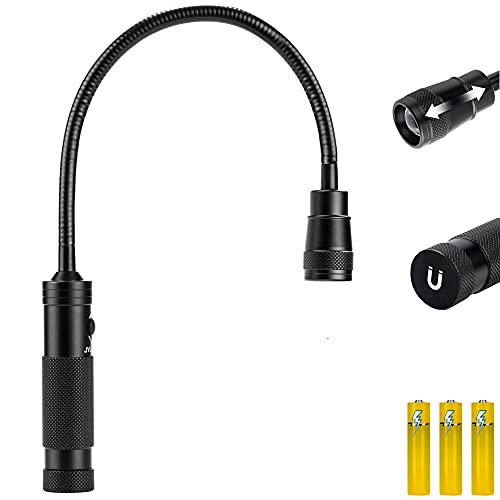
Favorlite LED Work Light
Favorlite LED Work Light
Light output: 500 lumens at maximum
Beam: zoomable, adjustable from flood to spot
Power: battery, three AAA cells included
Neck: 9.25-inch flexible gooseneck; about 16 inches overall
The Favorlite takes the same magnetic gooseneck idea and cuts the cord. It runs on three AAA batteries, which are included, so it suits a bandsaw that lives on a mobile base or in a corner of the shop where the nearest outlet is already spoken for. Output is 500 lumens at maximum, and the head zooms, narrowing to a spot for following a fine scroll line or widening to a flood that covers the whole table.
The neck is 9.25 inches, with a total reach of about 16 inches, and the magnetic base lets the lamp ride on the upper housing or the side of the frame. The shell is aluminum alloy with a rubber hose and button, the light is water and impact resistant, and the whole unit weighs under nine ounces, so a modest magnet is enough to keep it in place even when the saw vibrates.
Battery power is the trade here. There is no cord to route away from the blade path and no outlet needed, but output depends on fresh cells, so this light fits occasional and hobby use better than a production shift. As a cordless blade light that can also walk over to the drill press, it earns its place.
The harmiey entry is a three-pack of compact magnetic gooseneck lights, one for the bandsaw and two for the other machines that compete for light in a small shop. Each light carries 36 LEDs driven at 2 watts, producing about 500 lumens of 6,000K sunlight-white light that the maker describes as free of flashing or pulsation, which matters during long resaw sessions when flicker becomes tiring.
Each neck is about 9.5 inches and rotates through a full circle, the magnetic base snaps on and off steel surfaces, and control is by touch. The cord is roughly 55 inches with an AC plug, long enough to reach a power strip behind most saws. On a bandsaw, one light mounted above the upper guides covers the cut line well; the short neck keeps the head close to the frame and out of the path of wide resaw stock.
For a shop where the bandsaw, drill press, and lathe all sit in shadow, the three-pack solves the whole problem in one purchase. Output per light is modest, so on a large floor saw it works best as a dedicated cut-line light rather than the shop’s only source of illumination.
How to choose
Begin with the mounting surface. A magnetic base needs steel or cast iron; most floor-standing bandsaws offer plenty of both on the frame and wheel housings. Saws with aluminum or plastic housings, or with heavily curved castings, need a light that ships with adhesive mounting discs, or a flat spot must be found on the stand. Check where the head needs to sit before ordering, because a light that cannot mount near the upper guides cannot light the blade.
Neck length comes next. A 20-inch arm reaches from the top of a tall floor saw down to the table and still bends sideways for guide adjustments. On a benchtop saw, a 9- to 12-inch neck is easier to park and less likely to droop or foul a workpiece. Whatever the length, the neck should hold its pose under the saw’s vibration; a lamp that slowly sags mid-cut is worse than none.
Brightness in the 500 to 2,000 lumen range covers bandsaw work. Around 500 lumens is plenty for a focused pool of light on the cut line at close range. Higher output helps when the head must sit farther away or when the shop’s ambient light is dim. A zoomable or concentrated beam puts more of the output on the line and less on the rest of the table.
Finally, decide on power. Corded lights give constant output and no maintenance, at the cost of routing a cable so it can never reach the blade or the drive belt. Battery lights mount anywhere and move freely, but output falls as cells fade. Touch controls, base switches, and side buttons all work; what matters is that the switch can be reached without putting a hand near the blade.
Who should skip
Owners whose bandsaw already has a built-in work light should skip this purchase entirely; many saws ship with a factory lamp aimed at the blade, and a second light adds clutter without adding visibility. Anyone hoping to light a whole workbench or a corner of the shop should also look elsewhere, because every product here is a focused task light with a short reach, not an area light.
A magnetic light is also the wrong buy when the saw offers no ferrous surface and no flat spot for an adhesive disc, and when the plan is to mount the lamp on the moving blade guard of a saw whose guard travels a long way during resaw work. In those cases a clamp-on machine light or better overhead lighting serves the saw better.
Frequently Asked Questions
Where should a bandsaw light be mounted?
The most useful spot is on the frame or upper wheel housing, above and slightly behind the upper blade guides, with the neck bent so the beam lands on the blade just above the workpiece. That angle lights the cut line and the layout marks without shining into the operator’s eyes. Mounting on the table itself works for small saws, but the light then competes with fences and stock for space.
How bright does a bandsaw light need to be?
For close-range work, about 500 lumens aimed directly at the cut line is enough to read a pencil mark on dark walnut. More output, up to the 2,000 lumens of the largest pick here, helps on big saws where the head sits farther from the table, and in shops with weak ambient light. Beam focus matters as much as the lumen figure; a concentrated beam at 500 lumens can outwork a diffuse one at twice the output.
Will a magnetic base hold on a running bandsaw?
On a flat steel or cast-iron surface, yes. Bandsaw vibration is mild compared with most shop machines, and the bases on these lights are sized for machine use. Problems arise on painted, curved, or oily surfaces, and when a long neck is extended fully sideways, which multiplies the leverage on the base. Wiping the mounting spot clean and keeping the neck reasonably compact solves most slipping.
Can one light serve the bandsaw and other machines?
Yes, and that is one of the quiet advantages of the magnetic format. A lamp can live on the bandsaw for a resaw session, then move to the drill press or lathe in seconds. Switchable magnetic bases make the move easiest, and adhesive discs let each machine keep a permanent landing pad. A multi-pack simply gives every machine its own light and removes the moving altogether.
Final verdict
For most bandsaw owners, the WangJiaTai is the light to buy: the highest output here, a 20-inch arm that suits full-size saws, and a switchable magnetic base that holds hard and releases cleanly. The Shun Can Da is the right scale for benchtop saws, the Amazing Power solves non-magnetic housings with its adhesive discs, the Favorlite frees the saw from cords entirely, and the harmiey three-pack lights a whole row of machines at once. Any of the five beats squinting through the shadow of a blade guard.
Product and ASIN Reference
Product
ASIN
WangJiaTai Magnetic Work Light (9006L-500)
B0D17MM8WS
Shun Can Da LED Magnetic Work Light (30E-G-K)
B098N65BXM
Amazing Power LED Flexible Gooseneck Work Lamp
B075GWP1Y1
Favorlite LED Work Light
B08YNFSCS7
harmiey Sewing Machine Light (36LED) 3-Pack
B088YTQ877
J
JD's Woodworks Editorial Team
We compare specs, warranty terms, long-term owner feedback and street pricing before anything earns a spot. Rankings are never paid.
Affiliate disclosure. As an Amazon Associate we earn from qualifying purchases at no extra cost to you. Prices accurate as of the date shown.
Compare the best dewalt portable air compressor picks for trim, framing and finish work, the 6-gallon pancake, cordless FlexVolt and quiet trim models.
Compare the best cup laser engraver picks with rotary chucks and rollers for tumblers, mugs and glasses, from enclosed diode machines to open-frame models.
Compare the best cnc systems sold as complete packages — machine, controller and software in one box — by work area, spindle, drive and control ecosystem.
Miter saw vs table saw: compare crosscuts, rip cuts, accuracy, space, and value to choose the right saw for your shop and your first woodworking projects.
Compare five solar portable generators for shops, campsites, and outages, covering battery size, output, solar charging, outlets, and what to check first.
The best portable CNC machines for small shops and shared spaces, compared by footprint, weight, work area, and setup. Compact benchtop picks for wood, acrylic, and soft metal.
Find the best Penn Industries dust collector on Amazon: the PSI Woodworking DC3XX blower and the DC725 tabletop unit, compared on airflow, pressure, and shop fit.


 Favorlite LED Work Light
 harmiey Sewing Machine Light (36LED) 3-Pack