Best Portable Stick Welders: Light Inverter ARC Machines for Shop and Field Repairs
The best portable stick welders are light inverter ARC machines you can carry in one hand. Five stick-primary picks compared on output, input voltage, duty cycle and weight.
The best portable stick welders are light inverter ARC machines you can carry in one hand. Five stick-primary picks compared on output, input voltage, duty cycle and weight.
As an Amazon Associate I earn from qualifying purchases. This post may contain affiliate links at no extra cost to you.
As an Amazon Associate we earn from qualifying purchases.
A portable stick welder is a different tool from the transformer machine that used to live in the corner of a farm shop. Modern inverter stick welders — also sold as ARC or MMA welders — weigh between roughly seven and twelve pounds, run from ordinary outlets or a generator, and can be carried to the work instead of forcing the work to come to them. That matters in a woodworking shop more often than people expect: steel table bases, mobile-base frames, gate hinges, trailer repairs, mower decks and the brackets that hold dust-collection ducting all end up needing a weld at some point, and the joint is rarely next to the outlet you would choose.
This guide covers five stick-primary inverter machines that are genuinely portable: the YESWELDER ARC-205DS as the high-output dual-voltage default, the ARCCAPTAIN ARC200 for its synergic controls, the DEKOPRO 160A as the proven stick-only option, the HITBOX ARC Welder 200 as a dual-voltage value pick, and the TOOLIOM 135A as the smallest 110-volt-only machine. Every pick was chosen from its listing and manufacturer specifications, and every pick welds with stick electrodes as its main process. Machines that are primarily MIG, TIG or laser welders are excluded on purpose, and the buying guide below explains the limits that separate a useful portable stick welder from a headline amperage number.
Quick comparison
The five machines split into two groups. The YESWELDER, ARCCAPTAIN, DEKOPRO and HITBOX are dual-voltage units that run on 110-volt household power and deliver more output when plugged into a 220-volt supply. The TOOLIOM is a 110-volt-only mini welder: smaller and simpler, but capped by what a household circuit can feed. Output ranges from 135 amps on the TOOLIOM to 205 amps on the YESWELDER, and bare machine weights run from about seven pounds to about eleven pounds, so all five can be carried in one hand or on a shoulder strap. Duty cycle, input power and electrode size — covered next — matter more than the maximum amp figure printed on the box.
How to choose a portable stick welder
Start with your power supply, not the amperage headline
A stick welder cannot output more energy than the circuit feeding it provides. A machine rated at 200 amps will not deliver anything close to that from a standard 15-amp household outlet; on 110-volt input, expect the practical ceiling to suit smaller electrodes and thinner steel, whatever the front panel says. Dual-voltage machines solve this by giving you two working personalities: modest output in the garage on household power, and their full rated range in a shop with a 220-volt receptacle or from a suitably sized generator. If all of your welding happens within reach of one household outlet, a 110-volt-only machine like the TOOLIOM is honest equipment. If you weld thicker material even occasionally, dual voltage is the feature that decides whether the machine keeps up.
Match output and duty cycle to the electrodes you actually burn
For repair and fabrication work in a small shop, the electrodes that matter are usually 3/32-inch and 1/8-inch rods in 6011, 6013 and 7018. A 1/8-inch 7018 typically runs somewhere around 90 to 130 amps depending on position and joint, so a machine with a genuine 130 to 160 amps available on your actual supply covers most small-shop work. Duty cycle tells you how long the machine can hold that output: a 60 percent duty cycle means six minutes of welding in every ten at the rated current before the machine needs to rest and cool. Short repair welds rarely trouble any of these machines. Long seams on thick material are where a 40 percent rating, like the HITBOX carries, starts to shape your work rhythm.
Portability is weight plus leads, not weight alone
All five picks are light enough to carry, so the real portability differences are in the details. A top handle suits bench-to-bench moves; a shoulder strap suits climbing to a gate or carrying the machine across a yard. Lead length matters as much as machine weight, because a welder you can carry is less useful if its electrode holder and ground clamp only reach a few feet from the outlet. Check what is in the box before buying: most of these machines include an electrode holder, a ground clamp and a voltage adapter, but Lift TIG torches, where a machine supports that mode at all, are almost always a separate purchase.
Hot start, arc force and anti-stick are worth having
Three electronic aids show up across this list, and all three address real frustrations. Hot start adds a brief burst of current when the arc is struck, which helps electrodes light instead of sticking to cold metal. Arc force adds current when the arc gets short, helping keep the arc alive when your hand drifts. Anti-stick cuts the current when an electrode freezes to the work, so you can break it free instead of cooking the rod. None of these replace technique — arc length, rod angle and travel speed still decide bead quality — but on small inverter machines they make the difference between a tool a beginner can learn on and one that punishes every mistake.
Know what a portable stick welder will not do
Stick welding is a poor choice for thin sheet metal, where it blows through easily, and it does not weld aluminum in any practical small-shop sense, whatever a listing implies about specialty electrodes. These are DC machines, so they suit steel, stainless and cast-iron repair work with the right electrodes. They are also not weatherproof: the IP21S rating carried by several picks protects against dripping water in limited conditions, not rain, and the machine should stay dry even though stick welding itself tolerates outdoor wind better than gas-shielded processes. Finally, treat headline output figures with care and confirm the current specifications on the live listing before purchase, because sellers revise packages and ratings.
The picks in detail
YESWELDER ARC-205DS — the high-output dual-voltage default
Top Pick
YESWELDER ARC-205DS — the high-output dual-voltage default
The ARC-205DS is the strongest machine in this group on paper and one of the lightest, which is exactly the combination a portable stick welder should aim for. Its listing rates output at up to 205 amps with a 60 percent duty cycle at maximum, fed by dual-voltage 110-volt or 220-volt input, and the bare machine weighs about 8.4 pounds according to the manufacturer manual. It is positioned as a stick welder first, with hot start, arc force and anti-stick, a digital display, and compatibility with 6010, 6011, 6013 and 7018 electrodes. A Lift TIG mode exists on the platform, but the torch arrangement varies by package, so buy this machine for stick work and treat TIG as a possible extra rather than the reason for choosing it.
The honest caveat is the usual one for this class: the 205-amp ceiling belongs to 220-volt input. On a household circuit the machine is a capable light-to-medium stick welder for 3/32-inch and smaller 1/8-inch electrodes, and that is the duty most buyers will actually ask of it. The gap between the bare machine weight and the heavier shipping weight in the listing reflects the leads, holder and packaging, so plan shelf space for the kit rather than the unit alone. For a woodworker adding metal repair capability to the shop, this is the pick that covers the widest range without giving up one-hand carry.
ARCCAPTAIN ARC200 — synergic help for newer stick welders
Runner-Up
ARCCAPTAIN ARC200 — synergic help for newer stick welders
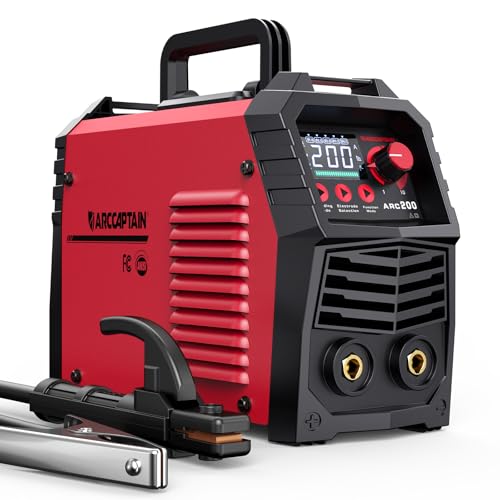
The ARC200 is a 200-amp dual-voltage inverter with a feature the others here do not offer: a synergic mode that proposes a starting current when you select the electrode diameter. Current, hot start and arc force can also be adjusted manually, and the settings show on a large LED display, so the machine can guide a beginner and still hand over full control later. The manufacturer manual lists a 20 to 200 amp range, a 60 percent duty cycle, electrode capacity up to 1/8 inch on 110-volt input and 5/32 inch on 220-volt input, and a net machine weight of 7.94 pounds, making it the lightest dual-voltage pick in this guide. The listed package includes a ten-foot electrode holder, a ten-foot ground clamp, a dual-voltage adapter and a shoulder strap.
Two limits deserve plain statement. The standard package does not include the Lift TIG torch or any gas equipment, so the TIG mode is an expansion path, not a working process out of the box. And the manual calls for a generously sized branch circuit for best performance, which is a reminder that the published range assumes the supply can feed it. Within those limits, the ARC200 suits garage, farm and trailer repairs where the welder moves to the job, and its suggested-current mode makes it the easiest starting point here for someone learning stick technique.
DEKOPRO 160A MMA Welder — the proven stick-only option
DEKOPRO 160A MMA Welder — the proven stick-only option
The DEKOPRO takes the opposite approach to the ARCCAPTAIN: it does one process and keeps the controls simple. This is a stick-only MMA inverter with a listed 10 to 160 amp range, dual-voltage 110-volt and 220-volt input, an IGBT inverter with a digital LCD, hot start and anti-stick, and ETL certification noted on the listing. Amazon technical details put the weight at about 11 pounds, which makes it the heaviest pick here while remaining an easy one-hand carry. The package is listed with an electrode holder, a work clamp, an input adapter cable and a brush, and the listing names 6010, 6011, 6013 and 7018 among the rods it runs.
That narrower focus is a genuine virtue for a shop machine. There is no wire feed to maintain, no gas to manage, and nothing about the setup that changes between jobs beyond the electrode you load. The trade-off is the 160-amp ceiling: on 220-volt input that covers 1/8-inch electrodes and medium repair work comfortably, but this is not the machine for sustained welding on thick sections. One point of listing uncertainty is worth repeating from the specification checks behind this guide: the current listing for this exact model presents it as an MMA and ARC machine without confirmed Lift TIG support, so treat it as a dedicated stick welder, which is how it earns its place here.
HITBOX ARC Welder 200 (IN-ARC200DUAL) — dual voltage with a modest duty cycle
The HITBOX IN-ARC200DUAL is a dual-voltage MMA inverter whose manual gives the most conservative, and therefore most believable, output figures in this group: 20 to 120 amps on 110-volt input and 20 to 160 amps on 220-volt input, with a 65-volt no-load voltage. Net weight is listed at 4.7 kilograms, about 10.3 pounds, and the package includes a 200-amp earth clamp with cable, a 200-amp electrode holder with cable and an adapter cord. For the repair work this guide is aimed at — brackets, frames, hinges, equipment fixes in steel — those outputs on the matching supply are sufficient, and the machine’s portability credentials are straightforward: compact body, carry strap provision and a weight that will not punish a walk across the shop.
The compromise is the 40 percent duty cycle in the manual’s specification table, the lowest here. In practice that means longer cooling pauses during extended welding at higher settings, which matters for production-style work and barely matters for the short, intermittent welds of repair and fabrication around a woodworking shop. Buyers should also confirm the live listing carefully before purchase, because HITBOX sells several similarly named ARC models with different ratings, and the model number IN-ARC200DUAL is the identifier that matches these specifications.
TOOLIOM 135A Mini Stick Welder (TL-135S Pro) — the smallest 110-volt-only pick
TOOLIOM 135A Mini Stick Welder (TL-135S Pro) — the smallest 110-volt-only pick
The TOOLIOM is the minimalist of the group: a 135-amp stick welder that runs on 110-volt input only, weighs roughly seven pounds, and is carried with an adjustable shoulder strap. Its specifications list a 20 to 135 amp output, a 60 percent duty cycle, a maximum welding thickness of about 1/8 inch on household power, and compatibility with 6011, 6013 and 7018 electrodes, with hot start, arc force and anti-stick fitted. A Lift TIG mode is supported, but the torch is not included, so as with the other picks it should not drive the purchase. For tacking, small brackets, thin-wall tube frames and light repairs near a household outlet, this class of machine is genuinely sufficient, and its size makes it the easiest here to store on a shelf or in a vehicle.
The single-voltage design is both its simplicity and its ceiling. The manufacturer documentation is blunt that the machine must never be connected to a 220-volt supply, and there is no higher-output mode waiting to be unlocked later. If your projects grow into regular 1/8-inch 7018 work on thicker steel, you will outgrow it and should start with one of the dual-voltage picks instead. As a first stick welder for light work, or a second machine kept for small jobs so a larger welder stays set up, it makes a clear and honest case.
Frequently asked questions
Can a portable stick welder run from a normal household outlet?
Yes, within limits. Every machine here runs on 110-volt or 120-volt household power, but the circuit caps the useful output, so expect smaller electrodes and thinner material than the headline rating suggests. Full rated output on the dual-voltage machines requires a 220-volt or 240-volt supply with adequate circuit capacity, and a qualified electrician should resolve any doubt about your wiring or receptacles.
What size stick welder does a woodworking shop actually need?
For steel table bases, mobile bases, brackets and general repairs, a machine that genuinely delivers around 130 to 160 amps on the supply you have covers 3/32-inch and 1/8-inch electrodes, which handle most small-shop steel. Buyers who only tack and repair thin material can work happily with less, as the TOOLIOM pick shows.
Is stick welding a good way to learn welding?
It is a traditional way to learn, and modern inverter machines make it more forgiving than it used to be. Hot start and anti-stick reduce the classic beginner frustrations, and a synergic machine like the ARCCAPTAIN can suggest a starting current. Arc length, rod angle and travel speed still have to be learned on scrap practice pieces before any repair that has to hold a load.
What else do I need besides the welder?
At minimum: an auto-darkening welding helmet, dry insulated welding gloves, flame-resistant clothing, the electrodes themselves, a chipping hammer and wire brush for slag, and a work area cleared of combustibles with suitable ventilation. If you plan to use a machine’s Lift TIG mode, budget separately for the torch, regulator, gas cylinder and consumables, because none of the standard packages here include them.
Can these welders weld aluminum or thin sheet metal?
Not in any practical sense for this guide’s purposes. These are DC stick machines aimed at steel, stainless and cast-iron repair with suitable electrodes. Thin sheet is easily burned through with stick, and aluminum calls for a different process. If that work is your priority, look at a dedicated MIG or AC TIG machine instead — a different category from the portable stick welders covered here.
Conclusion
Portability in a stick welder is earned by inverter weight, honest output on the supply you actually have, and leads long enough to reach the work. The YESWELDER ARC-205DS offers the most headroom in the lightest dual-voltage package here. The ARCCAPTAIN ARC200 adds the friendliest controls for a learner. The DEKOPRO 160A is the settled, stick-only choice with a long track record on its listing. The HITBOX IN-ARC200DUAL trades duty cycle for conservative, clearly stated dual-voltage ratings. And the TOOLIOM 135A is the small, simple answer when household power and light repairs define the job. Match the machine to your thickest regular electrode and your real power supply, confirm the specifications on the live listing, and any of the five will carry easily to wherever in the shop — or outside it — the next repair is waiting.
Disclosure
Disclosure: This article contains affiliate links. If you buy through those links, a commission may be earned at no additional cost to you. Product information was taken from the listings and manufacturer details available at the time of writing, and specifications should be confirmed on the live listing before purchase.
J
JD's Woodworks Editorial Team
We compare specs, warranty terms, long-term owner feedback and street pricing before anything earns a spot. Rankings are never paid.
Affiliate disclosure. As an Amazon Associate we earn from qualifying purchases at no extra cost to you. Prices accurate as of the date shown.
Miter saw vs table saw: compare crosscuts, rip cuts, accuracy, space, and value to choose the right saw for your shop and your first woodworking projects.
Compare five solar portable generators for shops, campsites, and outages, covering battery size, output, solar charging, outlets, and what to check first.
The best portable CNC machines for small shops and shared spaces, compared by footprint, weight, work area, and setup. Compact benchtop picks for wood, acrylic, and soft metal.
Find the best Penn Industries dust collector on Amazon: the PSI Woodworking DC3XX blower and the DC725 tabletop unit, compared on airflow, pressure, and shop fit.
Compare five large stationary horizontal metal band saws for fabrication shops on cutting capacity, motor, power supply, blade speed, and mitering before buying.
Find the best mortising chisel bits for clean square mortises in this guide: hollow-chisel sets and singles compared by size, shank, steel, and machine fit.
Find the best drill press base for your shop. Compare rolling stands and mobile bases by capacity, footprint, casters, locking, and setup before you buy.
Find the best dewalt planer dw734 blades for your 12-1/2-inch thickness planer. Compare OEM and aftermarket 3-knife sets, steel types, and fit before you buy.

 YESWELDER ARC-205DS — the high-output dual-voltage default
 ARCCAPTAIN ARC200 — synergic help for newer stick welders
 DEKOPRO 160A MMA Welder — the proven stick-only option
 TOOLIOM 135A Mini Stick Welder (TL-135S Pro) — the smallest 110-volt-only pick









