As an Amazon Associate I earn from qualifying purchases. This post may contain affiliate links at no extra cost to you.
Choosing a plasma cutter with a built-in air compressor is really a decision about where your air comes from, because the pump inside the case sets a hard ceiling on cut quality. A conventional cutter fed by a big shop compressor can be pushed harder with more air behind the arc; an all-in-one machine cannot. So the honest question is not the thickest number printed on the box, but how thick the machine cuts cleanly on its own air, and whether that matches the metal on your bench.
This roundup is for fabricators, farmers, HVAC installers, auto restorers, and home-shop owners who cut away from a plumbed air line, or who simply refuse to buy, drain, and wheel around a separate compressor for occasional cutting. Every machine below was selected from its Amazon listing name and published specifications, and each one generates its own air supply inside the case, so the only hookups are a power cord and a work clamp.
Quick Picks
As an Amazon Associate we earn from qualifying purchases
Ignore the severance number when you compare these machines, because a sever cut is a ragged parting of metal that still needs grinding, not a finished edge. Shop by the recommended or clean-cut figure instead: it describes the thickness the machine parts neatly at a usable travel speed on its internal pump. If your regular work is 16-gauge duct, auto body panels, and the odd piece of angle iron, a small 120 V unit is honestly enough. If you routinely part 5/16 inch plate, step up to a 30 A machine and accept the heavier case that comes with it.
Match the Plug to the Building
Built-in compressor models split sharply by input power, and the plug decides where the machine can work at all. A 120 V cutter like the Hobart or the Reboot runs from an ordinary receptacle, though full output wants a 20 amp circuit on the Hobart. The Lincoln Tomahawk 30 Air is a 208/230 V machine only, so it belongs on a welder outlet or a generator with the right receptacle. The Hypertherm sidesteps the question with auto-voltage circuitry that accepts 120 or 240 V single-phase power. Check the receptacle you actually have, not the one you plan to install someday.
Duty Cycle Decides How Long the Arc Stays Lit
Duty cycle is the share of a ten-minute window the machine can cut at a stated amperage before it needs to cool, and it separates the brands in this group more than headline amps do. The Lincoln holds 30 A at a 60 percent duty cycle and still delivers 25 A continuously, which suits long straight cuts in plate. The Hobart is rated at 35 percent at its full 12 A, fine for short sheet-metal work with natural pauses. On thinner material every machine here effectively gains headroom, because dropping the amperage stretches the working window.
Plan Around the Torch and Its Consumables
The torch is the part you will keep paying for, so look at what wears out and how easily you can replace it. Hypertherm and Lincoln machines use their own branded torch families with widely stocked electrodes and nozzles, and the Lincoln adds a parts-in-place check that refuses to fire with consumables installed wrong. The Reboot uses generic PT31 consumables, the cheapest pattern in this group to feed. Also note the arc start: the Lincoln’s touch start avoids high-frequency interference near vehicle electronics, while high-frequency starts light reliably through paint and rust.
The 4 Best Options
Hypertherm Powermax30 AIR
Top Pick
Hypertherm Powermax30 AIR
Best for: Mobile repair and farm work where the available outlet changes from job to job.
Output current: 15-30 A
Input voltage: 120-240 V, single phase, auto-voltage
Air supply: built-in air compressor, no external air needed
Mobile repair and farm work where the available outlet changes from job to job.
Watch out for
The internal compressor caps capacity compared with a similar 30 A cutter on shop air, and there is no connection point sensing for a machine torch, so it is a hand-cutting system only.
The Hypertherm Powermax30 AIR is the pick when one machine has to work in several buildings, because its auto-voltage power supply accepts 120 or 240 V single-phase input and adjusts on its own. Output runs from 15 to 30 A, the internal compressor removes any need for an external air supply or filter, and the AIR T30 hand torch rides on a 15 ft lead that gives you real reach around a vehicle or a sheet laid on horses. Hypertherm rates it for a 5/16 inch recommended cut in mild steel with a 5/8 inch severance, and the whole system stays carryable at about 30 lb.
Watch out for: The internal compressor caps capacity compared with a similar 30 A cutter on shop air, and there is no connection point sensing for a machine torch, so it is a hand-cutting system only.
Lincoln Tomahawk 30 Air
Runner-Up
Lincoln Tomahawk 30 Air
Best for: Maintenance and fabrication shops with a 230 V welder outlet that want long, steady cuts without tying up the shop compressor.
Output range: 15-30 A
Input power: 208/230 V, single phase, 60 Hz
Rated output: 30 A at 60 percent duty cycle; 25 A at 100 percent duty cycle
Maintenance and fabrication shops with a 230 V welder outlet that want long, steady cuts without tying up the shop compressor.
Watch out for
There is no 120 V option, so it cannot run from a household receptacle, and at 40 lb it is the heaviest machine here despite the included shoulder strap.
Lincoln built the Tomahawk 30 Air for repair work on 230 V power where dragging a compressor along is the nuisance, and its duty cycle is the strongest in this group: 30 A at 60 percent, with 25 A available continuously. The internal compressor handles everyday cutting, while a standard external air connection lets a shop compressor take over for heavier sessions. Its Touch Start system initiates the arc without high frequency, the front panel purge control sets airflow without striking an arc, and Rapid Arc Restrike keeps the cut moving across expanded metal and grating. The LC30 torch comes on a 10 ft cable.
Watch out for: There is no 120 V option, so it cannot run from a household receptacle, and at 40 lb it is the heaviest machine here despite the included shoulder strap.
Hobart AirForce 12ci
Hobart AirForce 12ci
Best for: HVAC installers, body shops, and homeowners cutting sheet metal and duct on ordinary household power.
HVAC installers, body shops, and homeowners cutting sheet metal and duct on ordinary household power.
Watch out for
The 1/4 inch figure is a severance cut rather than a clean edge, and full output calls for a 20 amp circuit, so a shared 15 amp garage circuit may trip under load.
The Hobart AirForce 12ci is the simplest machine in this roundup: plug it into a 120 V outlet and pull the trigger, because its internal piston compressor runs at a preset pressure with nothing to adjust. That simplicity fits sheet metal, HVAC duct, and auto body work, where the 12 A output is rated for a clean 1/8 inch cut in mild steel and can sever 1/4 inch when a job demands it. The inverter design keeps the case down to 26.7 lb, the XT12R torch carries a 12 ft lead, and the fan only runs when cooling is needed, which keeps dust out of the electronics between cuts.
Watch out for: The 1/4 inch figure is a severance cut rather than a clean edge, and full output calls for a 20 amp circuit, so a shared 15 amp garage circuit may trip under load.
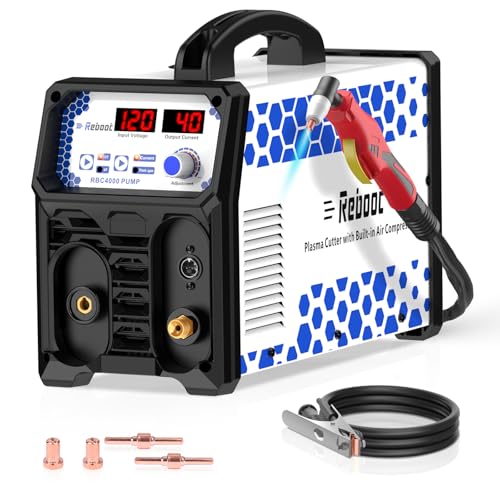
Reboot RBC4000PUMP
Reboot RBC4000PUMP
Best for: Beginners and occasional users who want the thickest clean cut available from a 120 V outlet without buying a compressor.
Output current: up to 40 A
Input voltage: 120 V
Air supply: built-in air compressor (integrated air pump)
Beginners and occasional users who want the thickest clean cut available from a 120 V outlet without buying a compressor.
Watch out for
High-frequency starts can disturb sensitive electronics nearby, and the maximum cut figure is a severance number, so plan your real work around the 3/8 inch clean rating.
The Reboot RBC4000PUMP puts a 40 A output and an integrated air pump into a 120 V machine at the budget end of this category, a combination the big brands do not offer. The listing rates it for a 3/8 inch clean cut and a 3/5 inch maximum cut, with a digital display, 2T/4T trigger control, and high-frequency starting that lights through painted or rusty surfaces. Its torch runs on PT31 consumables, the generic pattern sold everywhere, so replacement tips and electrodes are cheap and easy to source. For a first plasma cutter in a garage with no compressor at all, this is the lowest-friction way in.
Watch out for: High-frequency starts can disturb sensitive electronics nearby, and the maximum cut figure is a severance number, so plan your real work around the 3/8 inch clean rating.
Which One Fits Your Situation
You Cut Where There Is No Air Line
Take the Hypertherm Powermax30 AIR. Field repairs, farmyards, and rooftop HVAC work rarely offer both power and air in the same spot, and this machine asks only for a receptacle, accepting 120 or 240 V as it finds them. The 15 ft torch and work leads let the case stay on the ground while you climb, and the internal compressor means one less machine to load, unload, and protect from weather at every stop.
Your Shop Runs on a 230 V Welder Outlet
Choose the Lincoln Tomahawk 30 Air. Its 60 percent duty cycle at full output suits the long cuts that fabrication and maintenance work actually involves, and the external air connection means the shop compressor can take over on the rare day you push past the internal pump’s comfort zone. The touch start also plays well around the electronics in a modern service truck or equipment shed, where high-frequency interference is a genuine annoyance.
You Mostly Slice Sheet Metal and Duct
The Hobart AirForce 12ci matches thin material better than its spec sheet suggests. Duct work, patch panels, and flashing are all short cuts with pauses for measuring and fitting in between, so its modest duty cycle rarely becomes the limit, and the preset compressor pressure removes the one adjustment beginners most often get wrong. It is also the lightest machine here, which matters when it rides in a van every day.
You Want Plasma Cutting Without Buying a Compressor
Start with the Reboot RBC4000PUMP. It delivers the strongest clean-cut rating of the 120 V machines in this group, its PT31 consumables keep running costs low, and the whole setup is one box, one cord, and one clamp. If plasma cutting becomes a weekly habit, you will eventually outgrow it, but as a first machine it removes every excuse to keep reaching for the angle grinder.
Common Mistakes
Comparing severance numbers instead of clean-cut ratings, then blaming the machine when a thick cut needs heavy grinding.
Plugging a 120 V cutter into a shared 15 amp circuit and tripping the breaker mid-cut, which leaves a gouged, half-parted edge.
Assuming the internal compressor wants no maintenance at all, and never draining moisture or checking the intake filter the manual calls for.
Dragging the torch tip directly on the workpiece with a machine whose torch is designed to run with a standoff, which burns through consumables quickly.
Buying a 230 V-only machine for a garage that has no 230 V receptacle, then discovering the limitation on delivery day.
Frequently Asked Questions
Can a built-in compressor match a shop compressor on thick plate?
No, and the listings make that plain if you read the right numbers. The internal pump is sized for portability, so clean-cut capacity tops out around 5/16 to 3/8 inch in this group. A conventional cutter on a large shop compressor sustains more airflow and parts thicker plate cleanly. Buy the all-in-one for freedom from the air line, not for maximum thickness.
Do any of these machines still accept external air?
The Lincoln Tomahawk 30 Air does; an external air connection is standard alongside its internal compressor, and Lincoln even supplies different retaining caps for internal and external air operation. The Hypertherm, Hobart, and Reboot are designed around their internal supply only. If you already own a good compressor and expect to outgrow the built-in pump, that flexibility is a real argument for the Lincoln.
What circuit does a 120 V plasma cutter with a built-in pump need?
Budget for a 20 amp circuit. The compressor motor and the inverter draw power at the same time, and the Hobart specifies a 20 amp circuit for full output while the Reboot’s listing points to a 50 amp breaker recommendation at 120 V input. A lightly loaded 15 amp circuit may work at reduced amperage, but repeated trips will ruin cuts and patience alike.
Does a built-in compressor change consumable life?
It can, mostly through moisture. Small internal pumps have less drying capacity than a shop system with a tank and separator, and damp air erodes electrodes and nozzles faster. The Lincoln counters this with an internal water separator. Whatever you buy, keep spare electrodes and nozzles on hand, and treat a sudden drop in cut quality as a consumable problem before blaming the machine.
J
JD's Woodworks Editorial Team
We compare specs, warranty terms, long-term owner feedback and street pricing before anything earns a spot. Rankings are never paid.
Affiliate disclosure. As an Amazon Associate we earn from qualifying purchases at no extra cost to you. Prices accurate as of the date shown.
Table saws under the 1500 mark compared: the Grizzly G0771Z and Shop Fox W1837 hybrid saws with cast iron tables, 2 HP motors and T-square fences, specs from their listings.
Table saws for fine woodworking compared: the SawStop Professional Cabinet Saw and Powermatic PM1000, judged on fence precision, table flatness and vibration from listing specs.
Table saw combos explained: saws sold with a stand and accessories in one listing, what to check in the box, and which bundle fits your shop or jobsite.
Compare the best planer digital thickness gauges and digital readout kits for portable planers, with fit, resolution and mounting checks before you buy.
Model table saws for scale modelling and hobby work compared: the precision Proxxon FET 37070 and the compact Saker mini table saw, with specs taken from their Amazon listings.
Three CoreXY 3D printers for product development, each with the architecture stated on its listing: an enclosed multicolor machine, a large-format enclosed model and a heated-chamber model.


 Reboot RBC4000PUMP









