As an Amazon Associate I earn from qualifying purchases. This post may contain affiliate links at no extra cost to you.
Choosing a jointer by its cutterhead is really a decision about maintenance. A straight-knife machine asks you to set three long knives with a jig every time they dull, and it punishes figured grain with tear-out. A spiral or helical head swaps that routine for dozens of small carbide inserts you rotate one at a time, shearing wood in staggered bites instead of one full-width chop. The question is whether that quieter cut and simpler upkeep match the stock you mill, because head style, bed length, and table design all have to fit your shop at once.
OUR TOP PICK
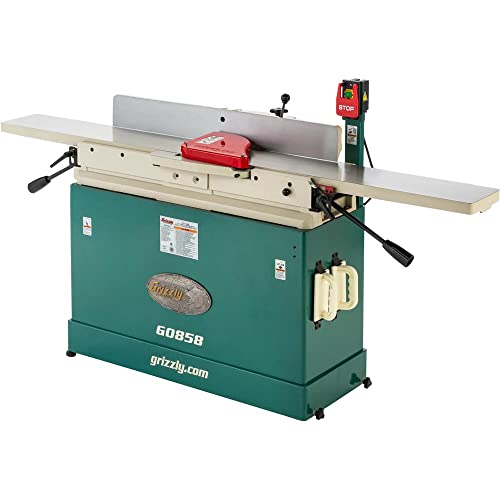
Grizzly G0858 8-Inch Parallelogram Jointer with Spiral Cutterhead
This roundup is for shop owners replacing a straight-knife floor jointer, furniture makers who fight tear-out in figured hardwood, and small professional shops that want insert upkeep instead of knife setting. Every machine below is a floor-standing model listed on Amazon US, picked from the names and specifications on its product page, and each one flattens faces and squares edges with a spiral or helical cutterhead rather than straight knives.
Quick Picks
As an Amazon Associate we earn from qualifying purchases
Count the inserts and check how they sit in the head
Spiral and helical heads both replace long knives with small square carbide inserts, but the arrangement matters. Heads with more inserts and more staggered rows take smaller bites per revolution, which leaves a smoother surface on curly maple, ribbon mahogany, and other grain that changes direction across the board. Four-sided inserts are the practical win: loosen one screw, rotate the insert a quarter turn, and a fresh edge is cutting again. Before you buy, confirm the insert size your model uses, because replacement inserts are not interchangeable between brands, and an odd size can mean ordering from the manufacturer instead of grabbing a generic pack.
Pick the width first, then the bed length
Width decides which boards you can face joint in one pass, and for most furniture work the jump from 6 inches to 8 inches is the difference between flattening a typical drawer side whole and ripping it down first. Bed length is the quieter half of the decision. A 56-inch bed handles short and medium stock well, but long table legs, door stiles, and bench tops stay supported far better on a 76-inch or 82-inch bed, where the board cannot seesaw as it crosses the cutterhead. If your projects keep getting longer, bed length will matter more than a small difference in motor size.
Understand parallelogram beds versus dovetail ways
Both designs raise and lower the infeed table, but they age differently. On a dovetail-way machine, the tables slide along machined ways and are adjusted with handwheels; the design is proven and rigid, though the ways need occasional gib adjustment as they wear. A parallelogram jointer hangs each table on a set of pivoting links, so the table edge stays close to the cutterhead at every depth setting and the tables tend to hold their coplanar alignment longer. Neither is a wrong answer, but if you hate re-truing tables, the parallelogram layout is the one built to reduce that chore.
Plan the circuit, the delivery, and the floor space
Four of the five machines here run on 230V single-phase power, so a dedicated circuit is part of the purchase whether it appears on the invoice or not. These are also freight-class machines: the lightest pick weighs 237 pounds and the heaviest approach 500, so delivery usually means a liftgate truck and a pallet in the driveway, not a box on the porch. Measure the doorway, the path to the jointer’s spot, and the swing room an 82-inch bed needs before ordering. A mobile base softens the space problem, but it does not shrink the machine.
The 5 Best Options
Grizzly G0858 8-Inch Parallelogram Jointer with Spiral Cutterhead
Top Pick
Grizzly G0858 8-Inch Parallelogram Jointer with Spiral Cutterhead
Best for: Shops that reposition equipment often and want parallelogram table adjustment.
Cutting width: 8 in
Table size: 8 x 76 in, parallelogram adjustment
Cutterhead: spiral, 4 rows with 36 indexable carbide inserts
The G0858 pairs the two upgrades shop owners ask for most: a parallelogram bed that keeps its tables aligned as the infeed side moves, and a four-row spiral cutterhead carrying 36 indexable carbide inserts. Lever-adjusted tables with a depth gauge make repeat depth settings quick, and the built-in mobile base matters more than it sounds, because an 8-inch jointer on a cabinet stand otherwise claims its floor space permanently. With a 3 HP motor behind an 8 by 76 inch bed, this is the balanced pick for a garage or basement shop that mills furniture stock every week and still needs to move the machine aside.
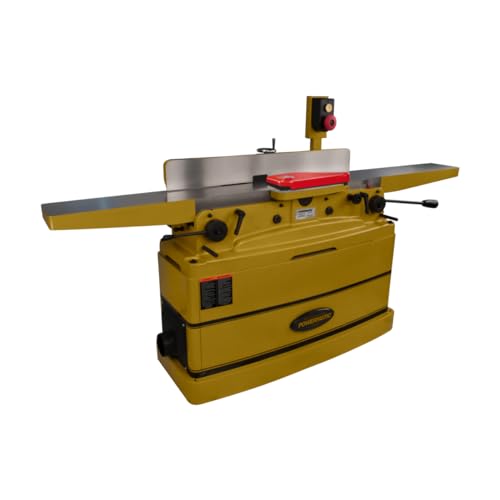
Powermatic PJ-882HH 8-Inch Parallelogram Jointer with Helical Cutterhead
Runner-Up
Powermatic PJ-882HH 8-Inch Parallelogram Jointer with Helical Cutterhead
Best for: Long stock, wide panels, and shops that bevel edges often.
The PJ-882HH is built around the longest bed in this roundup, an 82-inch parallelogram setup that keeps long, heavy boards supported well past the cutterhead on both sides. Its helical head carries 54 four-sided inserts, tied for the highest count here, and the fence tilts in and out through a single handwheel with positive stops, which makes returning to a square fence after bevel work a short job instead of a measuring session. This is the machine for a shop that regularly flattens table tops, long rails, and wide panels and wants the head and bed sized for that work from the start.
Powermatic 60HH 8-Inch Jointer with Helical Cutterhead
Powermatic 60HH 8-Inch Jointer with Helical Cutterhead
Best for: Buyers who want dovetail-way tables and a worm-gear fence adjustment.
Cutting width: 8 in
Cutterhead: helical with 54 four-sided carbide inserts
The 60HH is the traditionalist of the group: extra-long tables riding on dovetailed ways, a handwheel-operated worm gear driving the fence tilt, and a high-mounted switch you can reach without leaning over the bed. The helical cutterhead carries 54 four-sided carbide inserts, so the maintenance story matches the parallelogram Powermatic above even though the table mechanics are the older pattern. At 489 pounds it is a settle-it-once machine, and the long production run behind this model means manuals, parts diagrams, and setup advice are easy to find. Choose it if you prefer dovetail ways and a fence you crank rather than lever.
Shop Fox W1858 8-Inch Dovetail Jointer with Helical Cutterhead
Shop Fox W1858 8-Inch Dovetail Jointer with Helical Cutterhead
Best for: Heavy face jointing in dense hardwood where motor size decides the feed rate.
Table size: 8 x 72 in, precision-ground cast iron
Cutterhead: spiral, 4 rows with 36 indexable carbide inserts
The W1858 brings the largest motor in this lineup, 3 HP, to an 8 by 72 inch pair of precision-ground cast iron tables on dovetail ways. Its spiral cutterhead runs 36 indexable carbide inserts in four rows, and the center-mounted fence, built-in mobile base, and 4-inch dust port cover the practical details a working shop cares about. For face jointing thick, dense stock where a smaller motor would slow the feed, that extra power is the argument. It shares its basic platform with Grizzly’s dovetail-way machines, so insert sizes and setup guidance cross over more than the badge suggests.
JET JJ-6HHDX 6-Inch Long Bed Jointer with Helical Head
JET JJ-6HHDX 6-Inch Long Bed Jointer with Helical Head
Best for: One-car garages and shops without a spare 230V circuit.
Cutting width: 6 in
Tables: 56 in cast iron
Cutterhead: 2-1/2 in diameter, 27 four-sided carbide inserts in 4 staggered rows
The JJ-6HHDX is the only 6-inch machine here, and it earns its place by solving the two problems that keep smaller shops off floor jointers: it arrives prewired for 115V, and at 237 pounds it is the lightest machine in the group by a wide margin. The 56-inch cast iron tables are long for the 6-inch class, and the 2-1/2 inch cutterhead carries 27 four-sided carbide inserts in four staggered rows, spinning at 6,000 RPM. If your stock is mostly drawer parts, box sides, and medium boards, this gives you spiral-head upkeep and finish without rewiring the shop or giving up the space an 8-inch cabinet demands.
Which One Fits Your Situation
You are replacing a straight-knife 8-inch jointer
Start with the Grizzly G0858 if your old machine’s tables drifted out of alignment, since the parallelogram bed is the direct answer to that frustration. Pick the Powermatic 60HH instead if your dovetail-way jointer served you well and you simply want the same mechanics with a helical head. Either way you keep 8-inch capacity, gain insert-based maintenance, and stop setting long knives.
You mill long table tops, rails, and door parts
The Powermatic PJ-882HH is the fit, because its 82-inch bed is the longest surface here and long stock is exactly what extra bed length serves. Boards stay registered against the fence and supported at both ends through the whole pass, which is where flatness on long pieces is won or lost. The 54-insert helical head then leaves a surface that needs little cleanup before the planer.
Your shop has no 230V circuit yet
The JET JJ-6HHDX is the only machine in this group that arrives prewired for 115V, so it can start work the week it lands. You trade width for that convenience, and for shops milling mostly small and medium parts the trade is honest. If you later add a 230V circuit, the motor can be reconnected for it, so the machine does not become a dead end.
The jointer shares its floor with a car
Choose between the Grizzly G0858 and the Shop Fox W1858, the two machines here with a built-in mobile base. Both roll aside when the space has to serve double duty, and both are full 8-inch machines rather than compromises. The G0858 adds parallelogram tables; the W1858 counters with the larger 3 HP motor. Decide by whether alignment stability or cutting power worries you more.
Common Mistakes
Buying on width alone and ignoring bed length, then fighting long boards that tip and seesaw across a short table.
Assuming every spiral or helical head uses the same inserts, and discovering at the first rotation that your model takes a size nobody stocks locally.
Forgetting the 230V circuit, freight delivery, and a way to move a several-hundred-pound crate once it reaches the driveway.
Skipping the coplanar and fence-square checks after assembly because the machine is new; shipping can shift settings on any jointer.
Ordering the straight-knife sibling of the model you wanted, since several of these machines have near-identical model numbers across head styles.
Frequently Asked Questions
Is a spiral cutterhead actually quieter than straight knives?
Yes, and the reason is mechanical. A straight knife strikes the board across its full width at once, while staggered inserts engage a small section at a time, spreading the impact out. Owners moving from knife machines notice the difference most on wide face jointing passes. It is quieter, not quiet, so hearing protection still belongs in the routine.
What happens when one insert chips on a knot?
You loosen that insert’s screw, rotate it to a fresh edge, and keep working; each insert gives you four edges before replacement. A nick that would force a full knife change on a straight-knife machine becomes a two-minute fix. Keep spare inserts in the size your head uses, and a chipped corner never stops a project.
Can these jointers still cut rabbets?
Check the specific model before counting on it. Many spiral and helical heads are not designed for rabbeting cuts, and some manufacturers state that plainly for their insert heads. If rabbeting along an edge is part of your regular work, confirm the capability on the product page or plan to cut rabbets at the table saw or router table instead.
Do I really need 230V power for an 8-inch jointer?
For the 8-inch machines in this roundup, yes: every one of them is listed as a 230V single-phase machine, and running that motor properly means a dedicated circuit of the right size. The exception here is the 6-inch JET, which ships prewired for 115V. Budget the electrician visit alongside the machine if your panel has no spare capacity.
J
JD's Woodworks Editorial Team
We compare specs, warranty terms, long-term owner feedback and street pricing before anything earns a spot. Rankings are never paid.
Affiliate disclosure. As an Amazon Associate we earn from qualifying purchases at no extra cost to you. Prices accurate as of the date shown.
Table saws under the 1500 mark compared: the Grizzly G0771Z and Shop Fox W1837 hybrid saws with cast iron tables, 2 HP motors and T-square fences, specs from their listings.
Table saws for fine woodworking compared: the SawStop Professional Cabinet Saw and Powermatic PM1000, judged on fence precision, table flatness and vibration from listing specs.
Table saw combos explained: saws sold with a stand and accessories in one listing, what to check in the box, and which bundle fits your shop or jobsite.
Compare the best planer digital thickness gauges and digital readout kits for portable planers, with fit, resolution and mounting checks before you buy.
Model table saws for scale modelling and hobby work compared: the precision Proxxon FET 37070 and the compact Saker mini table saw, with specs taken from their Amazon listings.
Three CoreXY 3D printers for product development, each with the architecture stated on its listing: an enclosed multicolor machine, a large-format enclosed model and a heated-chamber model.


 Shop Fox W1858 8-Inch Dovetail Jointer with Helical Cutterhead
 JET JJ-6HHDX 6-Inch Long Bed Jointer with Helical Head









