5 Best TIG Welders Under 1000 for Shops (November 2026)
Compare five TIG welders under 1000 for home shops, covering AC/DC and DC-only machines for aluminum, stainless and steel, with specs and buying advice.
Compare five TIG welders under 1000 for home shops, covering AC/DC and DC-only machines for aluminum, stainless and steel, with specs and buying advice.
As an Amazon Associate I earn from qualifying purchases. This post may contain affiliate links at no extra cost to you.
Shopping for a TIG welder on a firm budget is less about finding the cheapest box and more about matching the machine to the metal you actually weld. Aluminum needs alternating current, stainless and mild steel do not, and that single split decides whether a low-cost DC-only unit is enough or an AC/DC machine is worth the extra outlay. Output range, duty cycle, and the controls for pulse and arc starting matter just as much, because they decide how thin you can weld and how long you can run before the machine needs to cool.
This guide is written for home shop welders, woodworkers adding metal fabrication to their work, and garage fabricators who need clean welds on steel, stainless, and aluminum without a professional-grade outlay. The five machines below were chosen from the names and specifications shown on their Amazon pages, covering DC-only portables through full AC/DC units with pulse control.
Quick Picks
As an Amazon Associate we earn from qualifying purchases
Product
Best for
Key spec
PrimeWeld TIG225X
Highest output for aluminum and steel
225 amp max TIG, AC/DC with pulse
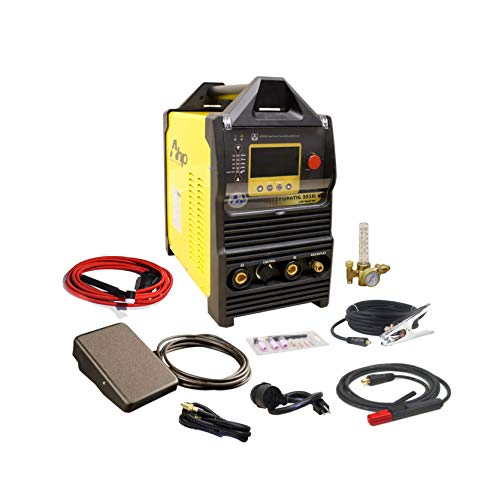
AHP AlphaTIG 203Xi
Widest AC adjustment for aluminum work
200 amp AC/DC, 20 to 200 Hz AC frequency
LOTOS TIG220ACDCP
Digital control with the most weld modes
220 amp max, 13 modes, 10 memory profiles
ARCCAPTAIN TIG200P AC/DC
Lightest full AC/DC machine for mixed metals
200 amp AC/DC, 26.5 pounds
YESWELDER TIG-205P
Most portable DC-only welder for steel
200 amp DC TIG, 10.7 pounds
How to Choose
AC or DC Output
Whether a welder can join aluminum is the first fork in the road. Alternating current breaks through the oxide layer on aluminum, so only an AC-capable machine handles that metal; a DC-only welder is limited to mild steel, stainless steel, and other ferrous or DC-friendly metals. If your project list includes aluminum brackets, boat parts, or automotive panels, rule out every DC-only option at once. If you weld only steel tube, stainless sheet, and general fabrication, a DC-only machine saves weight and complexity while still giving clean, controlled beads. Check the listing for the words AC/DC rather than assuming a TIG welder covers every metal.
Amperage and Duty Cycle
Maximum amperage sets the thickest material a machine can join in a single pass, and the number changes with input voltage. A welder rated at 200 amps on a 240 volt circuit may deliver far less on a standard 120 volt household outlet, so match the figure to the circuit you actually have. Duty cycle is the share of a ten minute window the machine can weld at a given output before it must cool, and a low figure at full power means frequent pauses on long seams. For occasional brackets and repairs, modest figures are workable; for long beads on thick plate, look for a higher duty cycle at the amperage you will use most.
Pulse, Start, and Arc Controls
Pulse control switches the current between a high peak and a low background level, which lowers average heat and makes thin sheet far easier to weld without burn-through. Adjustable pulse frequency gives finer control on delicate stainless and thin-wall tube, while a fixed or absent pulse setting leaves you managing heat with travel speed alone. High-frequency start lights the arc without touching tungsten to the work, keeping the tip clean; lift start is a workable fallback that needs a light touch. AC balance and AC frequency shape the cleaning action and arc focus on aluminum, and two-step and four-step trigger modes let you weld long seams without holding the torch switch down.
Torch, Pedal, and What Ships in the Box
The torch and pedal shape daily use more than any dial on the panel. A torch reaches into tight joints, a longer cable keeps the machine out of the way, and a foot pedal gives heat control that is hard to give up once you have used it. Some listings bundle the pedal and a regulator, while others sell the machine alone or reserve a pedal port for a separate purchase, so read the included-components list before ordering. Argon gas, tungsten electrodes, filler rod, and a flow meter are rarely all in the box, and the gas cylinder itself is always a separate purchase. Plan for those items so the first weld is not delayed by a missing accessory.
The 5 Best Options
PrimeWeld TIG225X
Top Pick
PrimeWeld TIG225X
Best for: Welders who want the highest output in this group for thick aluminum and steel.
225 amp maximum TIG output on 240 volts; 140 amps on 120 volts
AC/DC TIG and stick welding with pulse
Selectable square, sine, and triangle AC waveforms
The TIG225X sits at the top of this group on output, delivering 225 amps of TIG on a 240 volt circuit and 140 amps on a 120 volt circuit, which covers thicker aluminum and steel than any other machine here. It is an AC/DC unit with square, sine, and triangle waveforms, plus AC balance, AC frequency, and pulse controls for dialing in the arc on metals. A CK17 torch and a foot pedal ship with the machine, so the setup is usable from day one. Its 40 percent duty cycle at full output and 100 percent at 155 amps on 240 volts suit long beads on heavier work.
AHP AlphaTIG 203Xi
Runner-Up
AHP AlphaTIG 203Xi
Best for: Home fabricators who weld aluminum often and want wide AC adjustment.
The AlphaTIG 203Xi is the adjustment-heavy pick, with AC frequency from 20 to 200 Hz and AC balance from 20 to 80 percent electrode positive, giving fine control over cleaning action and arc focus on aluminum. It delivers 200 amps of AC and DC TIG and 180 amps of stick from dual 110 and 220 volt input, with high-frequency and lift start, two-step and four-step triggering, and pulse in AC and DC modes. A high-visibility LCD keeps settings readable, and the listing carries a 3-year warranty. It is rated for quarter-inch aluminum and three-eighths-inch mild steel, covering most home shop fabrication.
LOTOS TIG220ACDCP
LOTOS TIG220ACDCP
Best for: Fabricators who want digital memory profiles and the widest mode selection.
220 amp maximum output at 240 volts; 140 amps at 120 volts
13-in-1 modes: 9 AC TIG, 3 DC TIG, 1 stick
Square, sine, and triangle AC waveforms
AC frequency 20 to 300 Hz; AC balance 20 to 80 percent
The LOTOS TIG220ACDCP is the digital pick of the group, packing 13 weld modes into one machine: nine AC TIG modes, three DC TIG modes, and one stick mode, with three AC waveforms for different aluminum work. Its LCD dashboard and 10 memory profiles let you save settings for repeat jobs instead of dialing them in each time. Output reaches 220 amps on 240 volts and 140 amps on 120 volts, and the machine handles material from 1/16 inch to 3/8 inch thick. At 26.9 pounds it is light enough to carry to a job, and the listing carries a 3-year limited warranty.
ARCCAPTAIN TIG200P AC/DC
ARCCAPTAIN TIG200P AC/DC
Best for: Welders who need a light AC/DC machine for mixed metals around the shop.
200 amp TIG output at 220 volts; 120 amps at 110 volts
Stick output 160 amps at 220 volts; 110 amps at 110 volts
7-in-1: AC TIG, DC TIG, AC/DC pulse, square and triangular waveforms, stick, spot TIG
AC frequency 20 to 250 Hz; AC balance 20 to 60 percent
The ARCCAPTAIN TIG200P AC/DC is the portable full-feature pick, weighing 26.5 pounds while still offering AC and DC TIG, pulse, square and triangular waveforms, and stick welding in one box. Output runs 10 to 200 amps on 220 volts and 10 to 120 amps on 110 volts, with AC frequency from 20 to 250 Hz and AC balance from 20 to 60 percent. A 13 foot WP-26-style torch ships with the machine, and the listing covers aluminum from 0.5 to 5 mm and other metals to 10 mm. Its 25 percent duty cycle at 200 amps means planned pauses on long, high-current beads.
YESWELDER TIG-205P
YESWELDER TIG-205P
Best for: Steel and stainless work where portability matters more than aluminum capability.
200 amp maximum TIG output on 220 volts; 160 amps on 110 volts
Stick output 160 amps on 220 volts; 140 amps on 110 volts
The YESWELDER TIG-205P is the lightest machine here at 10.7 pounds, built for welders who work on steel and stainless and want a portable DC TIG unit. It delivers up to 200 amps on 220 volts and 160 amps on 110 volts, with high-frequency start, pulse TIG, and stick welding with hot start, arc force, and anti-stick. A large LED display shows settings clearly, and an auto memory function restores your settings after power-off. The key limit is honest and important: this is a DC-only machine, so it cannot weld aluminum.
Which One Fits Your Situation
Welding Aluminum at Home
Aluminum work calls for an AC machine with enough adjustment to clean the oxide layer and shape the arc. The PrimeWeld TIG225X gives the most output and the widest waveform choice for thicker aluminum, while the AHP AlphaTIG 203Xi offers the widest AC frequency and balance range for fine control. Either one suits a home shop that welds aluminum brackets, panels, and repairs alongside steel.
Steel and Stainless on a Small Setup
If your work is mild steel tube, stainless sheet, and general repairs, and your shop runs on standard household circuits, a DC-only machine is the simpler buy. The YESWELDER TIG-205P weighs just 10.7 pounds, runs on 110 or 220 volts, and covers steel and stainless with pulse control for thin material. Skip it only if aluminum is on your project list, since DC output cannot join that metal.
A Portable Machine for Mixed Jobs
When the welder moves between the bench, the driveway, and a job site, weight and setup time matter as much as output. The ARCCAPTAIN TIG200P AC/DC weighs 26.5 pounds yet keeps full AC/DC capability, pulse, and waveform control, so one machine covers aluminum, steel, and stainless on the go. Its 25 percent duty cycle at full output suits varied project work better than nonstop high-current production.
A First AC/DC Machine for a Home Shop
Buyers stepping up from a basic DC welder often want digital controls and saved settings more than raw amperage. The LOTOS TIG220ACDCP offers 13 modes, three AC waveforms, and 10 memory profiles behind a single-knob LCD dashboard, with 220 amps on tap for thicker work. It is a strong first AC/DC machine for a home shop that welds a little of everything and wants repeatable setups.
Common Mistakes
Buying a DC-only welder and then discovering it cannot join aluminum.
Judging a machine by its 240 volt output while only having a 120 volt circuit available.
Ignoring duty cycle and stalling on long beads when the machine needs to cool.
Assuming the foot pedal, regulator, and gas cylinder are all in the box.
Choosing the highest amperage on the page instead of the controls and torch that fit your work.
Frequently Asked Questions
Can a TIG welder under 1000 weld aluminum?
Yes, but only if it is an AC/DC machine. Aluminum needs alternating current to break through its oxide layer, so a DC-only welder cannot join it. Four of the five machines in this guide are AC/DC units that handle aluminum, while the YESWELDER TIG-205P is DC-only and limited to steel and stainless. Check the listing for AC/DC output before ordering.
What size circuit do I need for a TIG welder?
Every machine here runs on dual voltage, so it works on a standard 120 volt household outlet and a 240 volt circuit, but output drops on the lower voltage. A 240 volt circuit with a suitable breaker is needed for full amperage and thicker material. Check the machine’s input requirements and your panel capacity before buying, and have an electrician add a circuit if your shop lacks one.
Do I need a foot pedal for TIG welding?
A foot pedal is not required, but welders find it makes heat control easier, especially on thin material and at bead starts and ends. Some machines in this guide ship with a pedal, while others offer it as a separate purchase or reserve a port for one. If you plan to weld thin stainless or aluminum, budget for a pedal if your bundle does not include one.
What else do I need besides the welder?
You need argon shielding gas and a cylinder, tungsten electrodes, filler rod for the metals you weld, and a flow meter or regulator if one is not included. A welding helmet, gloves, and jacket are essential safety gear, and a dedicated work surface with a ground clamp keeps the arc stable. Confirm what ships in the box so you can order the missing pieces with the machine.
J
JD's Woodworks Editorial Team
We compare specs, warranty terms, long-term owner feedback and street pricing before anything earns a spot. Rankings are never paid.
Affiliate disclosure. As an Amazon Associate we earn from qualifying purchases at no extra cost to you. Prices accurate as of the date shown.
Table saws under the 1500 mark compared: the Grizzly G0771Z and Shop Fox W1837 hybrid saws with cast iron tables, 2 HP motors and T-square fences, specs from their listings.
Table saws for fine woodworking compared: the SawStop Professional Cabinet Saw and Powermatic PM1000, judged on fence precision, table flatness and vibration from listing specs.
Table saw combos explained: saws sold with a stand and accessories in one listing, what to check in the box, and which bundle fits your shop or jobsite.
Compare the best planer digital thickness gauges and digital readout kits for portable planers, with fit, resolution and mounting checks before you buy.
Model table saws for scale modelling and hobby work compared: the precision Proxxon FET 37070 and the compact Saker mini table saw, with specs taken from their Amazon listings.
Three CoreXY 3D printers for product development, each with the architecture stated on its listing: an enclosed multicolor machine, a large-format enclosed model and a heated-chamber model.



 ARCCAPTAIN TIG200P AC/DC
 YESWELDER TIG-205P









