As an Amazon Associate I earn from qualifying purchases. This post may contain affiliate links at no extra cost to you.
Pulsing is the feature that separates a TIG welder that merely runs a bead from one that manages heat on thin or heat-sensitive metal, but “pulse” on a listing can mean anything from a fixed rhythm to fully adjustable frequency, peak time and background current. The real decision is how much of that control the work needs: occasional pulse on DC for stainless is a different purchase from adjustable AC pulse for thin aluminum, and the wrong match shows up as warped panels or a puddle that will not settle.
This guide compares four machines whose listings name pulse TIG: the ARCCAPTAIN TIG200P AC/DC with its square and triangular AC waveforms, the 250-amp YESWELDER TIG-250P for thicker stock, the AHP AlphaTIG 225Xi with pulse from 0.5 to 200 Hz and a 5-amp DC start, and the dual-voltage YESWELDER TIG-200P ACDC. Fabricators welding thin aluminum, hobbyists stepping up from a DC-only box, and small shops splitting time between steel and alloy each get a distinct route through the four picks below.
Quick Picks
As an Amazon Associate we earn from qualifying purchases.
Product
Best for
Key spec from title
ARCCAPTAIN TIG200P AC/DC
Waveform control on aluminum
Square and triangular AC waveforms with pulse
YESWELDER TIG-250P AC/DC
Maximum output and duty cycle
250A output with pulse on AC and DC
AHP AlphaTIG 225Xi
Fine control on thin sheet
Pulse range of 0.5 to 200 Hz, 5A DC start
YESWELDER TIG-200P ACDC
Dual-voltage flexibility
110V/220V input with seven welding modes
How to Choose
Pulse frequency range and what it changes
Pulse frequency sets how fast the current swings between its peak and background levels. Slow pulsing, around half a hertz to a few hertz, gives a visible rhythm that helps time filler dips and limits total heat on thin sheet. Fast pulsing, up into the hundreds of hertz, stiffens and narrows the arc cone, which suits tight joints and edge work. Check the listed range rather than the word “pulse” alone: a machine adjustable from 0.5 to 200 Hz covers both jobs, while a narrow fixed band serves one and compromises the other.
Pulse on AC, on DC, or on both
Aluminum TIG runs on AC, so a welder whose pulse works only on DC cannot pulse an aluminum bead at all. Steel and stainless work runs on DC, where pulse is the main heat-management tool. Read the mode list on the listing carefully: the useful wording names AC pulse TIG and DC pulse TIG as separate modes. All four machines in this guide list pulse on both polarities, which keeps one box relevant as projects move between alloy wheels, stainless exhaust tubing and mild steel brackets in the same week.
Peak time, background current and the full sequence
Frequency is only one of three pulse settings that matter. Peak time, sometimes labeled pulse width or duty, sets the share of each cycle spent at full current, and background current sets how far the arc drops between peaks without going out. Around those sit the rest of the weld sequence: pre-flow, start current, up-slope, down-slope and post-flow. Machines that expose the whole sequence let a pulse program be built for one joint and repeated; machines with a single pulse dial ask the operator to compensate with torch angle and travel speed instead.
Duty cycle and input voltage at working amperage
A pulse program does not extend a machine’s thermal limits, so compare duty cycle at the amperage the work actually uses, not the headline maximum. A rating of 60 percent at full output supports long runs on heavier sections; lower ratings mean enforced pauses. Input voltage matters just as much: dual-voltage machines typically deliver reduced maximum output on a 120V circuit, and a 220V-only model is the wrong purchase for a garage without that circuit. Match the plug and the breaker to the listing before the machine arrives, and follow the maker’s wiring guidance.
The 4 Best Options
ARCCAPTAIN TIG200P AC/DC
Top Pick
ARCCAPTAIN TIG200P AC/DC
Best for: aluminum fabricators who want waveform choice as a second heat-control lever beside pulse.
Processes: AC TIG, DC TIG, AC pulse TIG, DC pulse TIG, stick and spot TIG (7-in-1)
AC waveforms: square and triangular alongside standard AC output
The ARCCAPTAIN TIG200P AC/DC builds its pulse offering around waveform choice. Alongside AC and DC pulse TIG it lists square and triangular AC waveforms, which change the shape of the cleaning and heating halves of the AC cycle on aluminum. The digital panel exposes the full sequence — pre-flow, start current, up-slope, peak and background current, down-slope and post-flow — so pulse settings can be paired with a complete weld program rather than a single dial. A spot TIG mode covers tack work, and stick welding is included for jobs away from the TIG bench.
YESWELDER TIG-250P AC/DC
Runner-Up
YESWELDER TIG-250P AC/DC
Best for: shops welding thicker aluminum and steel that want pulse headroom without moving to an industrial machine.
Output: 250A AC/DC TIG, with stick output up to 200A
The YESWELDER TIG-250P is the output leader here, with 250 amps of AC/DC TIG and pulse available on both polarities. That headroom matters less for outright thickness than for duty cycle: the listing rates the machine at 60 percent at full output, so long pulse runs on heavier aluminum sections stay inside the thermal envelope. The package includes two torches, a 13 ft WP-26 for general work and a 13 ft WP-9 spot torch, and the digital control set covers pre-gas, start current, slopes and post-gas alongside the pulse parameters.
AHP AlphaTIG 225Xi
AHP AlphaTIG 225Xi
Best for: thin stainless and sheet-metal work where a low start current and slow, even pulse rhythm matter most.
thin stainless and sheet-metal work where a low start current and slow, even pulse rhythm matter most.
Watch out for
bundle contents vary between model years and a wireless-pedal variant sits under a separate listing, so confirm exactly what the chosen listing includes.
The AHP AlphaTIG 225Xi is the fine-control pick. Its pulse range runs from 0.5 to 200 Hz and works on AC or DC, and the DC arc starts at 5 amps, which suits thin sheet and small tubing where a hot start marks the work. Output reaches 225 amps on 240V service and 150 amps on a 120V circuit, so the same machine covers a garage outlet and a shop circuit. Pre-flow and post-flow adjust across a 0 to 10 second range, and a water-cooler outlet is built in for longer sessions with a water-cooled torch.
YESWELDER TIG-200P ACDC
YESWELDER TIG-200P ACDC
Best for: buyers who split welding between 110V and 220V locations and want pulse on both polarities.
Output: 200A AC/DC TIG
Input: 110V/220V dual voltage
Processes: AC TIG, DC TIG, AC pulse TIG, DC pulse TIG, MIX TIG, spot TIG and stick (7-in-1)
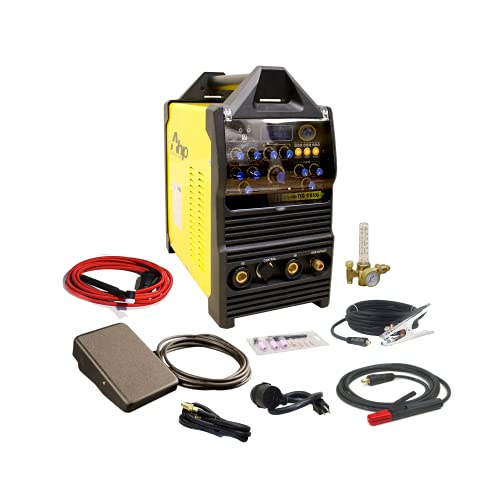
The YESWELDER TIG-200P ACDC is the flexible-power pick, running on 110V or 220V and packing seven modes into a 31 lb case. AC and DC pulse TIG sit alongside standard AC and DC TIG, a MIX TIG mode, spot TIG and stick, all set from a large LED display that stays readable across the bench. For a shop that welds at home during the week and at a friend’s 220V-equipped garage on weekends, that dual-voltage input removes the adapter hunt, while 200 amps still covers the aluminum thicknesses most small fabrication involves.
Which One Fits Your Situation
Thin stainless and sheet-metal work
Slow pulse with a gentle start is the priority here, which points to the AHP AlphaTIG 225Xi: its 5-amp DC start and pulse range beginning at 0.5 Hz suit exhaust tubing, thin enclosures and small brackets. The YESWELDER TIG-200P ACDC covers the same ground when the work also moves between job sites, trading some low-end finesse for dual-voltage convenience and a lighter case.
Aluminum parts and repair work
Aluminum needs pulse on AC, and the ARCCAPTAIN TIG200P AC/DC adds square and triangular AC waveforms on top of its pulse modes, giving two ways to shape the arc on castings, intercooler piping and sheet parts. Where the aluminum runs thicker and sessions run longer, the YESWELDER TIG-250P’s higher output and duty cycle rating take over, provided a 220V circuit is available.
Heavier sections and longer production runs
When the work is brackets, frames and plate rather than sheet, duty cycle decides the shortlist. The YESWELDER TIG-250P holds 60 percent at its full 250A output, the strongest thermal rating in this group, and its included WP-26 torch is sized for sustained work. The AHP 225Xi is the alternative when those longer runs still need pulse finesse at the start of each bead.
One machine for home and shop power
A welder that follows the work between a 110V garage outlet and a 220V shop circuit narrows the field to the two dual-voltage picks: the YESWELDER TIG-200P ACDC for the lightest, simplest package, or the AHP AlphaTIG 225Xi when the extra output on 240V service and the water-cooler outlet matter. Expect reduced maximum output on 110V from either machine, as their listings state.
Common Mistakes
Buying a DC-only pulse machine for aluminum work, when aluminum TIG requires AC output and therefore AC pulse.
Treating every “pulse” label as equal, without checking the listed frequency range and whether peak time and background current adjust independently.
Comparing headline amperage instead of duty cycle at the amperage the work actually uses, then hitting thermal shutdowns mid-job.
Assuming a foot pedal, gas regulator and consumables are in the box, when several listings sell one or more of them separately.
Skipping the maker’s manual and basic protective gear: set the machine up as the manual directs and wear a welding helmet, gloves and protective clothing for every session.
Frequently Asked Questions
What does pulse TIG actually do?
Pulse TIG cycles the welding current between a peak level that melts the joint and a lower background level that lets the puddle cool slightly, many times per second or once every couple of seconds. The listing’s frequency range and peak-time settings decide how that cycle behaves. Used well, it lowers average heat input, which helps thin material keep its shape and gives the bead a more even, stacked appearance.
Do I need pulse on AC, or is DC pulse enough?
It depends on the metal. Stainless and mild steel weld on DC, so DC pulse covers them fully. Aluminum welds on AC, and only machines that list AC pulse TIG can pulse an aluminum bead. Buyers who weld both should choose a machine whose mode list names pulse on both polarities, like the four compared here, rather than discovering the limit after the first aluminum job arrives.
Which pulse frequency suits thin metal?
Slow settings, roughly from half a hertz to a few hertz, are the usual starting point for thin sheet because each peak is easy to time with filler additions and the background half of the cycle sheds heat. Higher frequencies stiffen the arc for tight corners and edge joints. The exact numbers worth using come from the machine’s manual and scrap practice pieces, since joint fit-up and tungsten size change the answer.
Can a foot pedal be used together with pulse?
On most machines in this class, yes: the panel sets the pulse program and the maximum current, and the pedal then varies output within that ceiling while welding. The catch is the box contents, since some listings include a pedal and others sell it separately. Confirm the pedal situation on the exact listing, and check the maker’s instructions for how pedal mode interacts with the 2T and 4T torch settings.
J
JD's Woodworks Editorial Team
We compare specs, warranty terms, long-term owner feedback and street pricing before anything earns a spot. Rankings are never paid.
Affiliate disclosure. As an Amazon Associate we earn from qualifying purchases at no extra cost to you. Prices accurate as of the date shown.
Four hobby TIG welders compared for home shops: AC/DC picks for aluminum, a compact DC model for steel, listed specs, included gear and honest tradeoffs.
The best Creality Falcon engravers compared: Falcon A1 10W, CR-Laser Falcon 10W, Falcon2 Pro 22W and Falcon2 Pro S 40W, by power, work area and enclosure.
The best CNC machines for manufacturing compared: large-bed routers and closed-loop desktop mills with the work area, spindle and control for batch work.


 YESWELDER TIG-200P ACDC