As an Amazon Associate I earn from qualifying purchases. This post may contain affiliate links at no extra cost to you.
TIG filler rod looks like a simple consumable, but picking the wrong one is one of the fastest ways to ruin a weld that was otherwise set up correctly. The real decision is not which brand looks familiar; it is whether the alloy in your hand actually matches the base metal in the joint. A carbon steel rod fed into an aluminum joint, or a general-purpose aluminum rod used where the part will be anodized, gives you cracked beads, porosity, or a visible color mismatch no amount of torch skill can fix.
OUR TOP PICK
Weldcote Metals ER70S-2 TIG Welding Rod, 1/16 Inch x 36 Inch, 1 lb
Buyers usually fall into a few camps: fabricators who burn through mild steel rod on tube and plate, learners who need an affordable practice supply, stainless workers joining 304 and 308 grades, and repair welders patching aluminum castings and sheet. The picks below are drawn from the names and specifications on the product listings themselves, and they cover each of those groups: two carbon steel rods, one stainless rod, and two aluminum rods with different strengths.
Quick Picks
As an Amazon Associate we earn from qualifying purchases.
Product
Best for
Key spec from title
Weldcote Metals ER70S-2 TIG Welding Rod
Mild steel that is not perfectly clean
ER70S-2, 1/16 inch x 36 inch, 1 lb
YESWELDER ER70S-6 TIG Welding Rod
Bulk practice and general mild steel work
ER70S-6, 1/16 inch x 16 inch, 5 lb
Blue Demon ER308L TIG Welding Rod
Welding 304 and 308 stainless steel
ER308L, 1/16 inch x 36 inch, 1 lb tube
Blue Demon ER4043 TIG Welding Rod
General-purpose aluminum welding
ER4043, 1/16 inch x 36 inch, 1 lb tube
Blue Demon ER5356 TIG Welding Rod
5000-series and marine aluminum
ER5356, 1/16 inch x 36 inch, 1 lb tube
How to Choose
Match the Alloy to the Base Metal
Filler selection starts with the metal being joined, not with the machine. Carbon steel work takes the ER70S family, stainless joints take a 308L-class rod for the common 304 and 308 grades, and aluminum splits into two camps: 4043 for general work and castings, 5356 for 5000-series sheet and plate. Feeding a rod from the wrong family produces weld metal with the wrong chemistry, which shows up as cracking, weak joints, or corrosion that starts at the bead. Check the AWS classification printed on the package against the base metal before anything else, because diameter and price mean nothing if the alloy is wrong.
Pick a Diameter That Suits the Thickness
Rod diameter should roughly track the thickness of the joint and the amperage needed to weld it. Thin sheet and small tubing call for .045 inch or 1/16 inch rod, which melts into the puddle without chilling it or forcing you to feed huge amounts of filler. Heavier plate and larger fillets are better served by 3/32 inch or 1/8 inch rod, which deposits metal at a practical rate. Every rod in this guide is 1/16 inch, the most versatile size for light fabrication, but the same alloys are sold in neighboring diameters. Buying only one size for every job is a common false economy.
Weigh Rod Length Against Pack Size
TIG rod is sold as cut lengths, most often 36 inches, with some value packs using 16-inch rods instead. Longer rods mean fewer stops to grab a fresh stick on long seams, while shorter rods are easier to handle in tight positions and often cost less per pound in bulk packs. Pack weight matters just as much: a 1 lb tube suits occasional repairs and keeps a less-used alloy fresh and identifiable, while a 5 lb pack makes sense for a single alloy you use every week. Think about how fast you actually consume each alloy before choosing the biggest box on the page.
Read the AWS Classification, Not the Marketing
Every legitimate TIG rod carries an AWS classification such as ER70S-2, ER308L, or ER4043, and that code tells you the chemistry, the strength level, and the intended base metals in a standardized way. Listings that describe a rod only with vague phrases like “universal welding wire” and no classification are a gamble, because there is no standard to hold the product to. The classification also separates cut-length TIG rod from spooled MIG wire that shares a similar code. ER70S-6, for example, exists in both forms, so confirm the listing describes straight rods in a stated length before ordering.
The 5 Best Options
Weldcote Metals ER70S-2 TIG Welding Rod, 1/16 Inch x 36 Inch, 1 lb
Top Pick
Weldcote Metals ER70S-2 TIG Welding Rod, 1/16 Inch x 36 Inch, 1 lb
Best for: Mild steel repair and light fabrication on surfaces that carry light rust or mill scale.
For mild steel that is less than perfectly clean, the Weldcote Metals ER70S-2 rod is the sensible default. ER70S-2 is a triple-deoxidized carbon steel filler, and the added deoxidizers help it produce sound welds on steel with light rust or mill scale where a plainer rod can leave porosity. The listing describes it as intended primarily for single-pass welding of killed, semi-killed, and rimmed steels, with some multi-pass use, and names typical base metals such as ASTM A36 and A516-70. The 1 lb pack of 36-inch rods in 1/16 inch diameter suits repair work, brackets, and light fabrication where you want a sealed, identifiable quantity rather than a bulk box.
YESWELDER ER70S-6 TIG Welding Rod, 1/16 Inch x 16 Inch, 5 lb
Runner-Up
YESWELDER ER70S-6 TIG Welding Rod, 1/16 Inch x 16 Inch, 5 lb
Best for: Learners and busy home shops that consume a lot of mild steel filler and want a fluid, forgiving puddle.
Learners and busy home shops that consume a lot of mild steel filler and want a fluid, forgiving puddle.
Watch out for
The 16-inch length means frequent rod changes on long joints, and ER70S-6 is a mild steel rod only, despite the similar naming of stainless products from the same brand.
The YESWELDER ER70S-6 pack is the value play for mild steel, built around volume rather than rod length. ER70S-6 carries higher silicon and manganese deoxidizer levels than ER70S-2, which gives it a fluid, easy-wetting puddle that many welders find forgiving on ordinary hot-rolled steel. These rods are copper coated, cut to 16 inches, and sold as a 5 lb pack in 1/16 inch diameter, so the per-pound cost of practice coupons, fit-up tacks, and general shop work stays low. The shorter length is handier in cramped positions, though you will swap rods more often on long seams than with 36-inch filler.
Blue Demon ER308L TIG Welding Rod, 1/16 Inch x 36 Inch, 1 lb Tube
Blue Demon ER308L TIG Welding Rod, 1/16 Inch x 36 Inch, 1 lb Tube
Best for: Stainless fabrication and repair on 304 and 308 grades, including tubing, sheet, and exhaust work.
Stainless fabrication and repair on 304 and 308 grades, including tubing, sheet, and exhaust work.
Watch out for
ER308L is not the right filler for joining stainless to carbon steel, which calls for a 309L-class rod instead, and it should never be substituted for 316 grades in corrosive service.
When the joint is stainless, the Blue Demon ER308L tube is the standard answer for the grades home and light industrial shops see most. The listing positions it for welding types 304 and 308 stainless, and also names 321 and 347, with a low-carbon formulation that limits carbide precipitation in the heat-affected zone. It is rated for DCEN polarity and certified to AWS A5.9, and the rods come in a 1 lb tube at 1/16 inch diameter and 36 inches long, which keeps the stainless filler separated from carbon steel rod and easy to identify at the bench. It is also described as suitable for cryogenic-temperature service.
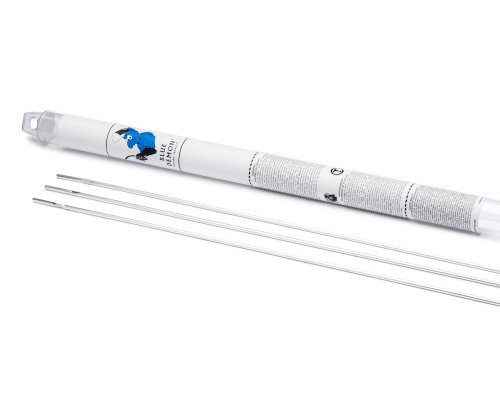
Blue Demon ER4043 TIG Welding Rod, 1/16 Inch x 36 Inch, 1 lb Tube
Blue Demon ER4043 TIG Welding Rod, 1/16 Inch x 36 Inch, 1 lb Tube
Best for: General aluminum repair, castings, and 6000-series sheet and extrusions.
General aluminum repair, castings, and 6000-series sheet and extrusions.
Watch out for
ER4043 weld metal does not color-match when the finished part is anodized, so visible anodized work is better served by 5356, and it is the weaker choice for 5000-series marine plate.
The Blue Demon ER4043 tube covers the most common aluminum jobs: castings, extrusions, and 6000-series sheet. The listing describes ER4043 as a general-purpose aluminum alloy containing silicon additives that improve the fluidity of the weld pool, which makes the bead flow out smoothly and helps on cast parts that are less forgiving than wrought sheet. It comes as 36-inch rods in 1/16 inch diameter in a 1 lb tube, a practical quantity for a metal many shops weld only occasionally. Welds made with 4043 also tend to show less hot cracking sensitivity than the magnesium-bearing alternative on crack-prone base alloys.
Blue Demon ER5356 TIG Welding Rod, 1/16 Inch x 36 Inch, 1 lb Tube
Blue Demon ER5356 TIG Welding Rod, 1/16 Inch x 36 Inch, 1 lb Tube
Best for: Marine aluminum, 5000-series sheet and plate, and parts that will be anodized after welding.
Marine aluminum, 5000-series sheet and plate, and parts that will be anodized after welding.
Watch out for
ER5356 is not recommended for sustained elevated-temperature service, and it is a poorer match than 4043 for many cast alloys, so check the base metal series before defaulting to it.
The second aluminum pick, Blue Demon’s ER5356, exists for the jobs 4043 handles poorly. The manufacturer describes it as a general-purpose aluminum alloy typically chosen for relatively high shear strength, with excellent corrosion resistance in salt water exposure, and recommends it for welding 5000-series base metals such as 5052, 5083, and 5086. That makes it the rod for boat fittings, marine repairs, and structural 5xxx sheet, and its weld metal also anodizes to a closer color match than 4043. The format matches the other Blue Demon tubes here: 36-inch rods, 1/16 inch diameter, 1 lb tube.
Which One Fits Your Situation
You Mostly Weld Mild Steel Tube and Plate
Start with one of the two carbon steel rods. If your steel is usually clean and you weld often, the YESWELDER ER70S-6 pack keeps consumable costs down and the puddle easy to manage. If your projects involve older steel, farm repairs, or surfaces you cannot strip, the Weldcote ER70S-2 earns its place, because its triple-deoxidized chemistry tolerates light rust and mill scale better. Many fabricators keep both: the -6 for everyday work and the -2 for dirty-metal days.
You Are Learning to TIG Weld
Practice consumes filler at a surprising rate, so the 5 lb YESWELDER ER70S-6 pack is the practical choice while you burn coupons and learn puddle control. Its fluid wetting behavior is forgiving of imperfect technique, and the shorter 16-inch rods are easier to feed steadily while your hands are still learning the motion. Save the smaller tubes of stainless and aluminum rod until your steel beads are consistent, because those alloys punish hesitation and poor gas coverage much faster.
You Fabricate With Stainless Steel
Keep a dedicated tube of Blue Demon ER308L at the bench and treat it as your default for 304 and 308 work, from tubing and sheet to exhaust components. The 1 lb tube format helps you keep stainless filler separate from carbon steel rod, which matters because mixing the two up ruins the corrosion resistance you chose stainless for. If your work joins stainless to mild steel, add a 309L-class rod rather than forcing 308L into that role.
You Repair Aluminum Parts
Choose by base metal series. Castings, engine-adjacent parts, and 6000-series sheet point to the Blue Demon ER4043 tube, whose silicon content helps the puddle flow over cast surfaces. Boat parts, fuel tanks, and 5000-series sheet point to the ER5356 tube for its strength and salt-water corrosion resistance. If you do not know the alloy, which is common with salvaged parts, 4043 is the more forgiving general default, while parts destined for anodizing should get 5356 for the closer color match.
Common Mistakes
Buying spooled MIG wire that shares a similar AWS code when the job needs straight cut-length TIG rod; the two forms are not interchangeable at the torch.
Choosing filler by brand familiarity instead of matching the AWS classification to the base metal being joined.
Using ER4043 on parts that will be anodized afterward, then discovering the weld bead anodizes to a visibly different color than the surrounding metal.
Stocking a single rod diameter for every thickness, which makes thin sheet frustrating and heavy plate slow.
Storing rods loose in a drawer where alloys get mixed together and surfaces pick up oil and dust that end up in the weld.
Frequently Asked Questions
Is TIG filler wire the same thing as MIG wire?
Not in the form sold. TIG filler is supplied as cut lengths, usually 36 inches, that are fed into the puddle, while MIG wire comes on a spool for a wire feeder. Some classifications, such as ER70S-6, exist in both forms, so a listing can look correct on chemistry and still be the wrong product. Always confirm the listing describes rods in a stated cut length before ordering.
Which rod diameter should a beginner start with?
A 1/16 inch rod is the most practical starting point for the thin-to-medium material most home shops weld, because it melts readily at modest amperage and is easy to feed in controlled amounts. Thinner sheet work benefits from .045 inch rod, while plate and larger fillets go faster with 3/32 inch. All five picks here are 1/16 inch, which keeps the choice focused on alloy rather than size.
Can ER70S-2 and ER70S-6 be used interchangeably?
For most mild steel joints, yes, either rod will produce a sound weld, which is why both appear here. The difference is emphasis: ER70S-2 carries deoxidizers for rusty or scaly steel, while ER70S-6 has higher silicon and manganese for a more fluid puddle on clean steel. Pick based on the condition of your material and how you like the puddle to behave, not on the assumption that one is better.
How should TIG filler rods be stored?
Keep rods in their tubes or a rod holder, off the floor and away from grinding dust and cutting oil. Once two alloys share one container, they are hard to tell apart by eye, and a stainless rod fed into a steel joint, or the reverse, compromises the weld. Wipe rods that have been handled a lot, and keep aluminum filler cleanest, since contamination produces a dirty, sooty bead.
J
JD's Woodworks Editorial Team
We compare specs, warranty terms, long-term owner feedback and street pricing before anything earns a spot. Rankings are never paid.
Affiliate disclosure. As an Amazon Associate we earn from qualifying purchases at no extra cost to you. Prices accurate as of the date shown.
Four hobby TIG welders compared for home shops: AC/DC picks for aluminum, a compact DC model for steel, listed specs, included gear and honest tradeoffs.
The best Creality Falcon engravers compared: Falcon A1 10W, CR-Laser Falcon 10W, Falcon2 Pro 22W and Falcon2 Pro S 40W, by power, work area and enclosure.
The best CNC machines for manufacturing compared: large-bed routers and closed-loop desktop mills with the work area, spindle and control for batch work.


 Blue Demon ER4043 TIG Welding Rod, 1/16 Inch x 36 Inch, 1 lb Tube