As an Amazon Associate I earn from qualifying purchases. This post may contain affiliate links at no extra cost to you.
Choosing a Bambu Lab printer looks simple from the outside because the range is short, but the real decision is which combination of build volume, enclosure and multi-color hardware fits the parts you actually print. A buyer making desk toys and replacement brackets needs something different from a workshop turning out ABS enclosures, and the Combo bundles change the answer again, because the AMS unit decides whether multi-color printing works out of the box or needs a second purchase later on.
This guide compares five Bambu Lab machines sold on Amazon. The compact A1 mini Combo suits small desks and first-time buyers, the A1 comes with or without AMS lite for open-frame printing at a 256 mm cube, and the enclosed P1S Combo and P2S Combo handle ABS, ASA and faster CoreXY work. Every pick is a current Bambu Lab listing, and the specifications quoted come from the Amazon product page for each model.
Quick Picks
As an Amazon Associate we earn from qualifying purchases.
Product
Best for
Key spec from title
Bambu Lab A1 mini Combo
Small desks and first printers
AMS lite included for multi-color printing
Bambu Lab A1
Single-color printing
256 × 256 × 256 mm³ build volume
Bambu Lab A1 Combo
Most buyers
AMS lite included, full-auto calibration
Bambu Lab P1S Combo
ABS and ASA parts
Up to 16 colors with AMS, 500 mm/s
Bambu Lab P2S Combo
Newest hardware
AMS 2 Pro with AI error detection
How to Choose
Build Volume and Footprint
Four of the five printers here share the same 256 × 256 × 256 mm³ build volume, so the A1 mini is the real outlier with its 180 × 180 × 180 mm³ cube. That smaller volume still covers brackets, planters, game pieces and most household parts, but it rules out helmets, large vases and long parts printed in one piece. Footprint matters too: the A1 series moves its bed back and forth, so the desk needs clear space in front of and behind the machine, while the enclosed P1S and P2S keep all motion inside a fixed 389 mm square frame.
AMS lite, AMS and AMS 2 Pro
Bambu Lab sells three generations of its Automatic Material System, and they are not interchangeable. The A1 and A1 mini work with the AMS lite, an open four-spool feeder that sits beside the printer. The P1S uses the first AMS, a sealed box that stacks up to four units for the 16-color support named in its listing title. The P2S ships with the AMS 2 Pro, which adds active filament drying to the sealed design. Buying a Combo bundle costs less effort than sourcing the matching unit later, and a non-Combo printer prints one color until its AMS is added.
Open Frame or Enclosed CoreXY
The A1 series printers are open-frame bed-slingers, and Bambu Lab lists PLA, PETG, TPU and PVA as their ideal filaments. ABS and ASA shrink and warp as they cool, so they belong in an enclosed machine that holds chamber heat. The P1S and P2S are enclosed CoreXY printers, where the bed only moves down and the light toolhead does the fast work; the P1S listing rates the design at 500 mm/s with 20,000 mm/s² acceleration, and its 300°C hotend covers the engineering materials the open printers should avoid.
Calibration, Speed and Noise
Every printer in this guide calibrates itself, but the details differ. The A1 series runs full-auto calibration before a print, checking bed level, Z offset and flow rate, and adds active flow rate compensation while printing. Bambu Lab rates the A1 family at 500 mm/s with noise at or under 48 dB thanks to active motor noise cancellation, which matters in a bedroom or shared office. The P2S raises the listed top speed to 600 mm/s and adds AI error detection that watches the print and flags failures early, a genuine help on long overnight jobs.
The 5 Best Options
Bambu Lab A1 mini Combo
Top Pick
Bambu Lab A1 mini Combo
Best for: First-time buyers and small desks that still want multi-color prints.
Build volume: 180 × 180 × 180 mm³
AMS lite included for multi-color printing
Full-auto calibration and active flow rate compensation
The A1 mini Combo is the smallest complete multi-color setup Bambu Lab sells. The printer offers a 180 × 180 × 180 mm³ build volume, and the box includes the AMS lite, so multi-color printing works from the first day instead of after a second order. It keeps the A1 family’s full-auto calibration and active flow rate compensation, runs at up to 500 mm/s, and stays at or under 48 dB, which suits a bedroom desk or a classroom corner. For a woodworker adding printed jigs, templates and small fixtures to the shop, the mini covers most jobs while taking up very little bench space.
Bambu Lab A1
Runner-Up
Bambu Lab A1
Best for: Single-color functional printing with the option to add multi-color later.
Build volume: 256 × 256 × 256 mm³
Maximum speed: 500 mm/s; acceleration 10,000 mm/s²
Full-auto calibration and active flow rate compensation
The standalone A1 is the full-size open printer without the AMS lite in the box. It prints a 256 × 256 × 256 mm³ volume at up to 500 mm/s with 10,000 mm/s² acceleration, and it keeps the features that made the range popular: full-auto calibration, active flow rate compensation, a quick-swap nozzle and noise at or under 48 dB. Bambu Lab lists PLA, PETG, TPU and PVA as its ideal filaments. This is the version to choose when nearly everything printed is a single color, because the AMS lite can always be bought separately later if multi-color work shows up.
Bambu Lab A1 Combo
Bambu Lab A1 Combo
Best for: Most home users who want multi-color printing without an enclosure.
Build volume: 256 × 256 × 256 mm³
AMS lite included for multi-color printing
Full-auto calibration and active flow rate compensation
The A1 Combo pairs the full-size A1 with the AMS lite in one box, and it is the version most buyers should shortlist. The printer keeps the 256 × 256 × 256 mm³ build volume, 500 mm/s top speed, full-auto calibration and active flow rate compensation of the standalone A1, while the bundled AMS lite feeds up to four filaments for multi-color models, signs and toys. The open frame keeps the machine easy to reach and maintain, and the ≤48 dB rating with active motor noise cancellation makes it one of the quieter fast printers sold for home use.
Bambu Lab P1S Combo
Bambu Lab P1S Combo
Best for: Functional ABS and ASA parts and buyers who want an enclosed printer.
Build volume: 256 × 256 × 256 mm³
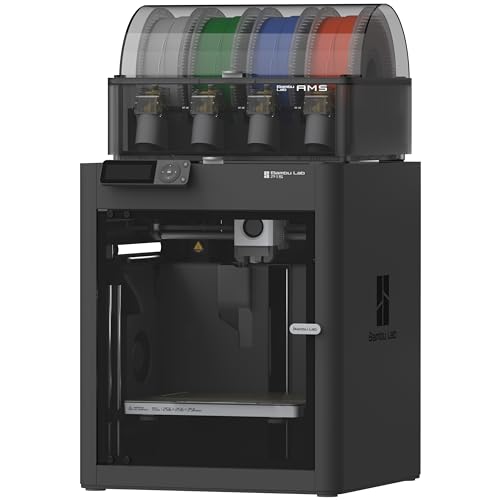
Enclosed CoreXY frame with AMS included
Up to 16 colors with additional AMS units
Maximum speed: 500 mm/s; acceleration 20,000 mm/s²
The P1S Combo moves up to an enclosed CoreXY frame with the first-generation AMS in the box. The enclosure and 300°C hotend open up ABS, ASA and other warp-prone materials that the open A1 series should avoid, and the listing rates the printer at 500 mm/s with 20,000 mm/s² acceleration. Build volume stays at 256 × 256 × 256 mm³, auto bed leveling is standard, and the AMS supports up to 16 colors when extra units are stacked. For a workshop printing durable brackets, enclosures and machine parts, this is the point where the range turns from hobby machine to work tool.
Bambu Lab P2S Combo
Bambu Lab P2S Combo
Best for: Frequent engineering-filament printing and long unattended jobs.
The P2S Combo is the newest enclosed CoreXY machine in this guide, and it replaces the P1S formula with updated hardware. The listing pairs the printer with the AMS 2 Pro, which adds active filament drying to the sealed multi-color box, and Bambu Lab rates the P2S at up to 600 mm/s. AI error detection watches prints and flags problems such as spaghetti failures, and the build volume remains 256 × 256 × 256 mm³ inside the enclosed frame. Buyers who print engineering filaments often, or who run long jobs unattended, get the most from the upgrades over the older Combo.
Which One Fits Your Situation
Your Desk Is Small and This Is Your First Printer
Pick the A1 mini Combo. The 180 mm build cube covers most beginner projects, the AMS lite is already in the box, and full-auto calibration removes the setup steps that frustrate new owners. It is also the easiest machine here to move, store on a shelf, or share between a desk and a workshop bench.
You Print One Color and Want the Simplest Setup
Choose the standalone A1. Most brackets, jigs, organizers and replacement parts are printed in a single filament, and the A1 gives the full 256 mm build volume, auto calibration and quiet running without paying for an AMS lite that would sit idle. The AMS lite can be added later if a project finally needs it.
You Want Multi-Color Prints in the First Week
Take the A1 Combo. The AMS lite arrives in the same box, so multi-color models, labeled parts and two-tone signs can start immediately. It keeps the full build volume of the A1 and the same quiet, self-calibrating routine, which makes it the easiest route into color printing in this range.
You Print ABS, ASA or Parts That Warp
Look at the P1S Combo first. Its enclosure holds the heat that ABS and ASA need, and the 300°C hotend covers the materials the open printers avoid. If the budget stretches further and filament drying matters, the P2S Combo adds the AMS 2 Pro and AI error detection on top of the same enclosed formula.
Common Mistakes
Buying a non-Combo printer and expecting multi-color prints on day one; without an AMS unit, every Bambu Lab printer here prints a single color.
Ordering the wrong AMS generation; the A1 series only works with the AMS lite, while the P1S and P2S use the AMS and AMS 2 Pro.
Choosing the A1 mini for parts drawn larger than its 180 mm build cube, then having to split models that would print whole on a 256 mm machine.
Running ABS or ASA on an open-frame A1 in a cold room, where the listing’s ideal filament list already points to PLA, PETG, TPU and PVA instead.
Forgetting bed travel on the A1 series; the moving bed needs clear space in front of and behind the printer, not just the machine’s own footprint.
Frequently Asked Questions
Does the Bambu Lab A1 print in multiple colors out of the box?
Only the A1 Combo does. The standalone A1 listing states that the AMS lite is required for multi-color printing and is sold separately, while the Combo bundles the AMS lite with the printer. If color models, signs or game pieces are planned from the start, the Combo is the simpler purchase and avoids a second shipment before the first color print can begin.
Can the A1 mini use the AMS from a P1S?
No. The A1 and A1 mini are built around the AMS lite, the open feeder designed for the A1 series, while the P1S and P2S use the enclosed AMS and AMS 2 Pro units. The systems use different hardware and connections, so an AMS bought for one family does not transfer to the other when a second printer joins the bench.
Which Bambu Lab printer is best for ABS parts?
The enclosed models are the right starting point. The P1S Combo listing includes ABS and ASA among its supported filaments and pairs the enclosure with a 300°C hotend, while Bambu Lab lists only PLA, PETG, TPU and PVA as ideal for the open A1 series. The P2S Combo keeps the same enclosed approach and adds filament drying in the AMS 2 Pro.
What is the difference between the P1S Combo and the P2S Combo?
Both are enclosed CoreXY printers with a 256 mm build cube and an AMS in the box. The P2S Combo is the newer machine: its listing raises the top speed to 600 mm/s, swaps the AMS for the AMS 2 Pro with active filament drying, and adds AI error detection. The P1S Combo remains the simpler enclosed option with the first-generation AMS.
J
JD's Woodworks Editorial Team
We compare specs, warranty terms, long-term owner feedback and street pricing before anything earns a spot. Rankings are never paid.
Affiliate disclosure. As an Amazon Associate we earn from qualifying purchases at no extra cost to you. Prices accurate as of the date shown.
Four hobby TIG welders compared for home shops: AC/DC picks for aluminum, a compact DC model for steel, listed specs, included gear and honest tradeoffs.
The best Creality Falcon engravers compared: Falcon A1 10W, CR-Laser Falcon 10W, Falcon2 Pro 22W and Falcon2 Pro S 40W, by power, work area and enclosure.
The best CNC machines for manufacturing compared: large-bed routers and closed-loop desktop mills with the work area, spindle and control for batch work.


 Bambu Lab P1S Combo
 Bambu Lab P2S Combo