As an Amazon Associate I earn from qualifying purchases. This post may contain affiliate links at no extra cost to you.
A thickness planer changes what a small shop can build. Rough lumber, reclaimed boards, and uneven glue-ups all become usable stock once a machine can bring every board to the same thickness with parallel faces. Instead of paying a premium for pre-milled boards in exact dimensions, a woodworker can buy thicker, cheaper rough stock, surface it at home, and keep full control over the final thickness of every shelf, tabletop, and cabinet part.
The benchtop class is where most home shops land, and the field is crowded. Nearly every model in this guide runs a motor in the same power range, so the real differences hide in the cutterhead, the width and thickness capacity, the way snipe is controlled, and how much effort a knife change takes. This guide compares four benchtop thickness planers that cover those differences honestly: a proven three-knife machine, a spiral cutterhead model, a straightforward two-knife option, and a compact entry-level planer for lighter work.
As an Amazon Associate, we earn from qualifying purchases.
How to Choose a Benchtop Wood Planer
Start with capacity, because capacity decides which boards the machine can accept at all. Width capacity in this class runs from about twelve inches to thirteen inches, and that half inch matters more than it sounds. A twelve-inch machine handles most single furniture boards, but a glued-up panel for a small tabletop can easily exceed it. Thickness capacity is more uniform, with most benchtop models accepting stock up to six inches thick, which covers everything from thin resawn veneer backing to heavy table legs. Match the machine to the widest board in the projects on the drawing board, not to the narrowest board on the lumber rack.
The cutterhead is the second decision, and it shapes both finish quality and upkeep. A straight-knife head with two or three long knives is the traditional design. It is simple, replacement knives are widely available, and a three-knife head makes more cuts per inch of board travel, which generally leaves a smoother surface. The trade-off is that a nick from a hidden staple or a knot damages the full length of a knife edge, and changing knives means setting each one level in the head. A spiral cutterhead takes a different approach, using many small individual cutters arranged in a spiral pattern. Each small cutter can be rotated to a fresh edge when it dulls or chips, so a single nick becomes a quick rotation instead of a full knife change. Spiral heads also tend to run quieter and handle figured grain with less tear-out, because each cutter takes a smaller, angled bite.
Feed rate and cuts per minute describe how the machine moves stock and how fine the finish can be. A higher cuts-per-minute figure, paired with a moderate feed rate, usually means smaller scallops between knife marks and less sanding afterward. Single-speed machines keep things simple, while the feed rate itself matters most on wide hardwood boards, where an aggressive feed can strain the motor. Speaking of the motor, most benchtop planers in this guide use a universal motor in the same amp class, so headline power is rarely the deciding factor. Depth of cut per pass matters more in daily use. Every model here limits a single pass to about an eighth of an inch, and sensible milling takes far less than that on the final passes, creeping up on the target thickness with light cuts that leave a cleaner surface.
Snipe deserves its own paragraph because it frustrates new planer owners more than any other issue. Snipe is the slightly deeper cut at the leading and trailing ends of a board, caused when the board is supported by only one feed roller as it enters or leaves the cutterhead. Machines fight it in different ways: a cutterhead or carriage lock that clamps the head firmly for each pass, long infeed and outfeed tables that keep the board level, and pressure-bar designs that hold stock down near the knives. Technique helps as well. Feeding boards end to end so each board supports the next, and supporting long stock with stands or a level bench, both reduce the dip at the ends.
Dust collection is not optional equipment on a planer. These machines produce a remarkable volume of chips, and a planer run without extraction will clog its own hood and coat the shop in minutes. Check the dust port size on any model under consideration and confirm it matches the hose on the shop vacuum or dust collector in the shop, or that an adapter exists. Finally, consider weight and storage honestly. Benchtop planers in this guide range from the mid-fifty-pound range to around eighty pounds. A machine that lives permanently on a stand can be heavier and more rigid, while a machine that gets lifted onto a bench for each session should be light enough to move without turning setup into a workout.
The DEWALT DW734 is the long-running benchmark in this class, built around a three-knife cutterhead and a twelve-and-a-half-inch width capacity. Three knives turning at a ten thousand RPM cutterhead speed produce up to ninety-six cuts per inch of board travel, the highest cut density among the straight-knife models in this guide, and that density is the main reason this machine has a reputation for leaving a finish that needs little sanding. A turret depth stop allows repeatable settings for common thicknesses, so returning to a dimension used earlier in a project takes a twist rather than a fresh round of measuring and test cuts.
Material support is another strength. The folding infeed and outfeed tables combine with the base to give a thirty-three-and-a-half-inch support surface, which helps keep boards level through the cut and works against snipe on longer stock. A material removal gauge shows how much a pass will take off before the board goes through, a small feature that prevents the classic mistake of dialing in too deep a cut on the first pass. The disposable knives are double-edged, so a dull set can be reversed once before replacement, and the listing notes that knife changes are designed to be quick.
Who It Suits
The DW734 suits woodworkers who plane a steady volume of furniture stock and want the smoothest finish a straight-knife head in this class can offer. It is a strong fit for cabinet and furniture work where boards arrive rough and leave ready for joinery. Buyers who need the full thirteen inches of width, or who regularly work highly figured grain that tears out under straight knives, should look at the spiral model below instead.
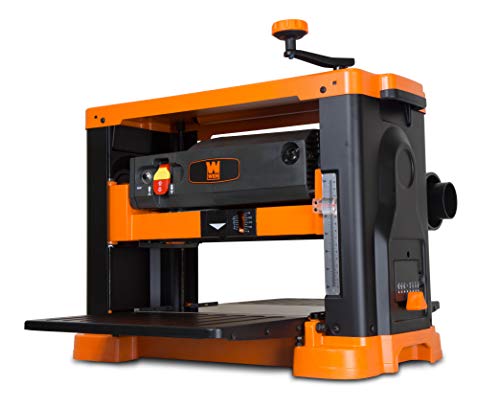
The WEN PL1326 takes the opposite approach to cutting. Its spiral cutterhead carries twenty-six small high-speed steel cutters, staggered around the head, and each one can be rotated to a fresh edge as it wears. For a shop that planes reclaimed lumber or figured hardwood, that design changes the economics of upkeep: a nick from a stray nail or a hard knot costs one small cutter rotation rather than a complete knife set. The spiral arrangement also shears the wood at an angle, which is gentler on reversing grain and generally quieter in operation.
Capacity is the widest in this guide at thirteen inches, with the same six-inch thickness ceiling as the other models. The listing includes an onboard material removal gauge and a depth stop for repeatable thickness settings, plus an adjustable dust port to suit different hose setups. The cutterhead turns at ten thousand RPM, and the machine planes boards in a single-speed feed arrangement that keeps operation simple: set the depth, lock in the pass, and feed the board.
Who It Suits
The PL1326 suits woodworkers who work with figured, reclaimed, or otherwise unpredictable stock and want the easier upkeep of individual cutters. It is also the natural pick for anyone whose glue-ups regularly push past twelve and a half inches wide. Buyers who prefer the simplicity of conventional knives, or who want the lightest possible machine for frequent moving, will find the two-knife models below easier to live with.
The CRAFTSMAN CMEW320 is the straightforward option in this guide: a two-knife cutter head in solid steel, a fifteen-amp motor, and a control layout that asks very little of the operator. The cutter head turns at eight thousand RPM and delivers sixteen thousand cuts per minute, which is a respectable cut rate for a two-knife design and enough for clean results on straight-grained softwoods and common hardwoods. The knives use a quick-change system, so swapping or reversing a set is a short job rather than a precision alignment exercise.
Capacity covers twelve-and-a-quarter inches of width and stock up to six inches thick, which handles the large majority of furniture and trim work. The head assembly rides on a four-column design for stability as it is raised and lowered, helping the machine hold a set thickness consistently across a batch of boards. For shops milling all the parts for one project in a single session, that consistency is the feature that matters most, because every board in the batch comes out at the same dimension.
Who It Suits
The CMEW320 suits woodworkers who want a capable, uncomplicated machine for general milling: dimensioning lumber for shelving, tables, and built-ins without paying for features they will not use. It is a sensible first planer for a growing shop and a reasonable second machine for a busy one. Woodworkers who routinely plane wide panels or highly figured stock should weigh the wider and spiral options above before deciding.
The WEN PL1252 is the compact entry point in this guide. It planes boards up to twelve and a half inches wide and six inches thick, matching the thickness capacity of every other model here, and it does so in a comparatively light package for its class. That matters because it decides whether the planer can live on a shelf and come out only for milling sessions, which is exactly how many small shops work.
The cutting setup is a two-blade head fitted with reversible twelve-and-a-half-inch SK5 steel blades. When one edge dulls, the blade flips to its second edge, doubling the working life of each set. The fifteen-amp motor generates twenty thousand cuts per minute at a feed rate of twenty-six feet per minute, and the depth of cut adjusts from zero to an eighth of an inch per pass, so light finishing passes are easy to dial in. A cast iron base gives the machine a stable footing on the bench, and a two-inch dust port connects to a shop vacuum for chip extraction.
Who It Suits
The PL1252 suits beginners buying a first planer, woodworkers in small or shared spaces, and anyone whose milling is occasional rather than daily. It handles the core job of thicknessing furniture stock in a package that stores away easily. High-volume users, and anyone who wants the finest finish straight off the machine, should step up to the three-knife or spiral models above, which leave less sanding behind.
Frequently Asked Questions
What is the difference between a thickness planer and a jointer?
A jointer flattens one face of a board and makes one edge straight and square to that face, while a thickness planer makes the opposite face parallel to a reference face and brings the board to a uniform thickness. The two machines do different halves of the milling process. A common sequence is to flatten one face on the jointer, then run the board through the planer with the flat face down so the second face comes out parallel and the board reaches its final thickness.
How can snipe be reduced when planing?
Snipe, the deeper cut at the ends of a board, shrinks when the board stays level and supported through the whole pass. Using the cutterhead lock where a machine provides one, keeping infeed and outfeed tables level with the bed, supporting long boards with stands, and feeding shorter boards end to end so each supports the next all help. Taking a lighter final pass also makes any remaining snipe shallower and easier to remove, and leaving boards slightly long until after milling lets the ends be trimmed away entirely.
Are spiral cutterheads worth choosing over straight knives?
A spiral head replaces two or three long knives with many small cutters that can each be rotated to a fresh edge, so upkeep after a nick is faster and cheaper, and figured grain usually planes with less tear-out. Straight knives cost less to replace as a set, are available almost everywhere, and a three-knife head can leave an excellent finish on straight-grained stock. The better choice depends on the wood being milled: shops working reclaimed or figured material gain the most from a spiral head, while shops milling clean, straight-grained lumber may never miss it.
What dust collection does a benchtop planer need?
A planer ejects a large volume of chips at high speed, so it needs active extraction rather than a passive bag. A dust collector is the best match for sustained milling, while a strong shop vacuum can keep up with shorter sessions on models with a smaller port. The important checks are that the port on the machine matches the hose on hand or an adapter, and that the hood stays clear during use, because a clogged hood quickly degrades both the finish and the feed.
Final Verdict
All four planers in this guide share the same basic recipe, a fifteen-amp motor and six inches of thickness capacity, so the right choice comes down to cutterhead and width. The DEWALT DW734 is the pick for finish quality from a straight-knife head, with its three knives, high cuts-per-inch figure, and long support surface making it the most complete general-purpose machine here. The WEN PL1326 is the pick for difficult wood, where its spiral head, individual rotatable cutters, and full thirteen-inch width earn their place on figured and reclaimed stock. The CRAFTSMAN CMEW320 covers the middle ground with a simple quick-change two-knife head and stable four-column design for everyday milling. The WEN PL1252 is the pick for small spaces and first-time buyers, trading some finish refinement for a compact, easy-to-store machine that still handles full-size furniture stock. Match the cutterhead to the lumber in the rack and the width to the widest panel on the project list, and any of the four will dimension stock reliably for years.
Product and ASIN Reference
Product
ASIN
DEWALT DW734 Benchtop Planer
B0000CCXU6
WEN PL1326 Spiral Benchtop Thickness Planer
B08NWF6P3Q
CRAFTSMAN CMEW320 Benchtop Planer
B07Y47LFH5
WEN PL1252 Benchtop Thickness Planer
B09486BBLJ
J
JD's Woodworks Editorial Team
We compare specs, warranty terms, long-term owner feedback and street pricing before anything earns a spot. Rankings are never paid.
Affiliate disclosure. As an Amazon Associate we earn from qualifying purchases at no extra cost to you. Prices accurate as of the date shown.
Four hobby TIG welders compared for home shops: AC/DC picks for aluminum, a compact DC model for steel, listed specs, included gear and honest tradeoffs.
The best Creality Falcon engravers compared: Falcon A1 10W, CR-Laser Falcon 10W, Falcon2 Pro 22W and Falcon2 Pro S 40W, by power, work area and enclosure.
The best CNC machines for manufacturing compared: large-bed routers and closed-loop desktop mills with the work area, spindle and control for batch work.

 DEWALT DW734 Benchtop Planer
 WEN PL1326 Spiral Benchtop Thickness Planer
 CRAFTSMAN CMEW320 Benchtop Planer
 WEN PL1252 Benchtop Thickness Planer









