As an Amazon Associate I earn from qualifying purchases. This post may contain affiliate links at no extra cost to you.
A portable TIG welder only earns the name if one person can carry it to the work, plug it into the power that is actually there, and start welding without a cart, a helper or a dedicated circuit. The real decision is how much machine you can move: weight and input voltage decide whether the welder goes to a repair site, a customer’s garage or the far end of your own shop, and whether it runs when it gets there.
The four machines below suit different buyers. Mobile repair and fabrication work calls for dual-voltage input and a case that rides in a truck. Small-shop owners adding TIG need AC output if aluminum is on the job list. Hobbyists with limited bench space need a compact DC unit for steel and stainless. Every pick comes from its Amazon listing, chosen for output, start type and the accessories the listing includes.
Quick Picks
As an Amazon Associate we earn from qualifying purchases.
Product
Best for
Key spec from title
Everlast Poweri-TIG 201
DC pulse control on the move
200A DC TIG with pulse, 120/240V
Everlast PowerTIG 200DV
Aluminum work away from the bench
200A AC/DC TIG with pulse, 120/240V
Weldpro 200A AC/DC TIG Welder with Pulse
A pedal included in the box
200A AC/DC TIG, 5 in 1
TOOLIOM 200A TIG Welder
The simplest carry-anywhere kit
200A HF TIG and stick, 2 in 1
How to Choose
Start with weight and footprint
Portability starts with what one person can lift onto a bench, into a truck bed or up a flight of stairs, and the listed item weight is the honest starting point. A compact inverter in the teens or twenties of pounds travels differently from a full AC/DC kit listed above forty pounds once the torch, cables and regulator are packed with it. Check the listing’s dimensions as well: a narrow case fits a crowded service van, while a wider unit with a top handle may balance better on a long carry across a site.
Dual voltage decides where it runs
A dual-voltage machine runs light work from a standard 110-volt household outlet and reaches full output on a 220-volt circuit, which is the whole point of taking TIG on the road. Single-voltage units limit you to shops already wired for them. Remember that the headline amperage is the high-voltage figure, so a welder that shows its best numbers on 220 volts will deliver less on a household outlet. If a job needs a new 220-volt receptacle, that is work for a licensed electrician, not an adapter workaround.
AC output if aluminum is on the list
Aluminum needs AC TIG: the alternating current breaks up the oxide layer while the arc runs, and DC-only machines cannot do that job properly. If your portable work includes aluminum boat fittings, trailer repairs or intake parts, an AC/DC model is the requirement, not an upgrade. If every portable job is steel or stainless, a DC-only inverter is lighter, simpler and usually the better carry. Decide from the metal you actually weld away from the bench, not the metal you might weld one day.
Start type and pulse control
High-frequency start fires the arc without touching the tungsten to the work, which keeps the electrode cleaner and makes restarts on finished parts less risky. Lift start is simpler and works well, but it asks for a steady hand. Pulse control swings the current between a peak and a background level, which helps manage heat on thin sheet, tubing and stainless that would warp or burn through at a steady setting. For portable repair work on mixed thicknesses, HF start plus pulse is the combination worth paying for.
The 4 Best Options
Everlast Poweri-TIG 201
Top Pick
Everlast Poweri-TIG 201
Best for: Steel and stainless work that moves between home and site, especially thin material that benefits from pulse control.
The Poweri-TIG 201 is the DC specialist of this group: a digital IGBT inverter covering DC TIG and stick at up to 200 amps, with fully adjustable pulse up to 250 Hz for managing heat on thin stainless and tubing. It runs on 120-volt or 240-volt input, so it travels between a home garage and a job site without a dedicated circuit, and it offers both high-frequency and lift start modes. The unit itself is listed at 35 pounds, and the low 5-amp start suits delicate work. What it cannot do is AC TIG, so aluminum stays off its menu.
Everlast PowerTIG 200DV
Runner-Up
Everlast PowerTIG 200DV
Best for: Welders who need aluminum capability in a movable package and want deep arc control for varied site work.
The PowerTIG 200DV is the feature-heavy pick: an AC/DC inverter with TIG and stick output, pulse in both current types, and adjustable AC frequency and balance for dialing in aluminum work. It starts as low as 5 amps in DC and 20 amps in AC, runs on 120-volt or 240-volt input, and holds a 60 percent duty cycle at its full 200 amps. The foot pedal and TIG torch come in the box. At 56 pounds it is the heaviest carry here, so portability means a short haul from truck to bench rather than a light one-handed lift.
Weldpro 200A AC/DC TIG Welder with Pulse
Weldpro 200A AC/DC TIG Welder with Pulse
Best for: Buyers who want one complete AC/DC kit, pedal included, for aluminum and steel work at more than one location.
Processes: AC TIG, DC TIG, AC Pulse TIG, DC Pulse TIG and Stick (5 in 1)
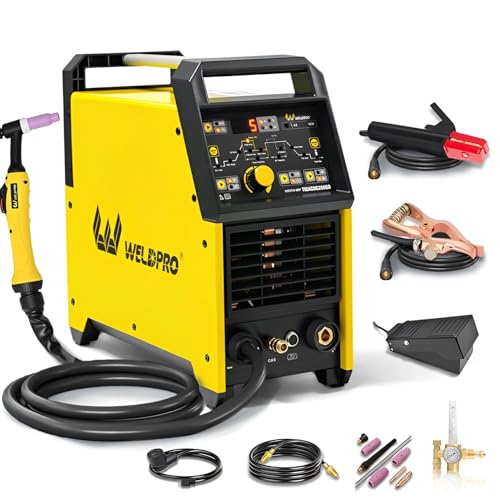
The Weldpro 200A removes a common second purchase by including the foot pedal in the box alongside the TIG torch. Its five modes cover AC TIG, DC TIG, pulse in both current types and stick, at up to 200 amps on dual-voltage 110/220-volt input, with a stated duty cycle of 40 percent at 200 amps. For a portable setup that has to weld aluminum on site and steel back at the bench, having the torch and pedal arrive together avoids a compatibility hunt and keeps the whole kit in one case when the machine travels.
TOOLIOM 200A TIG Welder
TOOLIOM 200A TIG Welder
Best for: Straightforward steel and stainless repairs where a light, simple two-process machine matters more than extra modes.
Processes: HF TIG and Stick (2 in 1)
Maximum output: 200 A
Input voltage: 110V (120V) / 220V (230V) dual voltage
Welding capacity: Up to 5/32 inch, handles E7018 electrodes
The TOOLIOM 200A is the simplest machine here: a 2-in-1 IGBT inverter for HF TIG and stick, rated at 200 amps on dual-voltage input. High-frequency start gives clean, contact-free arc starts, the listing rates it for plate up to 5/32 inch and for E7018 electrodes on the stick side, and built-in over-voltage, over-current and over-heat protection watches the electronics while the machine moves between outlets. There is no pulse mode and no AC output, so this is a carry-it-anywhere DC unit for steel and stainless rather than an aluminum tool.
Which One Fits Your Situation
You weld wherever the repair is
Pick dual voltage first and weight second. The Everlast Poweri-TIG 201 and the TOOLIOM 200A both run on household or shop power and cover steel and stainless, which is most field repair work. Add the Everlast PowerTIG 200DV if the site work includes aluminum, accepting the heavier case as the price of AC output in a movable machine.
Your shop has only household outlets
Every machine here runs on 110-volt input, but none reaches full output on it. For light fabrication, gates, brackets and tubing at home, any of the four works; the Poweri-TIG 201’s pulse mode is the most useful extra on thin material. Just plan projects around the lower output until a 220-volt circuit, installed by an electrician, is available.
Aluminum parts are on your project list
Limit the shortlist to the two AC/DC machines. The Everlast PowerTIG 200DV offers the deepest aluminum controls, with adjustable AC balance and frequency plus pulse in both current types, while the Weldpro pairs its five modes with an included pedal for modulating heat on cast and sheet aluminum. The two DC-only units cannot TIG weld aluminum, whatever their amperage.
You are learning TIG while moving around
Start with the machine whose controls you will actually use. The TOOLIOM keeps the panel simple for steel practice, and the Weldpro adds AC and a pedal for growing into aluminum later. Whichever you choose, follow the maker’s manual for setup, and wear a proper welding helmet, gloves and protective clothing for every session, in the shop or on site.
Common Mistakes
Buying a DC-only welder and expecting to TIG weld aluminum, which requires AC output to break the oxide layer.
Forgetting the gas setup: TIG needs an argon cylinder and a regulator, and listings differ on whether a flow meter or regulator is in the box.
Assuming the headline amperage is available on a 110-volt outlet, when full output is the 220-volt figure.
Choosing by output alone and ignoring listed weight, then discovering the complete kit is more than you want to carry daily.
Skipping the maker’s setup instructions and basic PPE, including a welding helmet and gloves, because the machine is small.
Frequently Asked Questions
Can a portable TIG welder run on a regular household outlet?
Yes, if it is a dual-voltage model like the four listed here. On a 110-volt household outlet the machine runs at reduced output, which suits thin steel, tubing and light repairs. Full rated amperage needs the 220-volt side, so thicker plate work waits for a proper shop circuit.
Do portable TIG welders weld aluminum?
Only the AC/DC models do. AC current cleans the oxide layer from aluminum as the arc runs, so the Everlast PowerTIG 200DV and Weldpro above can weld it, within their listed thickness ranges. DC-only portable machines such as the Everlast Poweri-TIG 201 and the TOOLIOM 200A are steel and stainless tools.
What else do I need besides the welder itself?
TIG needs shielding gas, so plan on an argon cylinder and a regulator or flow meter, plus tungsten electrodes and filler rod matched to the metal. A welding helmet, gloves and protective clothing are essential. Some listings include a torch and pedal; gas, tungsten and filler are usually bought separately.
Is HF start worth it on a portable machine?
For most buyers, yes. High-frequency start fires the arc without the tungsten touching the work, which keeps the electrode tip cleaner and makes starts on finished or thin parts more forgiving. Lift start works and keeps a machine simpler, but it takes a steadier technique to avoid sticking and contamination.
J
JD's Woodworks Editorial Team
We compare specs, warranty terms, long-term owner feedback and street pricing before anything earns a spot. Rankings are never paid.
Affiliate disclosure. As an Amazon Associate we earn from qualifying purchases at no extra cost to you. Prices accurate as of the date shown.
Four hobby TIG welders compared for home shops: AC/DC picks for aluminum, a compact DC model for steel, listed specs, included gear and honest tradeoffs.
The best Creality Falcon engravers compared: Falcon A1 10W, CR-Laser Falcon 10W, Falcon2 Pro 22W and Falcon2 Pro S 40W, by power, work area and enclosure.
The best CNC machines for manufacturing compared: large-bed routers and closed-loop desktop mills with the work area, spindle and control for batch work.


 TOOLIOM 200A TIG Welder