What's inside
As an Amazon Associate I earn from qualifying purchases. This post may contain affiliate links at no extra cost to you.
An end-grain workbench top looks like a block of butcher’s board: the grain ends face up, giving the surface a distinctive checkerboard pattern. A laminated plywood top is a stack of plywood sheets bonded into a thick slab. Both can handle everyday woodworking, but they behave differently under chisels, clamps, glue, moisture, and rough use.
For most home shops, laminated plywood is the practical starting point. End grain makes sense when you regularly chop into the bench or want a surface that can be renewed over many years. The right choice depends less on appearance than on how you work and whether you need the bench to double as a durable workholding system.
As an Amazon Associate we earn from qualifying purchases at no extra cost to you.

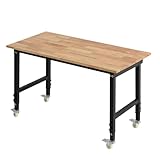

How the two tops are built
An end-grain top is made by standing short pieces of hardwood on end and gluing their long-grain sides together. Typical tops are roughly 2 to 4 inches thick. The exposed end grain takes impacts differently from a face-grain surface, but the top is heavy and its many glue joints need protection from standing water.
A laminated plywood top is usually made by stacking two or more sheets, applying adhesive, and clamping or screwing the layers together. Two sheets of 3/4-inch plywood make a top about 1 1/2 inches thick; three make one about 2 1/4 inches thick. Use cabinet-grade or other flat, void-minimized plywood rather than assuming every construction panel will make a reliable bench surface.
Comparison at a glance
| Factor | End-grain hardwood | Laminated plywood |
|---|---|---|
| Impact and chopping | Good for repeated mallet and chisel work; dents can be sanded out | Fine for assembly and general work; repeated hard chopping can damage the face veneer |
| Workholding | Accepts bench dogs and holdfasts if holes are properly sized and placed | Works with clamps; holdfast performance depends on thickness and construction |
| Weight | Very heavy; can make a bench stable but difficult to move | Moderate; easier to handle and replace |
| Moisture risk | Can swell or open at glue lines if kept wet | Edges and damaged veneer can swell or delaminate when soaked |
| Cost and repair | Often costly in material and labor; surface can be flattened again | Usually less expensive; damaged top can be patched or replaced |
When end grain earns its keep
Choose end grain if your routine includes chopping mortises, paring with a chisel against the bench, or striking work directly on the surface. The wood fibers can compress under a blow rather than splitting as readily as a thin face veneer. That does not make the top indestructible: a sharp chisel can still cut it, and repeated impacts can loosen glue joints in a poorly made or poorly maintained slab.
The extra mass is useful for a freestanding bench. A 3-inch hardwood top can weigh several hundred pounds, depending on its dimensions and species. That mass helps resist movement when planing, but it also makes installation awkward and may require checking the floor and bench base. If the bench is on casters or needs to be moved often, a heavy top can be more burden than benefit.
End grain also needs sensible moisture control. Wipe up water and glue, and avoid leaving wet rags or metal tools on it overnight. A hardwax oil or other repairable finish can slow moisture uptake without making the bench slippery. If the surface becomes rough or uneven, it can be flattened, but removing material from a thick top is dusty work and may require a router sled or a wide planer.
When laminated plywood is enough
For assembly, sanding, measuring, and light hand-tool work, plywood is usually enough. It provides a broad, stable surface at a lower price and is easy to cut to size. A replaceable hardboard skin, around 1/8 inch thick, is a useful sacrificial layer if you often spread glue, paint, or finish on the bench. Replace it when it gets scarred instead of rebuilding the whole top.
The main failure mode is damage to the face or edges. A dropped tool can chip veneer; water can raise the grain or make exposed plies swell; a screw driven too close to an edge can split a layer. Seal the edges, keep liquids moving rather than pooled, and use a separate cutting board for heavy chopping. If the top develops a small damaged spot, fill or patch it; if it delaminates across a large area, replacement is generally more sensible than a complicated repair.
For a simple, durable build, consider 3/4-inch cabinet-grade plywood laminated in two or three layers. Spread adhesive evenly, align the sheets, and clamp across the surface or use a flat assembly base. Screws can help hold layers together, but they do not replace full, even contact between them. Check flatness before the glue cures; a twisted slab will not become flat simply because it is thick.
Workholding, holes, and bench design
Think about the vise and dog-hole layout before building the top. A common bench-dog hole is 3/4 inch in diameter, but the right size depends on the dogs and holdfasts you plan to use. Test a hole in scrap of the same thickness first. Some holdfasts grip poorly in a smooth, oversized hole, while a hole that is too tight can make adjustment frustrating.
For plywood, through-holes near the edge can expose plies and weaken a narrow strip. Keep enough material around each hole, and consider solid hardwood edging where a vise or repeated clamping will load the edge. A thicker laminated top can improve holdfast grip, but no thickness guarantees it: hole diameter, material, and the holdfast’s shape all matter. If holdfasts are central to your work, test the setup before drilling a full grid.
Buying and maintenance priorities
For plywood, inspect sheets for flatness, face damage, and obvious core voids. For an end-grain top, check for tight, continuous glue lines, a flat surface, and no cracks that move when you press on them. Compare the delivered top’s dimensions and weight with your bench base; a heavy slab needs a base that will not rack or tip.
Choose a thin hardboard bench cover if you want a cheap surface for messy assembly. For either top, keep the bench dry and clean, and avoid using the work surface as a cutting table for screws or nails. A bench-dog set matched to your hole size can make a modest plywood bench more useful for planing and panel work.
If the bench mostly supports projects, tools, and occasional clamping, laminated plywood is the sensible buy. If you regularly strike the surface with chisels, value a repairable top, and can accommodate the weight and cost, end grain is a worthwhile upgrade. Neither material compensates for a wobbly base or poor workholding; build those parts well first.