best dust collectors for workshops compared across five machines, from a compact 660 CFM rolling unit to a 1,100 CFM canister collector, with buying guidance.
As an Amazon Associate I earn from qualifying purchases. This post may contain affiliate links at no extra cost to you.
A workshop dust collector does one job: it pulls chips and sawdust away from the machine at the moment of the cut, before the mess reaches the floor and before fine dust fills the air. This guide compares five standalone collectors for general workshop use, covering the classes most shops actually buy: a compact rolling unit for one benchtop tool, a portable 1 HP unit, a wall-mounted unit that keeps the floor clear, a high-airflow value unit with dual inlets, and a canister-filter unit for finer capture.
This is a general workshop roundup, not a single power-class list. It does not cover dust collection hose kits, cyclone separators, or ambient air filtration units, which are separate purchases that pair with a collector. A shop vacuum is also a different machine: it suits light cleanup, while a dust collector moves the volume of air that a table saw, planer or jointer needs.
Two numbers need plain handling. Airflow figures are maker-listed free-air numbers, measured with no hose attached, so treat the listed CFM as a ceiling, not a promise at the port. Micron figures are maker bag and canister numbers, not measured results in your shop. Match the collector to your machines, your circuit and your floor space.
What to Look For
Airflow class. A compact rolling collector moves around 660 CFM, a portable 1 HP unit around 500 to 800 CFM, and a full-size canister unit around 1,100 CFM. Bigger machines with wide cutterheads need more air than a benchtop sander. One machine at a time needs less airflow than two machines plumbed at once, so count the tools that will run together before choosing a class.
Filtration. A cloth bag rated at 5 microns catches chips and coarse dust and lets the finest dust through. A bag rated at 1 micron or 2.5 microns catches more of the fine fraction. A pleated canister rated at 2 microns catches more still and holds airflow longer as it loads. If sanding fills your shop with fine dust every day, filtration class matters more than raw airflow.
Inlet size and count. Most small-shop machines use a 4-inch dust port. A single 4-inch inlet serves one machine at a time. Two 4-inch inlets, or one 6-inch inlet that splits into two 4-inch lines, let two machines stay connected, with a blast gate closing the idle line. Check the port size on your largest machine first, because necking a 6-inch port down to 4 inches costs airflow.
Bag and canister capacity. A 12-gallon bag fills fast on planer runs. A 50-gallon bag means fewer dump trips but a taller unit and a heavier bag to carry. A canister unit still has a lower collection bag that fills, and the canister needs a turn of the cleaning handle now and then. A bag with a viewing window removes the guesswork from emptying.
Motor and circuit. A 1 HP motor on a standard household circuit suits most small shops. A 1.5 HP canister unit may need a 20-amp circuit at 115 volts, and a 2 HP unit may need 230 volts and a dedicated circuit. Dual-voltage motors give wiring flexibility, so check the circuit in your shop before choosing a class that needs more than the wall can give.
Footprint and mounting. A rolling unit on casters moves between machines. A wall-mounted unit frees the floor but works best as a fixed station near one machine. Measure the wall and floor space where the collector will live, including room to pull the bag off and carry it out.
Emptying and upkeep. Quick-release clamps make bag swaps fast. A zipper at the bottom of a bag lets dust out without removing the whole bag. A canister cleaning handle keeps the pleats clear without a teardown. None of these machines includes a hose in most cases, so plan for a hose and clamps as part of the setup.
The JET DC-1100VX-CK is the canister-filter unit in this guide, and it is the pick for a shop that wants finer capture without moving to a 230-volt circuit. Its 1.5 HP motor is rated at 1,100 CFM with an 11-inch steel impeller, and it runs on 115 or 230 volts, prewired for 115 volts with a 20-amp circuit at that voltage. The 2-micron pleated canister sits above a lower collection bag, and the Vortex Cone below the filter chamber drops chips into the bag instead of letting them clog the pleats.
The maker states that the canister captures 98 out of 100 particles at 2 microns and 86 out of 100 at 1 micron. Those are maker figures, not measured results in a home shop, but the filtration class is a real step above a cloth bag. The canister has a turn-of-the-handle cleaning feature, so servicing the filter takes seconds. The motor is a continuous-duty fan-cooled unit, built for long planer and jointer sessions.
Inlet choice is flexible: one 6-inch inlet, or two 4-inch inlets. A single 6-inch line matches a full-size machine port without a reducer, and the twin 4-inch setup lets two machines stay connected. The single-inlet pattern means dedicating the collector to one machine at a time unless a splitter and gates are added. The unit carries a 5-year warranty from the maker, which is the longest coverage among the five picks here.
The trade-off is bulk and cost. This is the largest and heaviest unit in the guide. A shop that runs one benchtop machine at a time will not use the airflow or the filtration class it carries. A shop with a full-size table saw and jointer, running on a 20-amp circuit, will use both. Confirm the live listing names model DC-1100VX-CK and the 1.5 HP configuration, because JET sells the same Vortex Cone line in a 2 HP 230-volt version under a different model number.
The WEN DC1300 is the value workhorse of this guide, and it is the pick for a shop that wants the most airflow per dollar. Its 14-amp motor spins a 10-inch steel impeller at 3,450 RPM and moves up to 1,300 CFM through dual 4-inch inlets, so a table saw and a planer can stay plumbed in at the same time, with a blast gate closing the idle line. The vertical collection bag holds up to 50 gallons of chips between dumps, and the unit rides on a mobile base with casters.
Dual inlets are the feature that sets this machine apart from the other floor units here. The JET reserves dual inlets for its larger models, and the portable 1 HP units give one inlet only. Two machines connected at once is a real workflow gain in a two-machine shop, and it is the main reason this unit leads the group on airflow. The 50-gallon bag also means fewer dump trips than the wall-mount class or the compact class, which matters on a day of heavy planer work.
The honest ceiling is filtration. The bag filter is rated at 5 microns, which is the older filtration class. Fine dust escapes that a canister would catch, so a shop that sands fine stock every day should pair this collector with an ambient air cleaner, or step up to a canister unit. The footprint also eats more floor space than any wall-mount unit, and the 50-gallon bag is heavy to carry when full.
The DC1300 suits a shop that runs two machines, wants the most air for the money, and can live with 5-micron filtration. It does not suit a shop where fine dust control is the first concern. Confirm the live listing names model DC1300, because WEN sells smaller collectors under similar names.
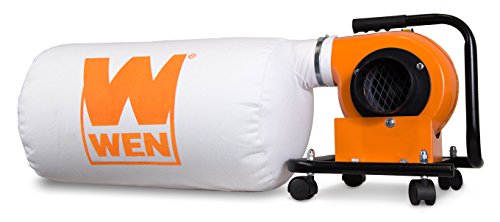
The WEN DC3401 is the compact pick in this guide, and it is the answer for a benchtop-only shop that wants chips off the floor for little money. Its 5.7-amp brushed motor drives a 6-inch impeller and moves up to 660 CFM through a 4-inch port, into a 12-gallon collection bag. The whole unit weighs 17 pounds, has a carrying handle, rides on a mobile base with casters, and can mount on a wall.
Small size is the point. This collector rolls to the machine in use, connects to one benchtop tool at a time, and stores on a shelf or a wall bracket when the work is done. It is the highest-charting true dust collector in the Amazon category among the picks here, which speaks to how many small shops choose exactly this pattern: one tool, one hose, one collector that moves. The 4-inch port matches the dust ports on most benchtop machines without an adapter.
The limits are plain. A 12-gallon bag fills fast on planer runs, so this unit suits short sessions and single-tool work rather than all-day milling. The 5-micron bag passes fine dust, like the DC1300 above. The brushed motor is a wear item over years of use, unlike the induction motors in the larger picks. It also needs a hose, which is a separate purchase.
The DC3401 suits a shop with benchtop tools, one machine at a time, and a tight floor plan. It does not suit a shop with full-size stationary machines or a fixed duct network. Confirm the live listing names model DC3401 as the standalone rolling collector, because WEN also sells a bundle of the DC3401 with the 3410 air filtration unit under a different listing, and the bundle is a different purchase.
The Grizzly G8027 is the portable 1 HP pick in this guide, and it is the simplest machine here: a 1 HP motor on 110 volts at 7.4 amps, rated at 500 CFM, with a single 4-inch inlet and a bag filter, on a portable base with casters. Grizzly lists it as a Best Value pick from WOOD Magazine, and it is the longest-running design among the five, with the same model number in use for years.
Portability is the reason to choose it. The unit rolls between machines, connects to one tool at a time, and stores against a wall. The 1 HP motor runs on a standard household circuit with no wiring work, and the single 4-inch inlet matches the dust ports on most small-shop machines. For a shop with a table saw, a band saw and a sander used one at a time, this pattern covers the work without a fixed duct run or a dedicated circuit.
The limits follow from the size. At 500 CFM it is the lowest-airflow pick in this guide, so a wide planer or jointer will push more chips than it can clear in a single pass. The bag filter is a cloth bag rather than a canister, so fine dust control is modest. The unit has no wall-mount option and no second inlet, so two-machine plumbing is not part of its design.
The G8027 suits a small shop that runs one machine at a time on standard household power and wants a proven portable collector. It does not suit a shop that needs to feed two machines at once or move the volume a full-size planer produces. Confirm the live listing names model G8027, because Grizzly sells larger collectors under nearby model numbers.
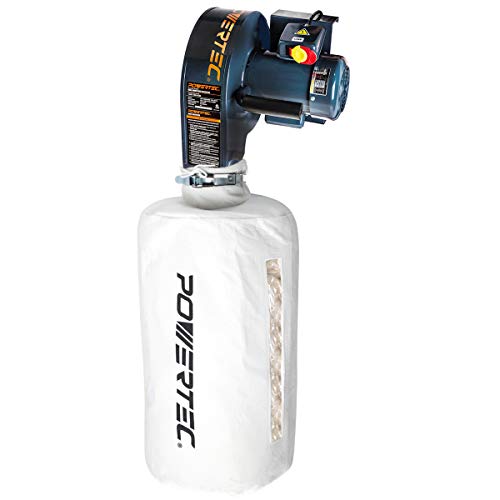
The POWERTEC DC5370 is the wall-mount pick in this guide, and it is the answer for a shop where floor space matters more than raw airflow. Its 1 HP induction motor is rated at 537 CFM, and it hangs on a wall bracket with a mounting bracket included, leaving the entire floor footprint free. The filter bag is rated at 2.5 microns, which is finer than the 5-micron bags on the WEN picks, and the 4-inch inlet connects to a single machine hose.
Wall mounting changes how a small shop feels. The collector sits above the work, the hose drops to the machine, and no floor space goes to a rolling base. The dual-voltage motor runs on 120 or 240 volts, which adds wiring flexibility. The bag has a viewing window to check the dust level and a zipper for emptying. The Vortex Base design guides airflow to reduce turbulence, and POWERTEC states it improves efficiency by up to 10 percent over a comparable model, which is a maker claim rather than a measured result.
The trade-offs are capacity and airflow. At 537 CFM it is a single-tool collector for short runs, and the small bag empties often on planer work. It has no casters and no mobile base, so it works best as a fixed station near the main machine. One listing conflict needs a live check: some listings for this wall-mount class show 560 CFM, which is the figure POWERTEC lists for the DC5371 sibling with a 1-micron bag. The DC5370 title lists 537 CFM with a 2.5-micron bag, so confirm the live listing names model DC5370 and the 2.5-micron bag before ordering.
The DC5370 suits a shop with a solid wall location, one main machine, and a floor plan that cannot spare space for a rolling unit. It does not suit a shop that needs to roll a collector between machines or feed two tools at once. Its stock evidence is the thinnest of the five picks, so open the listing live first and confirm a new unit with a buy option.
Comparison Table
Product
Motor
Airflow
Filtration
Inlet
Mounting
JET DC-1100VX-CK
1.5 HP
1,100 CFM
2-micron canister
6-inch or two 4-inch
Floor, casters
WEN DC1300
14-amp
1,300 CFM
5-micron bag
Two 4-inch
Floor, mobile base
WEN DC3401
5.7-amp
660 CFM
5-micron bag
4-inch
Rolling, optional wall mount
Grizzly G8027
1 HP
500 CFM
Bag filter
4-inch
Portable, casters
POWERTEC DC5370
1 HP
537 CFM
2.5-micron bag
4-inch
Wall mount
Frequently Asked Questions
How much airflow does a workshop dust collector need?
Match airflow to the machine and the hose. A benchtop sander or small band saw works with a compact 660 CFM unit on a short hose. A full-size table saw or jointer needs a 1,100 CFM canister unit or a 1,300 CFM dual-inlet unit, especially through a long hose with bends. Two machines plumbed at once need more air than one machine alone, and a blast gate on the idle line keeps the running machine fed. Listed CFM is a free-air figure, so the airflow at the tool is lower once a hose sits between the machine and the collector.
Bag filter or canister filter?
A cloth bag is cheaper, lighter and simpler to empty, and a 5-micron bag catches chips and coarse dust. A pleated canister rated at 2 microns catches more of the fine fraction and holds airflow longer as it loads. A canister costs more and adds bulk, and it needs a turn of the cleaning handle now and then. If sanding fills your shop with fine dust every day, choose the canister. If the work is mostly sawing and planing with chips rather than fine dust, a bag unit serves well, and an ambient air cleaner can handle the fines.
Can one collector serve a whole workshop?
A single-stage collector serves one machine at a time, or two machines with dual inlets and blast gates. A fixed duct network with several machines needs a larger collector, a separator to keep the bag empty longer, and a blast gate at each drop. Separators, ducting kits and hose kits are separate purchases that pair with a collector. For most small shops, a rolling collector moved between machines covers the work without any fixed plumbing.
How to Choose
Begin with the machines. List the tools that make dust, note the port size on each, and count how many run at once. A benchtop-only shop needs the compact WEN DC3401 or the portable Grizzly G8027. A shop with one full-size machine and a solid wall needs the POWERTEC DC5370. A two-machine shop needs the dual-inlet WEN DC1300. A shop that sands fine stock every day needs the canister-filter JET DC-1100VX-CK.
Then check the circuit. A 1 HP unit runs on a standard household circuit. The JET needs a 20-amp circuit at 115 volts, so confirm the wall can give it before ordering. Then measure the space: a wall-mount unit needs a solid wall and room to pull the bag, a floor unit needs floor space plus room to carry a full bag out, and a rolling unit needs a clear path between machines.
Finally, open each listing live before ordering and confirm a new unit with a buy option, because stock lines in roundups go stale fast. A collector that matches your machines, your circuit and your floor plan is the one that gets used every day.
Disclosure: As an Amazon Associate, we may earn a commission from qualifying purchases made through links in this article, at no additional cost to you.
J
JD's Woodworks Editorial Team
We compare specs, warranty terms, long-term owner feedback and street pricing before anything earns a spot. Rankings are never paid.
Affiliate disclosure. As an Amazon Associate we earn from qualifying purchases at no extra cost to you. Prices accurate as of the date shown.
Table saws under the 1500 mark compared: the Grizzly G0771Z and Shop Fox W1837 hybrid saws with cast iron tables, 2 HP motors and T-square fences, specs from their listings.
Table saws for fine woodworking compared: the SawStop Professional Cabinet Saw and Powermatic PM1000, judged on fence precision, table flatness and vibration from listing specs.
Table saw combos explained: saws sold with a stand and accessories in one listing, what to check in the box, and which bundle fits your shop or jobsite.
Compare the best planer digital thickness gauges and digital readout kits for portable planers, with fit, resolution and mounting checks before you buy.
Model table saws for scale modelling and hobby work compared: the precision Proxxon FET 37070 and the compact Saker mini table saw, with specs taken from their Amazon listings.
Three CoreXY 3D printers for product development, each with the architecture stated on its listing: an enclosed multicolor machine, a large-format enclosed model and a heated-chamber model.

 JET DC-1100VX-CK Vortex Cone Dust Collector
 WEN DC1300 Dust Collector
 WEN DC3401 Rolling Dust Collector
 Grizzly G8027 Dust Collector
 POWERTEC DC5370 Wall Mount Dust Collector









