The best 150 psi portable air compressor guide for garage and jobsite work, comparing six-gallon pancake picks on tank size, airflow, noise and carry weight.
The best 150 psi portable air compressor guide for garage and jobsite work, comparing six-gallon pancake picks on tank size, airflow, noise and carry weight.
As an Amazon Associate I earn from qualifying purchases. This post may contain affiliate links at no extra cost to you.
A portable air compressor with a one hundred fifty PSI maximum is the standard first compressor for a garage or a small jobsite. It runs brad nailers and finish nailers all day, fills tires, blows dust off a bench, and handles short bursts from an impact wrench. It does not run a sander or a spray gun without long pauses, and no six-gallon pancake in this guide pretends otherwise. This guide covers corded electric portable compressors with a one hundred fifty PSI maximum and a tank you can carry with one hand. Twelve-volt tire inflators and wall-mount units are different products and do not appear here. Every pick below is a real listing on Amazon US with a real ASIN, and every figure comes from the maker or the listing, not from a lab bench.
Tank size decides how long a tool runs before the motor cycles back on. A six-gallon tank at a one hundred fifty PSI maximum stores enough air for a nailer to fire a run of fasteners, then the pump refills the tank while you move to the next piece. A larger tank stores more air but weighs more and takes up more floor space, so the six-gallon pancake is the usual compromise for a portable unit.
Airflow at ninety PSI matters more than the maximum pressure number. The maximum tells you how much air the tank holds; airflow tells you how fast the pump replaces it. Most six-gallon pancakes in this class deliver two point six standard cubic feet per minute at ninety PSI. That pace keeps one nailer fed. It does not keep up with a tool that draws air without a pause, such as a random orbit sander or a paint gun. Check the airflow figure your tool needs against the compressor figure before you buy.
Noise is the figure buyers notice on the first day. Maker figures for the picks below run from the high seventies to the low eighties in decibels, and those figures come from the maker, not from a shared measurement method, so treat them as a rough guide rather than a promise. An oil-free pump needs no oil checks and no oil changes, and all three picks below use one. A carry handle, rubber feet, a drain valve at the bottom of the tank, and two quick couplers so a second hose can stay connected are the small features that make daily use easier. A hose and a few fittings in the box save a separate trip to the store, so note what each kit includes.
The Bostitch BTFP02012-WK is a six-gallon oil-free pancake compressor with a one hundred fifty PSI maximum and two point six standard cubic feet per minute at ninety PSI, measured per ISO1217. It ships as a thirteen-piece kit with a fifty-foot rubber and PVC blend hose, a blow gun with a safety nozzle, a tire chuck, a tire gauge, and inflation fittings. The fifty-foot hose is the longest in this guide and lets you reach the far end of a garage or the driveway without moving the tank.
Bostitch lists the motor at zero point eight horsepower and the weight at twenty-nine pounds, which makes this the lightest pick here. Two universal couplers let two users run hoses at the same time, and a high-flow regulator and couplers are meant to keep air moving to the tool. The pump is oil-free, so there is no oil to check and no oil to spill on a shop floor. The listing names a one-year limited warranty.
Noise is the one figure to read with care. Bostitch lists seventy-eight point five decibels, while the Amazon spec table for the same listing names eighty decibels. Both figures come from the listing, and the gap is small, but it shows why a single noise number should not decide the purchase. The Amazon listing for this kit was read on the product page, and fresh roundups from November 2026 link the same kit on Amazon US. The kit form matters: the compressor-only BTFP02012 and the WPK kit form share the same pump and tank, so confirm the listing you open names the WPK kit with the fifty-foot hose and the thirteen-piece accessory set before you order.
This pick suits a buyer who wants one box that covers the whole first setup. The hose, the blow gun, the chuck and the gauge arrive with the compressor, and the twenty-nine-pound body carries one-handed to a jobsite. It runs finish nailers, brad nailers, tire inflation and blow-down work. It does not run continuous-draw tools, and the six-gallon tank needs the pump to cycle during long nailing runs, which is normal for the class.
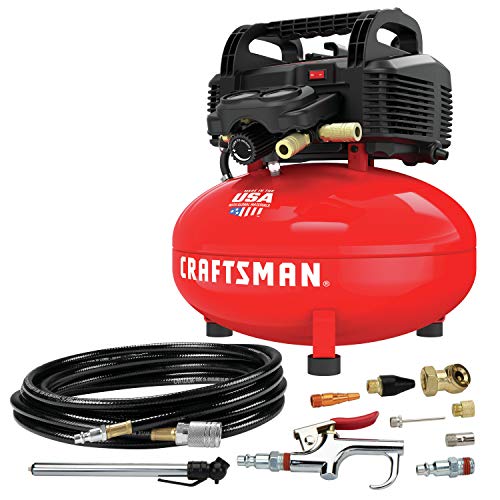
The Craftsman CMEC6150K is a six-gallon oil-free pancake compressor with a one hundred fifty PSI maximum, two point six standard cubic feet per minute at ninety PSI, and three point five standard cubic feet per minute at forty PSI, from a zero point eight horsepower motor on a one hundred twenty volt supply. It ships as a thirteen-piece kit with a twenty-five-foot hose, a tire chuck, a blow gun, a tire gauge, and fittings. Craftsman lists the weight at thirty pounds and notes the unit is made in the USA with global materials.
The CMEC6150K is the same class of machine as the Bostitch above, with the same tank size, the same maximum pressure, and the same airflow at ninety PSI. The differences are in the kit and the small details. The Craftsman hose is twenty-five feet, half the length of the Bostitch hose, so a buyer with a long garage may want a longer hose later. The listing names a one-year limited warranty, although some outside sources name a three-year limited warranty for this model, so confirm the warranty line on the live listing before you rely on it. One mirror showed the kit as unavailable sixteen days before this guide was written, while fresher mirrors and November 2026 roundups link the same kit on Amazon US, so open the listing live and confirm a new unit with a buy option before you order.
Noise is again a figure with two versions. Craftsman material in some roundups names seventy-eight point five decibels, while other roundups name eighty-two decibels for the same model. This guide uses the eighty-two decibel figure as the conservative one, and the gap is a reminder that maker noise figures are not measured the same way by every source. The compressor-only CMEC6150 and the CMEC6150K kit share the same pump and tank; the K kit form adds the thirteen-piece accessory set, so confirm the listing names the K kit form.
This pick suits a buyer who wants a first compressor and a first set of fittings in one box, with a thirty-pound body that carries easily. It covers trim nailing, inflation, and blow-down work. Like every pancake in this guide, it is an intermittent-duty machine: it fills the tank, the motor rests, and it refills when the tank pressure drops. It is not a machine for running a sander or a spray gun without pauses.
The ECOMAX 0210673A is a six-gallon oil-free pancake compressor with a one hundred fifty PSI maximum, sold with a ten-piece accessory kit that includes a twenty-five-foot PVC hose, a tire gauge, a blow gun, a chuck, and fittings. The listing names dual gauges and dual quick couplers, a flip-up carry handle, and a one hundred twenty volt supply. Fresh mirrors from the last few weeks tie this ASIN to model 0210673A, and November 2026 roundups link the same kit on Amazon US.
Read the listing with care before you order, because the same model number circulates in two forms. This ASIN names a one hundred fifty PSI maximum, while a separate listing for the same model number names a one hundred seventy-five PSI maximum. Both listings describe a six-gallon ECOMAX pancake, so confirm the live listing you open names the one hundred fifty PSI form and the ten-piece kit before you buy. The airflow figure on the listing is also garbled: it reads as three cubic inches per minute, which is a unit error on the listing, not a real airflow figure. Outside roundups put the airflow near two point six standard cubic feet per minute at ninety PSI, in line with the other picks here, but the listing itself does not give a clean airflow number, so confirm the figure on the live listing if airflow is the deciding factor for your tools.
Weight is another figure with two versions: some sources name around thirty pounds and others name thirty-four point one seven pounds. This guide does not assert either figure as settled. The tank is a pancake form with a carry handle, and the dual couplers let a second hose stay connected. The oil-free pump needs no oil checks. The listing names a ten-piece kit, which is three fewer accessories than the thirteen-piece kits above, so count the fittings you need before you choose between the kits.
This pick suits a buyer who wants the accessory kit in the box and a dual-coupler setup for two hoses. It covers the same jobs as the other picks here: trim nailing, inflation, and blow-down work. It does not run continuous-draw tools, and the garbled airflow figure on the listing is the main reason to open the live listing and confirm the numbers before you order.
Comparison
Compressor
Tank
Maximum pressure
Airflow at ninety PSI
Noise
Weight
Kit
Bostitch BTFP02012-WK
Six gallons
One hundred fifty PSI
Two point six SCFM
Seventy-eight point five dBA per maker, eighty dBA per Amazon table
Twenty-nine lb
Thirteen pieces, fifty-foot hose
Craftsman CMEC6150K
Six gallons
One hundred fifty PSI
Two point six SCFM
Eighty-two dBA
Thirty lb
Thirteen pieces, twenty-five-foot hose
ECOMAX 0210673A
Six gallons
One hundred fifty PSI
Near two point six SCFM per roundups, listing figure garbled
Not published
Thirty to thirty-four point one seven lb, sources differ
Ten pieces, twenty-five-foot hose
Frequently asked questions
Is a six-gallon pancake enough for framing nailers?
A six-gallon pancake runs a framing nailer in bursts, which is how framing work usually goes: fire a run of nails, move the lumber, fire again. The tank holds enough air for a burst, and the pump refills it while you reposition. What it does not do is feed a framing nailer firing without a pause for a long stretch, or run a tool that draws air without a pause. If your work is mostly trim, baseboard, and tire inflation, a six-gallon pancake is the right size. If you plan to run a framing crew all day on one compressor, a larger tank and a higher airflow figure fit the job better.
What does the one hundred fifty PSI maximum mean for tool runtime?
The maximum is the pressure the tank reaches before the pump switches off, and it sets how much air the tank stores. A higher maximum stores more air in the same tank, so the tool runs longer before the pump cycles back on. Your tools do not run at the tank maximum: a regulator drops the line pressure to the level each tool needs, often around ninety PSI for nailers. The airflow figure at ninety PSI is the number that decides whether the pump keeps up with the tool, so read the two figures together rather than judging a compressor by its maximum alone.
Do I need to drain the tank?
Yes. Air carries moisture, and the moisture collects at the bottom of the tank. Open the drain valve after each use and let the water out, especially in a humid shop. A tank left full of water rusts from the inside, and rust shortens the life of the tank. The drain valve sits at the bottom of the tank on all three picks here. Draining takes less than a minute and is the single easiest habit for keeping a small compressor in service for years.
How to choose
Match the compressor to the tools you already own. A brad nailer and a finish nailer need a modest airflow figure, and every pick here covers them. A framing nailer needs the same airflow in bursts, and the six-gallon tank covers a burst. A sander, a spray gun, or a die grinder needs more airflow than any six-gallon pancake in this guide delivers, so a buyer with those tools should look at a larger tank and a higher airflow figure instead.
Then weigh the kit against the hose. The Bostitch kit carries the longest hose in this guide at fifty feet, which matters in a long garage. The Craftsman kit carries a twenty-five-foot hose and a thirty-pound body. The ECOMAX kit carries ten accessories rather than thirteen, with dual couplers for a second hose. Noise figures differ by a few decibels across the picks, and the figures come from the maker, so do not let a small gap in the noise column decide the purchase. Open each listing live before you order, confirm the model number and the maximum pressure on the listing, and confirm a new unit with a buy option. The three picks here share a tank size, a maximum pressure, and an airflow class, so the choice comes down to the kit, the hose, and the weight you are willing to carry.
Disclosure: As an Amazon Associate, we may earn a commission from qualifying purchases made through links in this article, at no additional cost to you.
J
JD's Woodworks Editorial Team
We compare specs, warranty terms, long-term owner feedback and street pricing before anything earns a spot. Rankings are never paid.
Affiliate disclosure. As an Amazon Associate we earn from qualifying purchases at no extra cost to you. Prices accurate as of the date shown.
Table saws under the 1500 mark compared: the Grizzly G0771Z and Shop Fox W1837 hybrid saws with cast iron tables, 2 HP motors and T-square fences, specs from their listings.
Table saws for fine woodworking compared: the SawStop Professional Cabinet Saw and Powermatic PM1000, judged on fence precision, table flatness and vibration from listing specs.
Table saw combos explained: saws sold with a stand and accessories in one listing, what to check in the box, and which bundle fits your shop or jobsite.
Compare the best planer digital thickness gauges and digital readout kits for portable planers, with fit, resolution and mounting checks before you buy.
Model table saws for scale modelling and hobby work compared: the precision Proxxon FET 37070 and the compact Saker mini table saw, with specs taken from their Amazon listings.
Three CoreXY 3D printers for product development, each with the architecture stated on its listing: an enclosed multicolor machine, a large-format enclosed model and a heated-chamber model.


 Bostitch BTFP02012-WK 6-Gallon Oil-Free Pancake Compressor Kit









