As an Amazon Associate I earn from qualifying purchases. This post may contain affiliate links at no extra cost to you.
A Prusa i3 owner shopping for an extruder is really deciding how filament should reach the hotend on their machine. The stock extruder works well for rigid filament, but it can struggle with soft flexible filament, wear out after long service, or limit print speed when retractions get demanding. The choice comes down to staying with a Bowden setup or moving the extruder onto the print head, and to how much grip, weight, and firmware work each option brings with it.
This guide is for Prusa i3 MK2, MK3, and MK3S owners who want steadier feeding, for builders putting together a DIY i3 frame, and for anyone replacing a worn or slipping stock extruder. The three extruders below were chosen from names and specifications shown on Amazon product pages, and each one fits a different way of running a Prusa i3.
Quick Picks
As an Amazon Associate we earn from qualifying purchases
Product
Best for
Key spec
Bondtech BMG Extruder
Steady dual-gear Bowden feeding on a stock-style setup
3 to 1 gear ratio, 1.75 mm filament
BIQU H2 V2S Direct Drive Extruder
Flexible filament and a direct-drive conversion
770 N dual-gear force, 195 g weight
WINSINN Dual Gear Extruder
A low-cost dual-gear replacement on a DIY build
Dual-gear feed, TPU filament compatible
How to Choose
Bowden or Direct Drive
A Bowden extruder sits on the printer frame and pushes filament through a long tube to the hotend, which keeps the moving print head light and fast. A direct-drive extruder mounts on the print head itself, so filament travels only a short distance before melting. That short path gives far better control over soft and flexible filament, because the filament cannot buckle inside a long tube. Direct drive adds weight to the X carriage, so print speeds and acceleration may need retuning after the swap. Prusa i3 machines already carry a direct-drive style head, so a Bowden unit changes the feeding style rather than swapping like for like, and the mount and tube routing need checking first.
Gear Ratio and Grip
Gear ratio decides how much pushing force the extruder delivers for each turn of the stepper motor. A geared design such as a 3 to 1 set multiplies torque, so the drive gears grip filament without grinding it, and a smaller, lighter motor can do the same work. Dual-drive gears grip the filament from both sides instead of pressing it against an idler bearing, which doubles the contact area and makes slipping less likely during fast retractions. Single-gear extruders cost less, but they chew through filament when retraction counts climb or the nozzle runs at high flow. Check the gear material too, since hardened steel gears resist wear from abrasive filament longer than brass or soft steel.
Filament Range
The filament you plan to print should drive the extruder choice more than any other factor. Rigid PLA and PETG feed happily through almost any working extruder, so a basic dual-gear unit is enough for those materials. Soft TPU and other flexible filaments need a constrained filament path with no gaps where the strand can buckle, so direct-drive extruders with a short, guided path handle them best. Abrasive filaments with carbon fiber, wood, or glow additives wear down soft drive gears and brass nozzles, so hardened steel gears and a hardened nozzle belong on the list together. If you only ever print PLA, a high-temperature all-metal extruder and hotend buys capability you will never use.
Weight, Mounting, and Firmware
Every extruder swap changes the weight on the X carriage, the mounting pattern, or the firmware settings. A direct-drive unit can introduce ringing on prints unless acceleration and jerk settings are retuned, while a light Bowden unit keeps the head nimble but needs a tube run and a frame mount. Check the motor shaft diameter and length, the mounting hole pattern, and whether a motor is included or you reuse the original. Geared extruders need a new E-steps value in firmware, because one motor revolution now moves a different length of filament. For the Bondtech BMG family that value is 415 steps per millimeter at microstepping, and skipping this step causes under-extrusion on the first print.
The 3 Best Options
Bondtech BMG Extruder
Top Pick
Bondtech BMG Extruder
Best for: Prusa i3 owners who want a proven dual-gear Bowden upgrade with strong grip and light weight.
The Bondtech BMG is the dual-gear extruder that designs are measured against, and it is a Prusa i3 upgrade for a machine that stays on a Bowden-style feed. Its 3 to 1 internal gearing multiplies the torque of a NEMA 17 motor, while hardened steel drive gears grip 1.75 mm filament from both sides for feeding on jobs. The SLS-printed nylon housing keeps the body light, and a thumbscrew tensioner lets you adjust filament pressure without tools. It mounts to a groove-mount hotend interface, so it pairs with the E3D V6 hotend family on Prusa i3 machines, and the E-steps value simplifies setup.
Watch out for: the extruder is sold without a motor, so confirm you have a compatible NEMA 17 motor or buy one separately.
BIQU H2 V2S Direct Drive Extruder
Runner-Up
BIQU H2 V2S Direct Drive Extruder
Best for: Prusa i3 builders converting to direct drive for flexible filament and high-temperature materials.
The BIQU H2 V2S is a direct-drive extruder built for Prusa i3 DIY kits and other machines that need strong short-path feeding. Its dual-gear drive delivers 770 N of extrusion force through a 7 to 1 gear set, which grips flexible filament firmly through fast retractions. The all-metal hotend handles temperatures up to 270 degrees Celsius, so it covers high-temperature materials and everyday PLA and PETG. At 195 g it keeps the print head light for a direct-drive unit, and its 24 V design matches most Prusa i3 power supplies. It suits owners who want the extruder on the carriage to print soft materials.
Watch out for: a direct-drive conversion changes carriage weight and wiring, so check the mount, fan duct, and cable routing before ordering.
WINSINN Dual Gear Extruder
WINSINN Dual Gear Extruder
Best for: DIY Prusa i3 builders who want a cheap dual-gear replacement for a worn stock extruder.
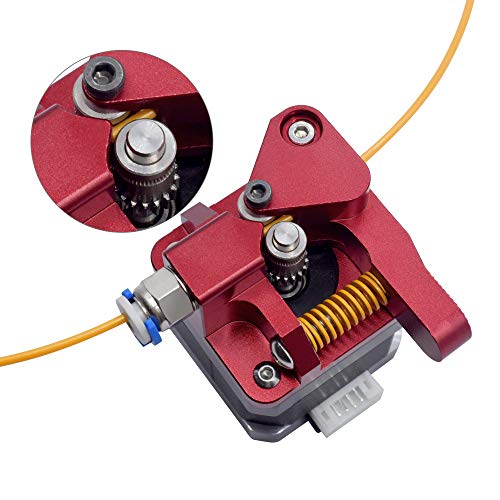
The WINSINN dual gear extruder is a low-cost way to replace a slipping stock feeder on a DIY Prusa i3 build. Two drive gears grip the filament from both sides, which feeds more steadily than the stock single-gear design and helps with TPU that a worn original would grind or stall on. The listing calls for a motor shaft longer than 20 mm, so it is worth measuring the stepper before fitting. Its MK8-style mounting suits the NEMA 17 motors used across Prusa i3 frames, and fitting takes a screwdriver and a fresh E-steps calibration. It is a first upgrade rather than a premium component.
Watch out for: the listing names Ender 3 and CR-10 machines first, so confirm the mount pattern and motor shaft length against your own Prusa i3 frame.
Which One Fits Your Situation
You Print Mostly PLA and PETG and Want a Reliable Upgrade
Choose the Bondtech BMG Extruder. Its dual-drive hardened steel gears and 3 to 1 gearing give steadier feeding than a single-gear stock unit, and the light nylon housing keeps the print head nimble. It is the simplest path to fewer failed prints without changing the whole feeding style of the machine.
You Print Flexible Filament Often
Choose the BIQU H2 V2S Direct Drive Extruder. The short direct-drive path stops soft TPU from buckling the way it can inside a long Bowden tube, and the 770 N dual-gear drive holds the filament firmly through retractions. The all-metal hotend also leaves room to try higher-temperature flexible materials later.
You Are Rebuilding a DIY i3 on a Tight Budget
Choose the WINSINN Dual Gear Extruder. It replaces a worn single-gear feeder with a dual-gear design for very little outlay, and its universal mount fits the NEMA 17 motors used on most DIY Prusa i3 frames. Measure the motor shaft before you order, then calibrate E-steps after fitting.
You Want the Most Proven Geared Extruder With Wide Community Support
Choose the Bondtech BMG Extruder. It has been fitted to Prusa i3 machines for years, so mounts, firmware values, and troubleshooting guides are easy to find online. The documented E-steps value of 415 and the standard groove-mount interface make setup predictable even for first-time upgraders, with no guesswork about the settings.
Common Mistakes
Buying an extruder without checking the motor shaft diameter and length, the mounting hole pattern, and whether a motor is included in the kit.
Forgetting to update the E-steps value in firmware after fitting a geared extruder, which causes severe under-extrusion on the first print.
Trying to print soft TPU through a long Bowden tube with a loose filament path, where the strand buckles instead of feeding.
Fitting a heavy direct-drive extruder without retuning acceleration and checking that the fan duct and wiring still clear the frame.
Assuming every extruder fits every Prusa i3 generation, when MK2, MK3, and MK3S carriages and mounts differ enough to matter.
Frequently Asked Questions
Will these extruders fit a Prusa i3 MK3S?
The Bondtech BMG and BIQU H2 V2S are sold for Prusa i3 machines and DIY i3 kits, but fitting depends on the carriage, mount, and hotend you already have. Check the mounting pattern, motor size, and hotend interface against your printer before ordering, and expect a printed adapter or a new X carriage part for some combinations. A quick check of the mount and motor saves a return.
Do I need to change firmware after swapping extruders?
Yes, whenever the gear ratio changes. A geared extruder moves a different length of filament per motor revolution, so the E-steps value must be updated and calibrated. The Bondtech BMG uses 415 steps per millimeter at standard microstepping, and the value should be verified with a measured extrusion test after fitting any new extruder. A short extrusion test confirms the new value.
Can a Bowden extruder print TPU?
It can, but only with limits. A Bowden tube gives soft filament room to buckle, so only firmer grades of TPU print reliably, and print speed and retraction need to stay low. A direct-drive extruder with a short, constrained filament path handles soft and flexible grades far better and is the safer choice for regular TPU printing. Keep speeds low and retraction short for the best results.
Is direct drive or Bowden better for a Prusa i3?
Direct drive suits flexible filament and gives tighter retraction control, while Bowden keeps the print head lighter for faster moves on rigid filament. Prusa i3 machines already carry the extruder on the carriage, so a direct-drive upgrade is the more natural fit, while a Bowden unit is a bigger change in feeding style that needs a frame mount and tube routing. Choose by filament.
J
JD's Woodworks Editorial Team
We compare specs, warranty terms, long-term owner feedback and street pricing before anything earns a spot. Rankings are never paid.
Affiliate disclosure. As an Amazon Associate we earn from qualifying purchases at no extra cost to you. Prices accurate as of the date shown.
Table saws under the 1500 mark compared: the Grizzly G0771Z and Shop Fox W1837 hybrid saws with cast iron tables, 2 HP motors and T-square fences, specs from their listings.
Table saws for fine woodworking compared: the SawStop Professional Cabinet Saw and Powermatic PM1000, judged on fence precision, table flatness and vibration from listing specs.
Table saw combos explained: saws sold with a stand and accessories in one listing, what to check in the box, and which bundle fits your shop or jobsite.
Compare the best planer digital thickness gauges and digital readout kits for portable planers, with fit, resolution and mounting checks before you buy.
Model table saws for scale modelling and hobby work compared: the precision Proxxon FET 37070 and the compact Saker mini table saw, with specs taken from their Amazon listings.
Three CoreXY 3D printers for product development, each with the architecture stated on its listing: an enclosed multicolor machine, a large-format enclosed model and a heated-chamber model.