3 Best 6000W Portable Generators for Home (November 2026)
Compare the best 6000W portable generators for home backup, RV trips, and job sites, with dual-fuel and inverter picks, wattage guidance, and outlet tips.
Compare the best 6000W portable generators for home backup, RV trips, and job sites, with dual-fuel and inverter picks, wattage guidance, and outlet tips.
As an Amazon Associate I earn from qualifying purchases. This post may contain affiliate links at no extra cost to you.
A 6000-watt portable generator sits in a useful middle ground: strong enough to keep a refrigerator, a freezer, lights, and a few power tools running during an outage, yet still light enough to roll out of a garage and load into a truck bed. The real decision is not the headline wattage, because every model in this class prints 6000 on the box. It is the running watts underneath, the fuel you can actually buy during a storm, and whether the power is clean enough for sensitive electronics.
This guide is for homeowners preparing for outages, RV owners who need a 120/240V hookup at a campsite, and anyone running tools away from a wall outlet. The three generators below were chosen from names and specifications on their Amazon listings, covering a dual-fuel inverter with remote start, a gasoline-only open-frame inverter, and a dual-fuel open-frame workhorse.
Quick Picks
As an Amazon Associate we earn from qualifying purchases
Product
Best for
Key spec
GENMAX GM6000iED
Home backup with propane as a second fuel
6000 starting watts, dual fuel, remote start
GENMAX GM6000XiE
Clean inverter power for RVs and electronics
6000 starting watts, 5250 running watts, electric start
A-iPower SUA6000ED
Long runs on a job site or during an outage
6000 starting watts on gasoline, 4-gallon tank
How to Choose
Starting watts versus running watts
Every generator in this class advertises 6000 starting watts, but that number only covers the brief surge when a motor starts. Running watts are what the generator can sustain all day, and the models here deliver between 5000 and 5500 running watts. Add up the running watts of everything you plan to power at once, then add the largest starting surge on top, usually a refrigerator compressor or a well pump. If that total sits above the running watts, the generator will trip its breaker or stall. A unit with 5500 running watts gives you more headroom for a second large appliance than one with 5000, so compare the running figure first and treat the starting figure as a bonus.
Inverter power versus open-frame power
Inverter generators turn the engine output into clean, stable power with low total harmonic distortion, which matters for laptops, televisions, routers, and battery chargers. Open-frame generators cost less per watt and are built for brute-force jobs, but their power can be rougher on sensitive electronics. Two of the picks below are inverters, and one is an open-frame unit. Choose an inverter when you plan to charge devices or run a modern furnace board, and choose an open-frame unit when the load is mostly motors, heaters, and lights. Noise is another split: inverters tend to run quieter, which matters at a campsite or in a neighborhood during a long outage.
Fuel choice: gasoline, propane, or dual fuel
Gasoline is easy to find and carries more energy per gallon, but it goes stale in storage and can gum up a carburetor if the generator sits for months. Propane stores for years without degrading, burns cleaner, and is easy to keep in standard tanks, though a dual-fuel unit makes slightly less power on propane than on gasoline. Two of the three generators below run on both fuels, so you can start an outage on gasoline and switch to propane when the gas station lines get long. If you only want one fuel, gasoline is the simpler choice for short outages, while propane suits buyers who want a tank sitting ready in the garage for years.
Outlets, runtime, and moving the unit
Count the outlets before you buy, because a generator with only household outlets cannot feed a transfer switch or a large RV cord. Look for a 120/240V locking outlet for home backup and an RV-ready outlet for a camper, plus enough standard outlets for the smaller loads. Runtime matters just as much: a bigger tank and a lower load stretch each fill, and the models here run from about six and a half hours to about thirteen hours depending on the load. Finally, check the weight and the wheels. These units weigh roughly 107 to 118 pounds, so a telescopic handle and solid wheels are not luxuries; they decide whether one person can actually move the generator alone.
The 3 Best Options
GENMAX GM6000iED
Top Pick
GENMAX GM6000iED
Best for: Homeowners who want clean inverter power, a propane backup, and remote start in one unit.
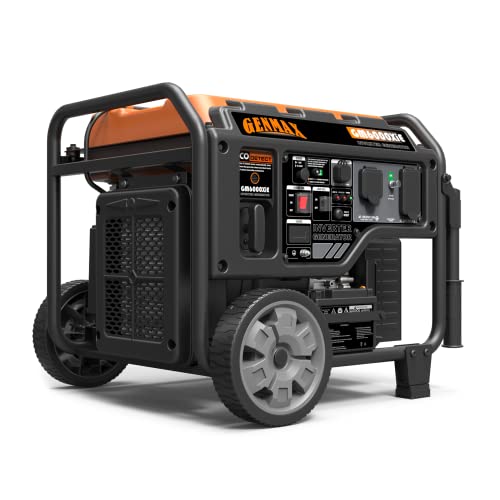
The GM6000iED is the most flexible generator here because it pairs inverter power with dual fuel and a remote start. Its 312cc engine delivers 6000 starting watts and 5250 running watts, and a dial on the control panel switches between gasoline and propane on the fly. Remote start means you can fire it up from inside the house, and the automatic choke keeps starting simple. A telescopic handle and two rolling wheels make a 118-pound unit manageable, and CO detection adds a layer of safety during outages.
Watch out for: Confirm the propane hose and regulator are in the box, and keep the remote start battery charged so the remote works when an outage hits.
GENMAX GM6000XiE
Runner-Up
GENMAX GM6000XiE
Best for: RV owners and homeowners who want quiet inverter power on gasoline and a locking outlet for a transfer switch.
The GM6000XiE is the gasoline-only sibling here, built as an open-frame inverter for buyers who do not need propane. It uses the same 312cc engine and the same 6000 starting watts and 5250 running watts, with identical output on gasoline. What changes is the package: a lighter open frame, electric start backed by recoil, an hour meter with LED indicators, and a 120/240V 30A locking outlet for a transfer switch or a large RV cord. Its listed sound level is 70 dBA, and it can run up to 13 hours at quarter load for overnight outage coverage.
Watch out for: This model runs on gasoline only, so there is no propane fallback if fuel stations run dry during a long outage.
A-iPower SUA6000ED
A-iPower SUA6000ED
Best for: Job sites and long outages where maximum running watts and a large tank matter more than quiet inverter power.
Starting watts: 6000 watts on gasoline, 5500 watts on propane
Running watts: 5500 watts on gasoline, 5000 watts on propane
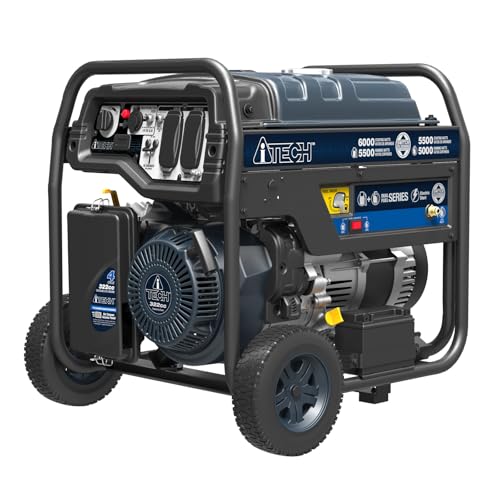
The SUA6000ED is the workhorse here, a dual-fuel open-frame generator with the highest running watts in this guide. On gasoline it delivers 6000 starting watts and 5500 running watts, and on propane it delivers 5500 starting watts and 5000 running watts, for a larger load. Its 322cc engine and 4-gallon tank provide up to six and a half hours at half load, and electric start avoids pull-cord struggles. A CO sensor and low oil shutdown cover common failures, and the outlet panel includes GFCI household outlets, a 120/240V 30A outlet, and a 12V charging receptacle.
Watch out for: This is an open-frame unit, so check the listed sound level before placing it near bedrooms or a neighbor’s fence line.
Which One Fits Your Situation
Keeping a home running through an outage
Pick the GENMAX GM6000iED. Its 5250 running watts cover a refrigerator, a freezer, lights, and a phone charger at once, and the dual-fuel design lets you switch to propane when gasoline is hard to find. Remote start is genuinely useful in bad weather, since you can start the unit without standing in the rain, and the CO detection shuts the generator down if exhaust builds up near the house.
Powering an RV or sensitive electronics
Pick the GENMAX GM6000XiE. Inverter power with low total harmonic distortion is the right call for laptops, televisions, and modern appliance controls, and the 120/240V 30A locking outlet connects cleanly to an RV cord or a transfer switch. At 106.9 pounds it is the lightest pick here, and the long runtime at quarter load stretches a single tank through the night.
Running tools on a job site
Pick the A-iPower SUA6000ED. Its 5500 running watts on gasoline give you the most headroom for saws, compressors, and chargers running together, and the 4-gallon tank keeps refueling breaks short. Electric start saves your shoulder on cold mornings, and the GFCI outlets add protection on a damp site. Keep it outside and downwind, since open-frame units are louder than inverters.
Storing fuel for a long storm season
Pick the GENMAX GM6000iED again, for the propane option. A propane tank can sit in the garage for years without going stale, while gasoline needs stabilizer and rotation to stay usable. With this unit you can keep the generator fueled and ready on propane, then run it on gasoline when a storm is forecast and fresh fuel is easy to buy.
Common Mistakes
Buying on starting watts alone and overloading the generator once the running watts are exceeded.
Running a generator inside a garage, shed, or near an open window, where carbon monoxide can build up quickly.
Forgetting to add the starting surge of a refrigerator or well pump to the load math.
Leaving untreated gasoline in the tank for months, then fighting a gummed-up carburetor during an outage.
Using a long, thin extension cord that overheats or starves a tool of voltage.
Frequently Asked Questions
What can a 6000W portable generator run?
A 6000-watt portable generator can run a refrigerator, a freezer, lights, a television, phone chargers, and a few small appliances at the same time, as long as the combined running watts stay under the rated output. Larger loads such as a well pump, a central air conditioner, or an electric water heater usually need more power or careful load management, so add up your loads before you buy.
How long will a 6000W generator run on a tank?
Runtime depends on the tank size and the load. The models in this guide run from about six and a half hours at half load to about thirteen hours at quarter load. Running fewer appliances stretches each tank, and keeping spare fuel on hand matters more than squeezing an extra hour out of a single fill during a long outage.
Do I need an inverter generator?
You need inverter power if you plan to run laptops, televisions, routers, or modern furnace controls, because inverters produce cleaner power with low total harmonic distortion. If your loads are mostly motors, heaters, and lights, an open-frame generator works fine and usually costs less per watt. Many buyers choose an inverter for peace of mind even when the load does not strictly require it.
Can I connect a portable generator to my house panel?
Yes, but only through a proper transfer switch or an interlock kit installed by a licensed electrician. Never plug a generator into a wall outlet, because backfeeding can energize power lines and endanger utility workers. A 120/240V locking outlet on the generator connects to the transfer switch, letting you power selected circuits safely during an outage.
J
JD's Woodworks Editorial Team
We compare specs, warranty terms, long-term owner feedback and street pricing before anything earns a spot. Rankings are never paid.
Affiliate disclosure. As an Amazon Associate we earn from qualifying purchases at no extra cost to you. Prices accurate as of the date shown.
Table saws under the 1500 mark compared: the Grizzly G0771Z and Shop Fox W1837 hybrid saws with cast iron tables, 2 HP motors and T-square fences, specs from their listings.
Table saws for fine woodworking compared: the SawStop Professional Cabinet Saw and Powermatic PM1000, judged on fence precision, table flatness and vibration from listing specs.
Table saw combos explained: saws sold with a stand and accessories in one listing, what to check in the box, and which bundle fits your shop or jobsite.
Compare the best planer digital thickness gauges and digital readout kits for portable planers, with fit, resolution and mounting checks before you buy.
Model table saws for scale modelling and hobby work compared: the precision Proxxon FET 37070 and the compact Saker mini table saw, with specs taken from their Amazon listings.
Three CoreXY 3D printers for product development, each with the architecture stated on its listing: an enclosed multicolor machine, a large-format enclosed model and a heated-chamber model.