As an Amazon Associate I earn from qualifying purchases. This post may contain affiliate links at no extra cost to you.
Cutting a curve on a bandsaw is a different job from ripping a straight board, and the saw that does one well does not always do the other. A curve cut depends on a narrow blade that can turn without binding, a throat deep enough to swing the workpiece, and guides that hold the blade steady while the wood changes direction. Buy too wide a blade or too small a throat and the cut wanders, the blade drifts off the line, or the workpiece simply will not fit around the turn.
This guide is for woodworkers who cut rounded chair parts, arched aprons, curved templates, toy wheels, and scrollwork shapes, and for beginners setting up a first small shop saw. The five bandsaws below were chosen from the names and specifications on their Amazon product pages, with the emphasis on narrow-blade support, throat capacity, and the table and guide features that matter when the cut is never straight.
Quick Picks
As an Amazon Associate we earn from qualifying purchases
Product
Best for
Key spec
SKIL 3386-01 9-Inch Band Saw
Beginners cutting their first curves on a benchtop
9-inch throat, blades from 1/8 inch wide
WEN 3962 10-Inch Two-Speed Band Saw
Hobby shops that want a stand-mounted saw with two speeds
9-3/4 inch throat, 1520 or 2620 FPM
RIKON 10-305 10-Inch Bandsaw
Small shops that want a fence included for mixed work
9-5/8 inch throat, 1/3 HP motor
RIKON 10-3061 10-Inch Deluxe Bandsaw
Makers who want tool-less guides and two speeds
1/2 HP motor, 1515 or 3280 FPM
WOODSKIL 9-Inch 3-Amp Band Saw
Compact benches where a light saw must still turn tight radii
3-amp motor, blades from 1/8 inch wide
How to Choose
Blade width decides the tightest curve
The narrowest blade a saw accepts sets the smallest radius it can follow. A 1/8-inch blade turns a much tighter circle than a 1/4-inch blade, so a saw that lists 1/8 inch as its minimum width is the better pick for scrollwork, toy parts, and tight inside curves. Wider blades cut straighter and last longer on long runs, but they resist turning and will bind or twist when forced around a bend. Check the blade-width range in the listing before buying, and plan on keeping a narrow blade fitted for curve work and a wider one for straight cuts.
Throat size limits the workpiece, not the cut
Throat depth is the distance from the blade to the saw frame, and it decides how wide a board you can swing through a curve. A 9-inch throat handles chair seats, small table aprons, and most craft pieces, while a 9-3/4-inch throat gives a little more room for larger rounded panels. Measure the widest piece you expect to curve, add a couple of inches for handling, and compare that number with the throat figure. A saw with too little throat forces you to cut curves in sections, which leaves visible joints.
Speed control protects thin and hard stock
A single-speed saw runs one blade speed for every material, which is fine for softwood but can scorch hardwood or melt plastic on a slow, tight turn. Two-speed saws let you drop to the slower setting for dense hardwood and thin veneer, then switch up for fast cuts in softwood. Slower speeds also give a beginner more time to steer through a curve without the blade grabbing. If you cut a mix of hardwoods, softwoods, and occasional non-ferrous metal, two speeds are worth having.
Table size and blade guides steady the work
Curved cuts need the workpiece to glide and pivot smoothly, so a generous table matters more than it does for straight ripping. A table around 12 by 12 inches or larger supports the board through the turn without tipping, and a table that tilts to 45 degrees opens up beveled curved edges. Blade guides matter just as much: upper and lower guides that sit close to the blade keep it from twisting sideways mid-curve, and tool-less guide adjustment means you will actually reset them when you change blade widths.
The 5 Best Options
SKIL 3386-01 9-Inch Band Saw
The SKIL 3386-01 is the smallest saw in this roundup and the most direct choice for a beginner who mainly cuts curves. Its 9-inch throat is sized for craft pieces, toy parts, and small furniture components, and it accepts blades from 1/8 inch wide, which is the width that turns the tightest radii. An articulating LED work light sits over the cut line so you can see a pencil line clearly, and the rack and pinion table adjustment makes quick angle changes simple when a curved edge also needs a bevel.
Specs
Motor: 2.5 amp, 120V
Blade speed: 2,800 SFPM
Throat capacity: 9 inches
Maximum cutting capacity: 3-1/2 inches
Table dimensions: 12 x 11-3/4 inches
Blade type: 1/8 inch to 3/8 inch, 59-1/4 to 59-1/2 inches
Included: rip fence, miter gauge, 6 TPI blade, LED work light
Dust port: 1-1/2 inch
Best for: Beginners cutting tight curves on small craft and furniture parts.
Watch out for: The 3-1/2 inch cutting height limits thick stock, so check the thickness of your curved pieces before ordering.
WEN 3962 10-Inch Two-Speed Band Saw
The WEN 3962 is a stand-mounted 10-inch saw that suits a hobby shop better than a benchtop model, because the included stand puts the table at a comfortable working height for steering long curved pieces. Its two speeds cover the two situations curve cutting creates most often: the slower speed for dense hardwood and careful turns, and the faster speed for softwood and long sweeping arcs. The blade range runs from 1/8 inch to 1/2 inch, so the same saw can carry a narrow curve blade or a wider blade for straight work.
Specs
Motor: 3.5 amp, 120V, 60 Hz
Blade speeds: 1520 or 2620 FPM
Throat: 9-3/4 inches
Maximum workpiece thickness: 6 inches
Blade length: 72 inches
Blade width: 1/8 to 1/2 inch
Work table: 14-1/8 x 12-1/2 inches, bevels 0 to 45 degrees
Included: stand, fence, miter gauge, work light, 3-in-1 dust port
Warranty: two-year
Best for: Hobby shops that want a floor-standing saw with two speeds for mixed curve work.
Watch out for: The saw is heavy with its stand, so confirm where it will live in the shop before it arrives.
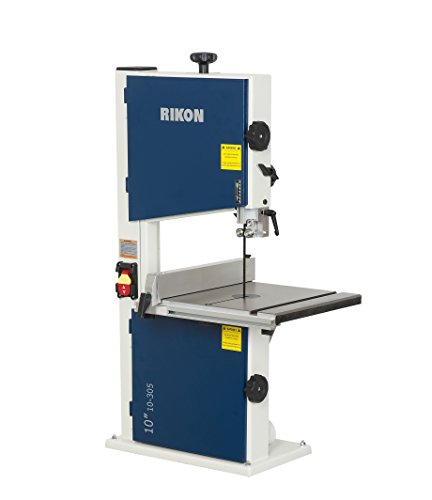
RIKON 10-305 10-Inch Bandsaw
Top Pick
RIKON 10-305 10-Inch Bandsaw
Best for: Small shops that want a fenced benchtop saw for curves plus occasional straight cuts.
The RIKON 10-305 is a compact benchtop saw that ships with a rip fence, which makes it a practical pick for a small shop that cuts curves most of the time but still needs straight cuts. Its 10-inch wheels run a 70-1/2 inch blade in widths from 1/8 inch to 1/2 inch, so a narrow blade for scrollwork and a wider blade for ripping can share the same machine. The 9-5/8 inch throat and 4-5/8 inch cutting height cover the rounded parts found in most small furniture and cabinet projects.
Watch out for: The single speed means dense hardwood curves need a slow, steady feed, so plan the feed rate before starting a tight turn.
RIKON 10-3061 10-Inch Deluxe Bandsaw
Runner-Up
RIKON 10-3061 10-Inch Deluxe Bandsaw
Best for: Makers who swap blades often and want tool-less guides and two speeds.
The RIKON 10-3061 is the upgraded 10-inch benchtop model in this roundup, and its strongest feature for curve work is the tool-less blade guide system. Changing from a wide ripping blade to a narrow curve blade means resetting the guides, and tool-less adjustment makes that a quick job instead of a chore you skip. Two blade speeds, a 1/2 HP motor, and a 5-inch cutting height give it more headroom than the smaller benchtop saws, while the cast iron table tilts 5 degrees left and 45 degrees right for beveled curves.
Watch out for: A 1/8 inch blade needs an aftermarket blade stabilizer on this saw, so budget for that accessory if tight scrollwork is the main job.
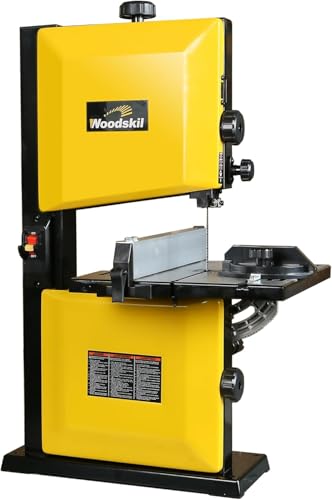
WOODSKIL 9-Inch 3-Amp Band Saw
WOODSKIL 9-Inch 3-Amp Band Saw
Best for: Compact benches where a light saw must still handle tight-radius curves.
The WOODSKIL 9-inch saw is the lightest machine in this roundup, which makes it a good fit for a crowded bench where the saw gets moved aside between jobs. It runs a 3-amp motor at 2500 FPM and accepts blades from 1/8 inch to 3/8 inch wide, so a narrow blade for tight radii fits without modification. The cast aluminum table tilts from 0 to 45 degrees and comes with a 120-degree miter gauge, and a removable safety key prevents accidental starts in a shared or family workshop.
Watch out for: The 3-1/2 inch cutting depth and lighter build suit thin stock best, so thick curved blanks may need a larger saw.
Which One Fits Your Situation
First saw for learning curves
Pick the SKIL 3386-01. Its 9-inch throat and 1/8-inch minimum blade width cover the tight turns a beginner practices on, the LED light keeps the cut line visible, and the benchtop size fits a small bench. The low cutting height is a fair trade for a first saw that teaches steering and feed control.
Hobby shop with room for a stand-mounted saw
Pick the WEN 3962. The stand puts the table at a natural height for guiding long curved pieces, the two speeds handle hardwood and softwood differently, and the 6-inch cutting height covers thicker curved blanks. It is the most versatile saw here for a shop that cuts curves several times a week.
Small shop that also rips straight boards
Pick the RIKON 10-305. The included rip fence makes straight cuts accurate, while the 1/8-inch minimum blade width keeps tight curves possible on the same machine. Its 9-5/8 inch throat and cast-size table suit furniture parts, and the benchtop footprint leaves bench space free.
Frequent blade changes between curves and straight cuts
Pick the RIKON 10-3061. Tool-less guides make blade swaps fast, the two speeds cover dense and soft stock, and the 5-inch cutting height adds headroom for thicker work. The cast iron table stays flat under heavier pieces, and the 5-year warranty is also the longest coverage among these five saws.
Common Mistakes
Fitting a wide blade for a tight curve, then forcing the turn until the blade twists or binds in the kerf.
Choosing a saw by wheel size alone and ignoring throat depth, which is what decides whether a wide curved panel fits.
Running one speed for every material, so dense hardwood scorches on slow turns or softwood tears on fast ones.
Leaving the blade guides far from the blade, which lets the blade deflect sideways halfway through a curve.
Feeding a curved cut too fast, which pushes the blade off the marked line and leaves a wavy edge to clean up later.
Frequently Asked Questions
What blade width should I use for cutting curves on a bandsaw?
Use the narrowest blade your saw accepts for tight curves, usually 1/8 inch, because a narrow blade turns a smaller radius without binding. Step up to 3/16 inch or 1/4 inch for gentler arcs and thicker stock, where the extra beam strength keeps the cut steady. Match the blade to the radius: the tighter the curve, the narrower the blade needs to be.
Can a 9-inch bandsaw cut curves in thick hardwood?
A 9-inch saw cuts curves in hardwood up to its cutting height, usually around 3-1/2 inches, but the feed must be slow and steady. Dense hardwood needs a sharp blade, a slow feed, and a narrow blade that can turn without twisting. For curved blanks thicker than the saw’s cutting height, a larger saw or cutting in sections is the practical answer.
Why does my bandsaw blade wander when I cut a curve?
Wandering usually comes from a blade that is too wide for the radius, guides set too far from the blade, or dull teeth that drift instead of cutting. Check the blade width against the curve radius first, then move the upper and lower guides close to the blade. A fresh narrow blade and a slow, even feed solve most wandering.
Do I need a two-speed bandsaw for curve cutting?
Two speeds help when you cut more than one material, since the slower speed suits dense hardwood and the faster speed suits softwood and long sweeping curves. A single-speed saw still cuts curves well in one material type, so the extra speed is a convenience rather than a requirement. If your work mixes hardwoods and softwoods, two speeds are worth having.
J
JD's Woodworks Editorial Team
We compare specs, warranty terms, long-term owner feedback and street pricing before anything earns a spot. Rankings are never paid.
Affiliate disclosure. As an Amazon Associate we earn from qualifying purchases at no extra cost to you. Prices accurate as of the date shown.
Table saws under the 1500 mark compared: the Grizzly G0771Z and Shop Fox W1837 hybrid saws with cast iron tables, 2 HP motors and T-square fences, specs from their listings.
Table saws for fine woodworking compared: the SawStop Professional Cabinet Saw and Powermatic PM1000, judged on fence precision, table flatness and vibration from listing specs.
Table saw combos explained: saws sold with a stand and accessories in one listing, what to check in the box, and which bundle fits your shop or jobsite.
Compare the best planer digital thickness gauges and digital readout kits for portable planers, with fit, resolution and mounting checks before you buy.
Model table saws for scale modelling and hobby work compared: the precision Proxxon FET 37070 and the compact Saker mini table saw, with specs taken from their Amazon listings.
Three CoreXY 3D printers for product development, each with the architecture stated on its listing: an enclosed multicolor machine, a large-format enclosed model and a heated-chamber model.