As an Amazon Associate I earn from qualifying purchases. This post may contain affiliate links at no extra cost to you.
Slicing veneer is a different job from ripping boards to width, and the saw that does it well is chosen on a narrow set of numbers. You need enough height under the guide to stand a wide board on edge, enough motor strength to push a wide blade through dense hardwood without slowing, and guides that hold that blade dead straight for the full length of the cut. A saw that falls short on any one of those points leaves you with wavy slices, uneven thickness, and wasted stock.
This guide is for furniture makers and serious hobbyists who want to cut their own veneer from boards they already own, for marquetry and inlay work, and for anyone building book-matched panels from a single wide board. The five bandsaws below were chosen from names and specifications on Amazon product pages, with resaw height, motor strength, blade capacity, guide design, and fence quality weighed for thin, even slicing.
Quick Picks
As an Amazon Associate we earn from qualifying purchases
Product
Best for
Key spec
JET JWBS-14SFX
Tall boards and deep resaw cuts
More than 13 inches of resaw capacity
RIKON 10-326
Ready-to-cut setup with blade included
111-inch blade included in the box
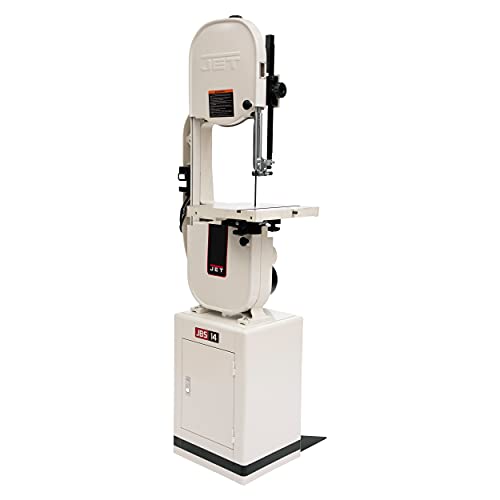
JET JWBS-14DXPRO
First floor-standing saw with no riser block
12 inches of cutting height
Laguna 14-12
Smoothest cuts on book-matched panels
Ceramic blade guides
Powermatic PWBS-14CS
General shop saw that can grow with a riser block
6-inch riser block included
How to Choose
Resaw height decides the widest board you can slice
Resaw height is the vertical space between the table and the upper guide, and it sets the widest board you can stand on edge and slice into veneer. A board that is wider than this height simply cannot be cut in one pass, so match the number to the stock you actually buy. Most of the saws in this guide clear twelve or thirteen inches, which covers the wide walnut, maple, and cherry boards that veneer work usually starts from. If your boards are rarely wider than eight inches, a shorter saw still works, but you lose the option of slicing a wide board into several matched leaves at once.
Motor strength keeps a wide blade moving
A resaw blade is wide, often half an inch or three quarters of an inch, and it removes a lot of material with every inch of travel. A motor under one horsepower will slow down in dense hardwood, and that slowing shows up as a wavy cut and a blade that wanders off the fence line. The saws here run from one and a quarter to one and three quarter horsepower, which is the range that holds blade speed steady through a deep cut. Dual voltage motors add flexibility, since they can run on a standard household circuit now and move to a higher voltage circuit later if the shop wiring allows it.
Blade width and length set the cut quality
A wide blade resists twisting and follows a straight line, which is exactly what thin veneer demands, while a narrow blade is better for curves and tight turns. For veneer, fit the widest blade the saw accepts, usually three quarters of an inch on a fourteen-inch saw, with a low tooth count that clears sawdust from the deep kerf. Blade length matters too, because it must match the saw exactly, so check the listed length before ordering spares. A blade that is too long or too short will not tension correctly, and poor tension is one of the fastest ways to ruin a veneer slice.
Guides and fences hold the line
Blade guides sit close to the blade above and below the table, and their job is to stop the blade from deflecting sideways under load. Bearing guides are common and easy to adjust, while ceramic guides run with very little friction and stay cool during long cuts, which helps when a single board takes several slow passes. The fence matters just as much, because veneer is sliced against it for the full length of the board. Look for a tall fence face that supports a board standing on edge, a scale that is easy to read, and a locking mechanism that does not shift when you tighten it.
The 5 Best Options
JET JWBS-14SFX 14-Inch Woodworking Bandsaw
Top Pick
JET JWBS-14SFX 14-Inch Woodworking Bandsaw
Best for: Slicing wide boards into thin veneer in a single pass.
The JET JWBS-14SFX is built around resawing, with more than thirteen inches of cutting height and a one and three quarter horsepower motor that holds speed through dense hardwood. Its cast iron table gives a wide, stable surface for a long board standing on edge, and the machined aluminum resaw fence helps keep each slice parallel to the last. Dual dust ports sit at the back of the saw, which matters when a deep cut produces a steady stream of sawdust. The blade is sold separately, so order a wide resaw blade with the saw and fit it before the first cut.
RIKON 10-326 14-Inch Deluxe Bandsaw
Runner-Up
RIKON 10-326 14-Inch Deluxe Bandsaw
Best for: A woodworker who wants a complete resaw setup out of the box.
Brand: RIKON Power Tools
Model number: 10-326
Included components: 111-inch 5/8-inch x 6 TPI blade, 14-inch bandsaw, closed stand, manual, rip fence assembly, wrenches
Product dimensions: 30 inches L x 25 inches W x 75 inches H
The RIKON 10-326 arrives ready to cut, with a 111-inch blade, a closed stand, a rip fence assembly, and wrenches in the box, so there is little to buy before the first slice. Its thirteen inches of cutting height covers most wide boards used for veneer, and the heavy frame, at 274 pounds, damps vibration that would otherwise show up as ripples in a thin leaf. Tool-free guide adjustments make it quick to set the guides close to the work, which is a small job that gets repeated every time the board thickness changes. A five-year warranty backs the saw for long-term shop use.
JET JWBS-14DXPRO 14-Inch Deluxe Pro Bandsaw
JET JWBS-14DXPRO 14-Inch Deluxe Pro Bandsaw
Best for: A first floor-standing resaw saw that needs no riser block.
The JET JWBS-14DXPRO reaches twelve inches of cutting height without a riser block, thanks to a cast iron frame that is taller than the usual fourteen-inch saw. That makes it a strong pick for a first floor-standing saw, since there is no extra part to fit and no added setup step before resawing. Two blade speeds let you slow down for dense material or speed up for softer stock, and the fifteen-inch square table tilts for angled cuts when a project calls for them. The kit includes the machine, the stand, and a saw blade, so it is usable as soon as it is assembled.
Laguna 14|12 Bandsaw
Laguna 14|12 Bandsaw
Best for: Book-matched panels and shop-sawn veneer where cut quality matters most.
The Laguna 14|12 is the precision pick in this group, and its ceramic blade guides are the reason. Ceramic blocks support the blade close to the cut with very little friction, which keeps the blade cool and steady during the long, slow passes that thin veneer requires. A micro-polished cast iron table on an oversized trunnion gives a smooth, stable surface, and the Hi-Low aluminum fence presents a tall face for resawing or a low face for narrow stock. Twelve inches of resaw capacity is one inch less than the tallest saws here, but the cut quality makes up for it on book-matched panels.
Powermatic PWBS-14CS 14-Inch Woodworking Bandsaw
Powermatic PWBS-14CS 14-Inch Woodworking Bandsaw
Best for: Occasional resawing plus general cutting in a shared shop saw.
Occasional resawing plus general cutting in a shared shop saw.
Watch out for
The base cutting height is 6 inches, so fit the included riser block before slicing wide boards, and confirm stock since the listing showed no featured offers.
The Powermatic PWBS-14CS is the general-purpose saw here, with a six-inch riser block that extends its cutting height for taller resaw work when you need it. Its extra-large two-piece cast iron table gives plenty of support for a board standing on edge, and the rip fence comes with a four-inch resaw attachment that holds tall stock square to the blade. A one and a half horsepower motor runs on either 115 or 230 volts, and the saw ships with a quarter-inch blade, a work light, and a chip blower. It suits a shop that resaws sometimes but also cuts curves and trim.
Which One Fits Your Situation
You slice wide boards into veneer every week
Pick the JET JWBS-14SFX, because its resaw capacity of more than thirteen inches and its one and three quarter horsepower motor handle the widest boards without slowing down. The machined aluminum resaw fence keeps each leaf parallel, and the large cast iron table supports a long board through the whole cut. Add a wide, low-tooth-count resaw blade, since the blade is sold separately, and you have a saw set up for steady weekly veneer work.
You want to start cutting on delivery day
Pick the RIKON 10-326, because the box includes a blade, a closed stand, a rip fence assembly, and wrenches, so assembly is the only job before the first cut. Its thirteen inches of cutting height covers most veneer stock, and the heavy frame keeps vibration down while you learn the saw. This is the simplest route from delivery to a first usable leaf of veneer.
You care most about a flawless book-matched panel
Pick the Laguna 14|12, because its ceramic guides hold the blade steadier than bearing guides during a long cut, and that steadiness shows up directly in the flatness of the slice. The Hi-Low fence supports a tall board well, and the polished cast iron table lets stock glide without catching. Budget for a resaw blade as well, since none is included in the box.
You need one saw for resawing and everyday cutting
Pick the Powermatic PWBS-14CS, because its riser block extends the cutting height when veneer work calls for it, while the standard setup handles curves, trim, and general cuts the rest of the time. The JET JWBS-14DXPRO is the alternative if you want twelve inches of height with no riser block to fit, in a cast iron frame that is ready to resaw from the start.
Common Mistakes
Fitting a narrow blade for veneer work, when a wide blade tracks straighter and leaves a flatter slice.
Skipping blade tension checks, since a slack blade drifts and produces leaves that vary in thickness along their length.
Forgetting to set the fence for blade drift, which makes every slice taper even when the saw is set up well.
Feeding the board too fast through dense hardwood, which slows the blade and leaves washboard marks on the veneer.
Slicing boards that are not flat and square first, because a twisted board cannot produce a flat leaf no matter how good the saw is.
Frequently Asked Questions
What resaw height do I need for veneer?
Most veneer work starts from boards between six and twelve inches wide, so a saw with twelve or thirteen inches of resaw height covers nearly everything a home shop will slice. Measure the widest boards you actually buy before choosing, and leave a little headroom so the board clears the upper guide. A taller saw also lets you slice several leaves from one wide board in a single setup.
Which blade is best for slicing thin veneer?
A wide blade, usually half an inch or three quarters of an inch on a fourteen-inch saw, tracks the straightest and resists twisting under load. Choose a low tooth count, such as three teeth per inch, so sawdust clears from the deep kerf instead of packing in and heating the blade. A dedicated resaw blade with a thin kerf also wastes less of the board on every slice.
Can a small benchtop bandsaw slice veneer?
A small saw can slice narrow veneer from thin stock, but it struggles with wide boards and dense hardwood because its motor is weaker and its resaw height is shorter. The frame can also flex under the tension a wide blade needs, which shows up as a wavy cut. For regular veneer work from wide boards, a floor-standing fourteen-inch saw is the practical minimum.
How thin can I slice veneer on a bandsaw?
With a sharp resaw blade, a well-tensioned saw, and a fence set for drift, slices around one sixteenth of an inch are realistic for many woodworkers. Thinner slices are possible but demand a very flat board, a steady feed rate, and a blade that is truly sharp. Expect to lose some thickness to sanding and flattening, so slice slightly thicker than the finished veneer you need.
J
JD's Woodworks Editorial Team
We compare specs, warranty terms, long-term owner feedback and street pricing before anything earns a spot. Rankings are never paid.
Affiliate disclosure. As an Amazon Associate we earn from qualifying purchases at no extra cost to you. Prices accurate as of the date shown.
Table saws under the 1500 mark compared: the Grizzly G0771Z and Shop Fox W1837 hybrid saws with cast iron tables, 2 HP motors and T-square fences, specs from their listings.
Table saws for fine woodworking compared: the SawStop Professional Cabinet Saw and Powermatic PM1000, judged on fence precision, table flatness and vibration from listing specs.
Table saw combos explained: saws sold with a stand and accessories in one listing, what to check in the box, and which bundle fits your shop or jobsite.
Compare the best planer digital thickness gauges and digital readout kits for portable planers, with fit, resolution and mounting checks before you buy.
Model table saws for scale modelling and hobby work compared: the precision Proxxon FET 37070 and the compact Saker mini table saw, with specs taken from their Amazon listings.
Three CoreXY 3D printers for product development, each with the architecture stated on its listing: an enclosed multicolor machine, a large-format enclosed model and a heated-chamber model.


 Laguna 14|12 Bandsaw
 Powermatic PWBS-14CS 14-Inch Woodworking Bandsaw









